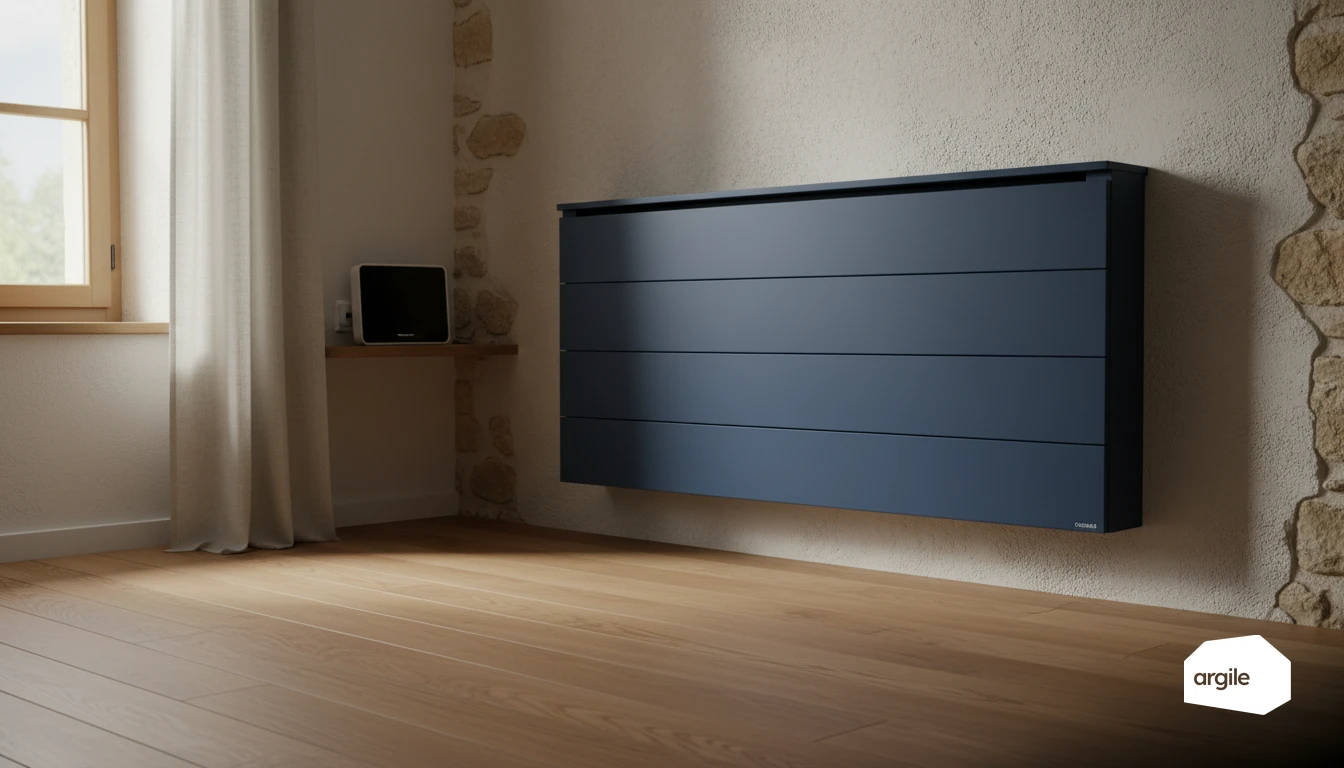
A storage heater stores heat in a refractory core raised to as much as 700°C during off-peak hours, then releases it over 8 to 12 hours. The unit weighs 100 to 200 kg, which means checking the floor's load capacity and the fixing method before installation, particularly on a timber floor. Its whole value rests on the price gap between peak and off-peak hours on the client's tariff, and it collapses in a poorly insulated home, where the appliance's standing losses cancel out the tariff benefit.
Understanding storage heaters and how they work with off-peak hours
The storage principle: storing heat at night, releasing it during the day
A storage heater contains a refractory core (bricks or blocks) heated by an electric element. At night, it "charges" by rising in temperature and stores the energy as heat. During the day, it releases it gradually by radiation and convection, sometimes helped by a fan or air outlet flaps.
Off-peak hours and the meter signal: how the heater triggers
To limit the bill, charging generally happens during off-peak hours. The heater receives the command via an off-peak contact from the meter, often driven by a day/night contactor at the consumer unit. In auto mode, it starts charging in the right window, while still keeping regulation (thermostat) to avoid charging "at full blast" unnecessarily.
Inertia, losses and comfort: what you'll see on site
On site, you'll notice strong thermal inertia. Comfort is often stable, but the temperature rise is slow. Losses exist even when the heater is "off", and they're felt most in a poorly insulated home. Charge settings and placement (air circulation, no curtains) quickly make the difference. To compare with other electric heating technologies, you can check our article on the different types of electric radiators.
Choosing the right storage heater for the home
Power, room volume and insulation: the right sizing benchmarks
The right storage heater starts with power suited to the room's actual volume and your insulation. As a quick benchmark, you often see 60 to 80 W/m² in a well-insulated home, and 90 to 110 W/m² when insulation is poor. Also adjust for ceiling height, walls facing outside, and glazed openings. If in doubt, prioritise insulation and a room-by-room calculation rather than a rough total estimate.
Models, refractory bricks and controls: points to compare without mistakes
Compare the storage capacity (mass and quality of the refractory bricks), the output power and, above all, the controls. Look for a precise thermostat, weekly scheduling, and management of off-peak charging. Good control avoids "charging for nothing" and improves comfort.
Special cases: small flats, poorly insulated houses, rarely used rooms
In a small flat, a compact model with good controls is often enough, since heat from neighbouring units counts. In a poorly insulated house, storage heating alone can struggle during cold peaks. Prioritise insulation and plan for a top-up. For a rarely used room, a lighter heater or an eco mode limits the kWh going to waste.
Installation and settings: getting steady heat without overconsumption
Placement in the room: air circulation, clearances and safety
Place the heater on a clear wall. Air must be able to enter and exit freely. Avoid curtains touching the appliance, furniture pushed up against it, and overly enclosed alcoves. Follow the clearances specified by the manufacturer, especially near textiles. Good air circulation gives more even heat, without needing to push the power.
Wiring and protections: dedicated circuit, breaker, off-peak contact
For reliable heating, plan for a dedicated circuit with a cable cross-section and breaker suited to the power, an electrical item Argile prices into the quote from a works library and free-text lines. Add 30 mA RCD protection at the consumer unit. On a storage model, an off-peak contact allows charging at the right time. The pilot wire also simplifies room-by-room control.
Useful settings: charge, thermostat, scheduling and occupant habits
Aim for a stable setting. Too many variations lead to higher consumption. Adjust the charge (for storage models) based on the weather and occupancy. Schedule consistent time slots and avoid cutting the heat off entirely during the day. In practice, 19°C in living areas and 17°C in bedrooms remain a good benchmark. To go further on optimising time slots, see our article on scheduling time slots.
Bill, comfort and grants: what a storage heater changes in 2026
A storage heater charges at night and releases the heat during the day. In 2026, the real lever remains your off-peak contract and the quality of the control.
Optimising the use of off-peak hours: usage scenarios and common mistakes
Effective scenario. Full charge during off-peak hours, gentle maintenance during the day, limited top-up in the late afternoon. Common mistakes. Leaving the top-up running continuously, charging too early, overheating an empty room. Fine-tuned settings and room-by-room scheduling often achieve more than "turning up the thermostat".
Quick comparison: storage heater, convector, heat pump (when to switch)
At equal comfort, a thermal-inertia radiator is more responsive but makes less use of off-peak hours. A convector is simple but hits the bill hard. A heat pump becomes attractive if the home is well insulated and you heat for long periods, especially over medium to large surfaces.
2026 grants: cases where you can access schemes (depending on associated work)
A "like-for-like" heater replacement is rarely subsidised. However, you can more easily access MaPrimeRénov' and CEE if the project includes a heat pump, insulation (loft, walls) or effective controls (scheduling, management). In large-scale renovations, the audit and support process frames access to grants.
Maintenance, troubleshooting and points to watch for your interventions
Common faults: element, thermostat, fan, sensor and symptoms
On an electric heater, the symptoms speak for themselves. Partial or lukewarm heating, often a worn heating element. Unstable temperature, a misadjusted thermostat or a poorly positioned sensor. Noise, vibration, a hot smell, think clogged fan or worn bearing. If the unit cuts out, also check the thermal cut-out and the power supply.
- No heat at all. Check voltage, terminal block, thermal safety.
- Heats continuously. Sensor disconnected or control faulty.
- Fan noise. Dust, play, damaged blades.
Safety and compliance: overheating, connections, dust and checks
First of all, cut the power and secure the circuit. Look for browning marks on the terminal block, hardened insulation and burning smells. Dust off the grilles. In a bathroom, respect the safety zones and IP rating. To go further on inspection points, also see the electrical diagnostic. A 30 mA RCD check and clean tightening avoid many callbacks.
Client advice: simple actions to keep a heater efficient year after year
Explain to the client to dust the appliance and the back twice a year, to leave space in front of it, and not to cover it. Simple scheduling, a stable setpoint and brief airing help keep comfort steady without overconsuming.