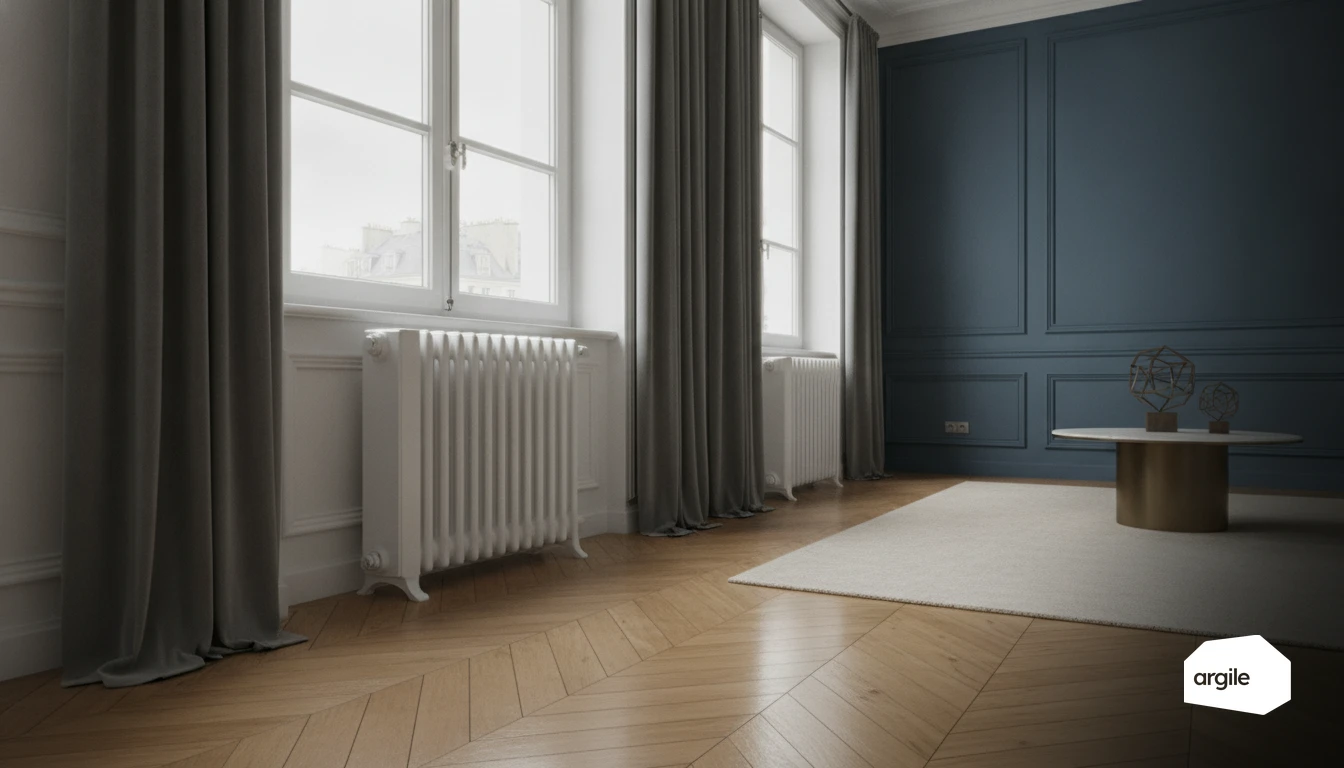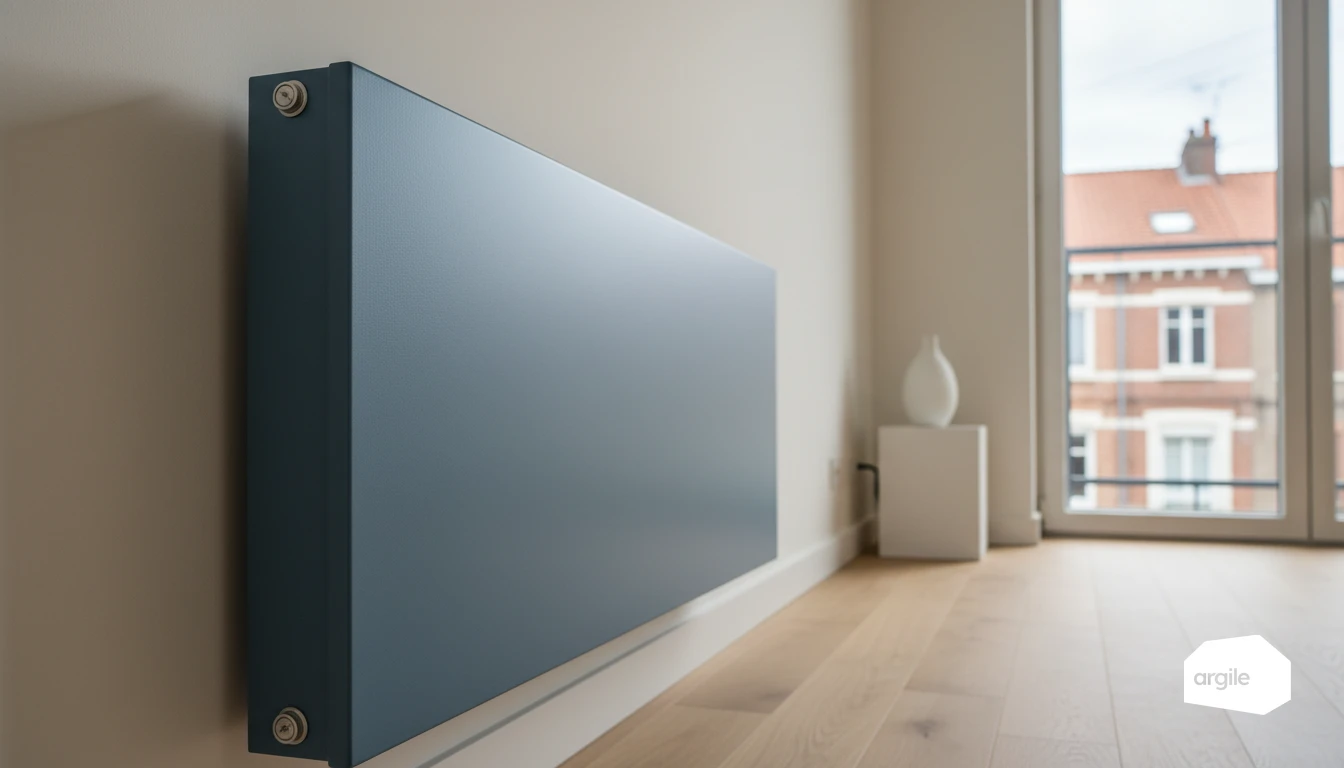
"Convector or radiant panel" has no answer in efficiency terms, and it is the ecodesign regulation that says so. Regulation 2015/1188 puts both appliances in the same class, fixed electric local space heaters, and has imposed the same 38% seasonal space heating energy efficiency floor on both since 1 January 2018 above 250 W. Because the on-mode useful efficiency of a resistance appliance is fixed at 100%, divided by a conversion coefficient of 2.5 and then reduced by 10 points, everything left to reach 38% comes from the control features. The choice is settled on comfort and installation, never on a headline saving figure.
Convector, radiant panel, storage core: one regulatory box
What the regulation calls a fixed electric heater
Regulation 2015/1188 defines a fixed electric local space heater as a resistance appliance that does not work by storing thermal energy and is intended to be fixed, hung or wall mounted without being built into the structure or the finishes of the building. A wall convector, a radiant panel and a continuously regulated thermal-mass radiator all fall inside that definition. The regulation does have a separate "radiant" class, but it requires the grille covering the element to reach at least 130 °C in normal use: a domestic radiant panel, whose face runs around 70 to 90 °C, does not qualify.
The 38% floor, and what it is worth
| Class under Regulation 2015/1188 | Efficiency floor since 01/01/2018 |
|---|---|
| Fixed electric, rated output above 250 W | 38% |
| Fixed electric, rated output up to 250 W | 34% |
| Electric storage | 38.5% |
| Electric underfloor | 38% |
| Portable electric | 36% |
| Electric radiant | 35% |
A thermal-mass radiator only moves onto the storage line, and its 38.5% floor, if it is designed to store heat in an insulated core and release it several hours after the charging phase. That is the definition of the old off-peak storage heater, not of a cast-iron-core radiator under continuous control.
Why efficiency cannot separate the technologies
Annex III sets the formula: seasonal efficiency is the on-mode efficiency, reduced by 10 points, corrected by the control factors and by standby consumption. For an electric appliance the on-mode useful efficiency is fixed at 100% and electricity consumption is multiplied by a conversion coefficient of 2.5. On-mode seasonal efficiency is therefore 40%, and the appliance starts at 30% before any control credit. Convector, radiant panel, thermal mass: all three start from the same 30%.
Controls, the only variable in the declared figure
Factor F(2), one option only
Factor F(2) rewards room thermal comfort control. Only one line is taken, the values do not add up.
| Control feature | F(2) for a fixed electric heater |
|---|---|
| Single stage heat output, no room temperature control | 0.0% |
| Two or more manual stages, no room temperature control | 0.0% |
| Mechanical thermostat | 1.0% |
| Electronic room temperature control | 3.0% |
| Electronic room temperature control plus day timer | 5.0% |
| Electronic room temperature control plus week timer | 7.0% |
Factor F(3), options that add up
| Additional option | F(3) for a fixed electric heater |
|---|---|
| Presence detection | 0.0% |
| Open window detection | 1.0% |
| Distance control option | 1.0% |
| Adaptive start control | 1.0% |
| Working time limitation | 0.0% |
| Black bulb sensor | 0.0% |
Note the presence-detection line: it is worth a point on a portable appliance and nothing on a fixed one. A sales pitch that leads on it for a wall-mounted heater is selling a feature the regulator itself does not credit.
What the arithmetic forces onto the product
A fixed appliance starts at 30% and has to reach 38%. It therefore needs at least 8 control points, against a theoretical maximum of 10 (7 from F(2) plus 3 from F(3)). Only two combinations get there: electronic control with a week timer plus one F(3) option, or electronic control with a day timer plus all three F(3) options. Put plainly, no convector with a mechanical thermostat has been placeable on the market since 1 January 2018, and the bare panel heater you are stripping out predates that date. That is the real break in the period, more than the shift to thermal mass.
What actually separates the three families on site
Surface temperature and radiant share
A convector heats the air passing through it, with a hot outlet and a plume that hugs the ceiling. A radiant panel warms a face that radiates onto bodies and onto the surfaces opposite, which registers immediately but demands clear space in front of the unit. A thermal-mass radiator heats a core, dry or fluid, whose surface temperature stays lower and steadier. None of those three behaviours appears on an efficiency data sheet: they are read with an infrared thermometer and felt on a survey. The core question is then settled between dry and fluid thermal mass.
Intermittency: the real site question
This is where the technology changes something measurable. A convector and a radiant panel rise fast and fall fast, which suits a room used in bursts, a spare bedroom, a study, a bathroom. A thermal-mass radiator takes longer to rise but holds temperature through the off periods, which makes it coherent with a living room occupied continuously. The reasoning is the same as for a programmer's time bands: occupancy pattern decides, not the catalogue.
Weight, fixing and substrate
A convector weighs a few kilos and goes on any substrate. A cast-iron-core radiator routinely passes 30 kg and forces you to check what the wall is and where the brackets land. On a plasterboard partition, allow for fixings rated to the load, or a noggin. Record the catalogue weight on the survey sheet before you order.
What the job actually has to carry
The room control obligation is already in force
Approved Document L Volume 1 is explicit at paragraph 6.13: electric panel heaters that form part of a new system or that are fitted as replacement components need time and temperature control giving separate control of each room, or of each appliance where that satisfies the thermostatic room control guidance of paragraphs 5.20 to 5.22. Paragraph 5.20 sets the same expectation whenever a heat generator is replaced in an existing dwelling. On direct electric heating the emitter is the appliance, so the control travels with each unit rather than sitting in a hallway. French installers reach the same result through the six pilot-wire commands or an equivalent.
Efficiency is not where the Building Regulations look
Approved Document L states that electric resistance heating is assumed to be 100% efficient, and that no minimum efficiency is therefore set for these systems. That is worth knowing before an efficiency argument is made across the kitchen table: the Building Regulations judge an electric heating system on its controls and on the fabric it serves, and the ecodesign 38% is a primary-energy market-placing figure, not a competing performance claim. There is no efficiency league table to sell from.
Size before you choose the technology
The convector-or-radiant debate is never settled before the output is. An over-specified room short-cycles whatever the technology, and the client feels the discomfort before seeing the bill. Start from a heat loss calculation, room by room, with the design external temperature and the real state of the fabric. Argile works that out to EN 12831-1, and the output it returns holds for all three families, since all of them return 100% of the electricity they draw.