The 3CL-DPE 2021 method, annexed to the French order of 31 March 2021, puts the pilot light power Pveil of a gas boiler at between 100 and 240 W depending on the type of appliance and its year of manufacture. Burning continuously, a 240 W pilot light uses roughly 2,100 kWh NCV a year, a 120 W pilot light roughly 1,050 kWh NCV. These figures are stated on a net calorific value basis, whereas the gas bill is issued in kWh GCV: moving between the two means applying the GCV/NCV factor, set at 1.11 for natural gas by the same method.
What the pilot light really represents in the boiler's energy balance
The pilot light in the 3CL method: a permanent load, not a trimming variable
On an older atmospheric gas boiler, the pilot light is a permanently lit flame that relights the main burner on every call for heat. The 3CL-DPE 2021 method does not treat it as an approximation: it assigns it a power Pveil that goes straight into the denominator of the generation efficiency, alongside the standby losses QP0. Two otherwise identical boilers, one with a pilot light, do not come out with the same conventional efficiency, and the gap can be quantified before you set foot on site.
The default figures you can stand behind, by type and age
The table below reproduces the default pilot light powers from section 13.2.2 of the method, with the matching consumption over a full year of 8,760 hours. This is the figure you can carry into a calculation note with nothing more to justify it than the text itself.
| Gas boiler type | Age | Pveil | Continuous consumption |
|---|---|---|---|
| Conventional | before 1980 | 240 W | 2,100 kWh NCV/yr |
| Conventional | 1981-1990 | 150 W | 1,310 kWh NCV/yr |
| Standard | 1991-2000 | 120 W | 1,050 kWh NCV/yr |
| Low temperature | 1991-2000 | 120 W | 1,050 kWh NCV/yr |
| Condensing | 1981-1985 | 150 W | 1,310 kWh NCV/yr |
| Condensing | 1986-2015 | 120 W | 1,050 kWh NCV/yr |
| Standard, low temperature, condensing | from 2016 | no pilot light | 0 |
The method gives separate figures for appliances dedicated to hot water, and for combined production from a boiler in section 14.1.2.
| Appliance | Age | Pveil |
|---|---|---|
| Gas water heater | before 1981 | 150 W |
| Gas water heater | 1981-2000 | 120 W |
| Gas water heater | 2001-2015 | 100 W |
| Gas water heater | after 2015 | no pilot light |
| Combined production, conventional | before 1990 | 200 W |
| Combined production, conventional | later generations | 150 W |
| Combined production, condensing | not stated | no pilot light |
What pushes the real power draw above the default figure
The air-gas setting, the state of the injector, burner fouling and flue draught all move the real gas rate around the tabulated value. A yellow, long or unstable flame burns more than the default figure and signals a degraded mix. That is the point at which you measure rather than estimate: the table value is the reference, the meter reading is the evidence.
Measuring the pilot light at the meter: reading method and NCV/GCV conversion
The one-hour index reading, the only evidence that stands up
Shut off every other gas appliance in the dwelling, leave only the pilot light running, read the meter index, wait a full hour and read it again. The difference is a volume in m³, measured under meter conditions. It is the only figure you can put in front of a customer or another trade, because it is repeatable and dated. Note the start and end times, the room temperature and the meter number on the visit sheet.
From m³ to kWh: the conversion factor is on a gross basis
In France the volume read at the meter is converted into energy using a conversion factor specific to the locality, printed on the bill, and that factor is expressed on a gross calorific value basis. GCV includes the heat of condensation of the water vapour in the flue gases; NCV does not. So multiplying your hourly volume by the factor from the bill gives you kWh GCV, not kWh NCV.
The NCV/GCV formula to apply, and the 1.11 factor not to forget
The 3CL-DPE 2021 method sets the GCV/NCV conversion factor by fuel.
| Fuel | GCV/NCV factor |
|---|---|
| Natural gas | 1.11 |
| LPG | 1.09 |
| Heating oil | 1.07 |
| Wood | 1.08 |
| Coal | 1.04 |
The conversion works both ways: energy on a gross basis equals energy on a net basis multiplied by the factor, energy on a net basis equals energy on a gross basis divided by it. A pilot light measured at 1,167 kWh GCV over the year therefore weighs 1,051 kWh NCV, and it is that second figure that compares with the table row. The full logic behind the two bases is set out in our article on the condensing gas boiler.
What you record on the technical visit and what you write up
The diagnostic protocol, from quickest to most committing
- Type of appliance and year of manufacture from the data plate: that pair is what gives you the row in the table.
- Cleanliness of the pilot injector and position of the flame on the thermocouple.
- Ventilation grilles and any stray air paths.
- On the flue side, draught and any spillage marks.
- Meter measurement, where the job justifies the time.
Carbon monoxide measurement, mandatory and bounded by a shutdown threshold
The French order of 15 September 2009 requires, as part of the annual service, an assessment of the boiler's air pollutant emissions, including carbon monoxide measured in the ambient air. Its article 3 sets out how to read the result.
| CO measured in the ambient air | Reading and action to take |
|---|---|
| below 10 ppm | situation is normal |
| between 10 and 50 ppm | deemed abnormal, calls for investigation of the flue draught and the ventilation of the room |
| 50 ppm and above | serious and immediate danger, instruction to the user to keep the boiler shut down |
The analyser measurement protocol and the stabilisation conditions determine whether the reading is valid at all.
The service certificate: what you write and what the customer keeps
Article R. 224-41-8 of the code de l'environnement gives you fifteen days after the visit to issue the service certificate. The customer keeps it for at least two years and makes it available to inspectors. The order of 15 September 2009 also requires the make and reference of the measuring instrument used to be stated. A certificate carrying the pilot light power you recorded and the starting meter index is worth more than a ticked box.
What you propose next, and how you price it on the quote
Cleaning and adjustment: the work that brings the pilot light back to its tabulated value
Cleaning the injector and thermocouple, setting the flame height and restoring the air inlets bring consumption back towards the default value. They do not remove it. That distinction belongs in writing on the quote: servicing restores the reference, only replacing the appliance removes the item.
Replacing the appliance: the only job that takes the item to zero
From 2016 onwards, the 3CL-DPE 2021 method credits no pilot light at all to standard, low temperature and condensing gas boilers, whatever the fuel. The gain is therefore total and quantifiable: the table row matching the appliance you removed disappears from the balance. On an older model, converting the ignition is neither covered by the instructions nor cost-effective, and full replacement is the only job you can actually guarantee.
Widening out to the work plan: controls, distribution, hot water production
The visit is the moment to look beyond the appliance itself. Weather-compensated controls remove unnecessary calls for heat, balancing the emitters brings return temperatures down, and insulating pipework in unheated spaces addresses losses that never show at the meter. Document those items separately in the work plan, with the grants available and their eligibility conditions, rather than inside a lump sum.
Pricing and documenting the pilot light item with Argile
Putting the figure down on the visit, not recalculating it that evening
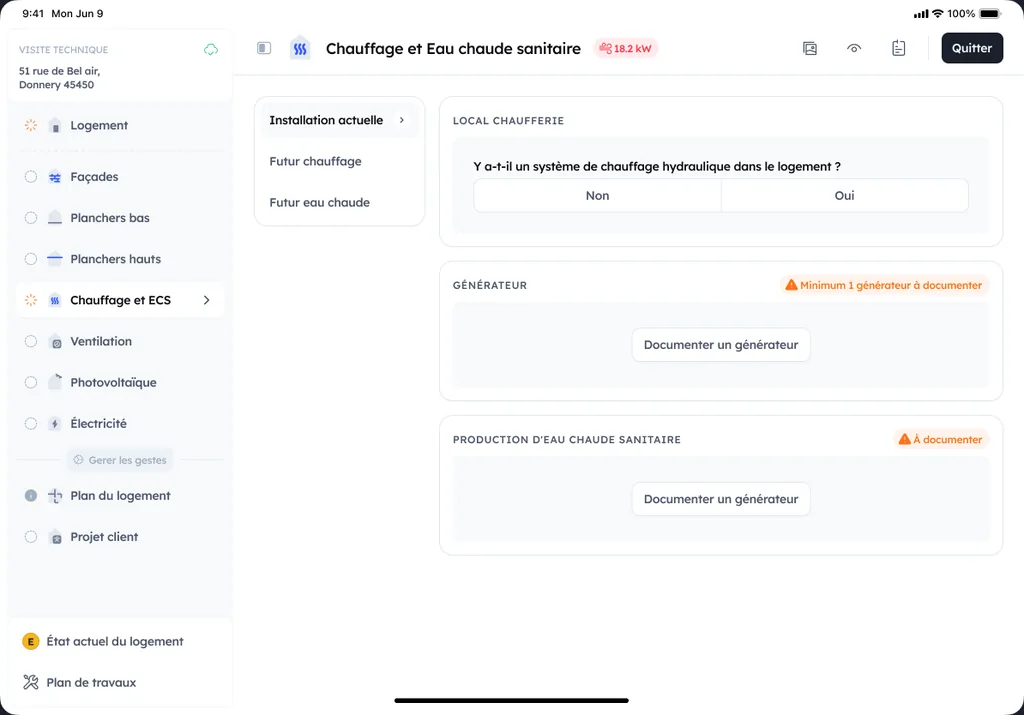
With Argile, the appliance is recorded on the phone during the visit: its type and its year are enough to bring up the associated conventional characteristics, pilot light included. You leave the visit with an order of magnitude you can defend instead of an impression, and without working through the table by hand.
Building a work plan where every item carries its own saving
You compare several work plans (controls, distribution, appliance replacement) and each line carries its own saving in kWh, not a global percentage. That level of detail is what makes a note defensible against a cheaper competing quote, and usable if it is ever challenged.
Centralising the evidence from the technical visit
Data plate, meter index, CO readings, photos of the flame and the injector, product references, accreditation details. Everything attaches to the job file, which cuts the administrative back-and-forth and secures both the service certificate and any grant application.