Understanding the long-term performance of cellulose insulation on site
What determines durability: density, moisture and substrate
The performance of cellulose insulation depends first and foremost on the actual density after installation. Too light, and it can settle or move. Too dense, and it adds unnecessary load to the linings. Moisture is the second critical factor. Durable cellulose stays dry, is ventilated on the cold side, and protected on the warm side. Finally, the substrate matters. A sealed, airtight cavity performs better than a volume crossed by air leakage.
Settlement: what to anticipate by area (vertical, horizontal, sloping)
| Area | Target density (kg/m³) | Allowance for extra thickness (%) |
|---|---|---|
| Horizontal (unoccupied lofts, blown) | 25 to 35 | 10 to 20 |
| Vertical (dense-packed cavity) | 55 to 65 | 0 |
| Sloping roofs (cavities, dense-packed) | 45 to 60 | 0 to 10 |
These ranges should be checked against the Technical Assessment and the machine settings. The right approach is to aim for a stable density, not a thickness based on guesswork.
Site watch-outs: air leaks, vapour control, services and hatches
- Track down air leaks (spots, junctions, hatches) to prevent air movement that can displace the insulation.
- Ensure continuity of the vapour control layer or air barrier. A poorly sealed vapour retarder creates damp zones.
- Take care around services. Ducts and boxes must remain accessible without creating voids.
- Check hatches. A non-airtight hatch becomes a dust and heat “chimney”.
Blown loft insulation: getting blown cellulose right without nasty surprises
Preparing the substrate: airtightness, junction boxes, downlights, required protections
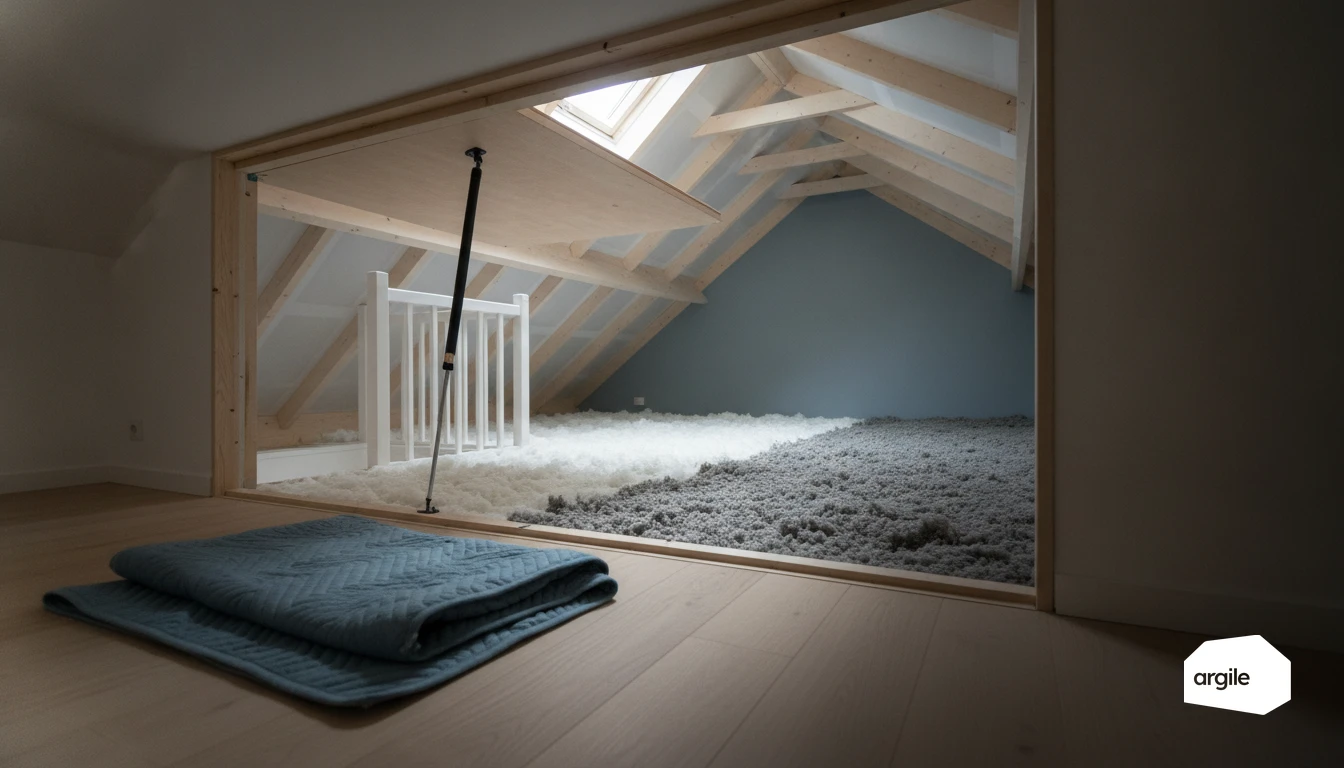
Before blowing, deal with air leakage. Cellulose installed over a “leaky” ceiling loses effectiveness quickly. Protect hot spots and services as well.
- Airtight electrical boxes, accessible connections.
- Protective covers over recessed downlights, with clearance to the flue pipe as per the manufacturer’s instructions.
- Edge baffles and hatch baffles, with a continuous vapour control layer if the system calls for it.
Setting the blowing machine and achieving the right density: practical installation benchmarks
The right setting gives you a steady flow, without “clumps”. Aim for a density that matches the product data sheet and Technical Assessment.
| Installation | Target density | Starting overfill |
|---|---|---|
| Unoccupied lofts (horizontal) | kg/m³ | % |
Allowing for settlement: setting out, depth markers and final checks
Settlement is normal. Build it into your setting out and install depth markers. At the end of the job, check the thickness at several points, especially near hatches and traffic areas. Record the measurements in your report; that is your safety net.
Dense-packing cellulose into cavities: securing density to prevent settlement
In cavities, cellulose only performs over time if the cavity is truly closed and the target density is achieved. Otherwise, settlement creates voids at the top and performance drops.
Choosing the right cavities: vapour control layers, membranes, linings and stapling
Aim for a continuous, airtight cavity. Membrane on the inside, rigid lining on the outside, taped overlaps, tight stapling to the framing. Treat every penetration and every corner. A cavity that leaks does not fill properly, then empties out.
Dense-packing method: drill points, filling, weight and pressure checks
Increase the number of drill points to limit air pockets. Dense-pack until pressure return is steady, then validate with a weight check: bags used and actual cavity volume. Record the values on the site sheet; that is your proof of performance.
Sensitive cases: old masonry, timber frame, sloping roofs and moisture risks
On older masonry walls, monitor rising damp and the condition of the finishes. In timber frame and sloping roofs, vapour balance is key. Prefer a hygrovariable membrane if the context requires it. If in doubt, stop and diagnose.
Wet-sprayed installation: when to use it and how to ensure durability
How wet-sprayed cellulose works: adhesion, thicknesses and compatible substrates
Wet-sprayed installation consists of spraying cellulose insulation lightly moistened onto a substrate so it adheres and forms a continuous mat. It is mainly used where you need to follow irregular shapes or treat vertical walls without joints. The substrate must be sound, clean and sufficiently receptive. On framing, a support fleece or net helps hold the thickness and limits rework.
Drying and return visit: timings, ventilation and checks before closure
Durability depends on drying. As long as the insulation has not dried through, avoid closing it with a lining. Provide effective ventilation of the space and, if needed, dehumidification. Before closure, check for any cold or damp spots and deal with any water ingress (leak, infiltration, rising damp) at the source.
Final site checks: uniformity, density and finish
- Check continuity of the layer, with no gaps or localised overthickness.
- Check density and thickness against the manufacturer’s specification, especially at junctions and around services.
- Trace the batches and the declared boron salt treatment, and record drying measurements before closure.
Boron salt, durability and client expectations: answering in 2026 without drifting into eco talk
Boron salt treatment: role (fire, insects, mould) and long-term stability
In cellulose insulation, boron salt plays three roles. It improves reaction to fire. It limits insect activity and slows certain moulds. Over time, it remains effective as long as the insulation stays dry. The real weak point is water: a leak, prolonged condensation, a water damage event. In those cases, the salt can migrate and the overall performance of the assembly can deteriorate.
What to tell the client in 2026: warranties, documents to request and product traceability
Stay factual. On the work side, your safety net is the decennial warranty and a clear handover certificate. On the product side, ask for the technical data sheet, safety data sheet, CE marking and, where available, an ACERMI-type certification or Technical Assessment. Keep a photo of the bags, the batch number and the delivery note. That is enough for clean traceability, without any sales pitch.
Cellulose insulation as a recycled insulation material: mention it only if asked, without drifting off topic
If the client asks, yes, cellulose insulation is often made from recycled paper. But quickly come back to the essentials. Long-term performance depends above all on installation quality, density, controlled moisture and the documents that govern the product and the work.