Why digital tools are becoming essential on RGE job sites in 2026
More demanding customers: responsiveness, evidence and well-framed financial aid
In 2026, your customers want a fast answer, and figures that hold up. Digital tools help you prepare a clear quote, frame MaPrimeRénov' and CEE from the outset, and keep a solid file. Photos, product references, instruction manuals, everything is tracked without chasing after documents.
Fewer errors and more margin: when data prevents missed items
A paper survey often means an item disappears between the audit and the job site. With work-item libraries, consistency checks and centralised quantities, digital tools limit oversights on insulation, ventilation or the heat pump. You keep a protected margin and a smoother project.
Saving time without cutting corners: standardising your field methods
On site, method saves hours. Checklists, reports, time-stamped photos, signatures and handover reports flow back to the office continuously. Digital tools standardise your habits, even when the team changes. You move faster, with consistent quality. To go further on setting up a full process, see from technical visit to quote.
Collecting the right data from the visit onwards to boost efficiency
Preparing the visit with the useful information: building, constraints, access, heating
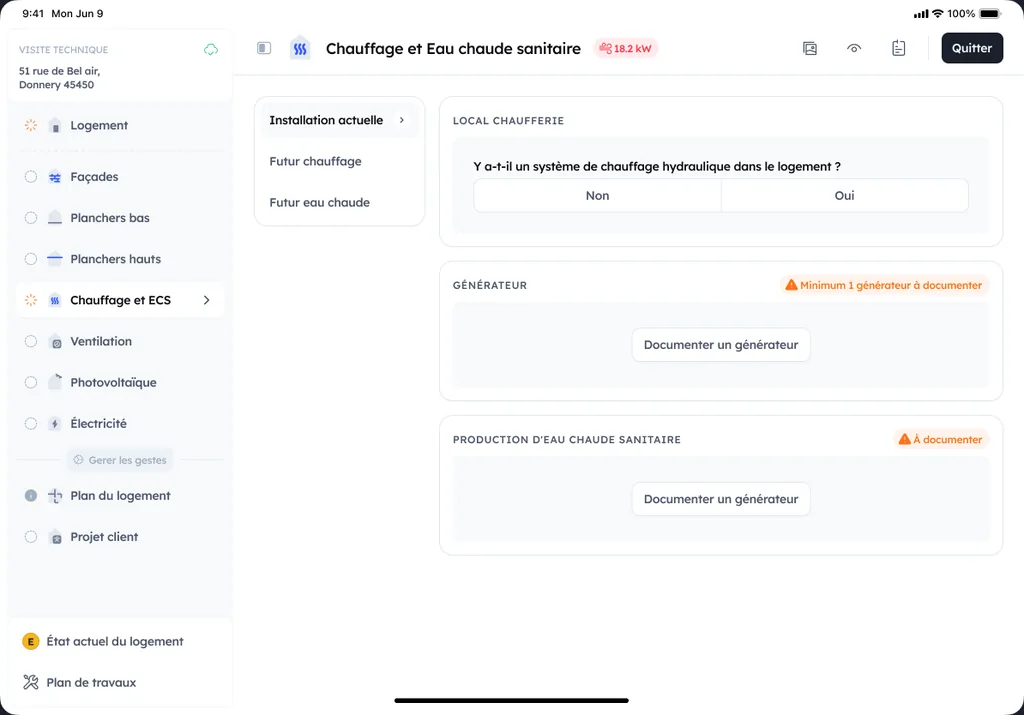
Before heading out, gather the year of construction, the DPE if it exists, photos, and the history of past works. Check access to the loft, crawl space, outdoor unit, and the possible location for equipment. Note the current heating system, the energy source, and usage patterns. With a simple digital template, you arrive on site with a clear framework.
On site: photos, measurements, surveys, and simple traceability for your files
On site, take framed photos by zone (envelope, windows, ventilation, network, electrical panel). Record surfaces, heights, available thicknesses and weak points. Add equipment references, and a quick sketch if needed. Time-stamped notes create useful traceability for your grant applications and your pricing. This survey can be done straight from a phone: photos, measurements and equipment locations are recorded during the visit, with no re-entry back at the office.
Centralising in the right place: avoiding scattered files and multiple versions
Centralise everything in a single folder, with consistent naming. Photos, plans, surveys, assumptions, and administrative documents stay in the same place. You avoid duplicates and version errors, especially when several team members are involved. The result: fewer back-and-forths, and a quote that goes out faster. The simplest approach is to attach everything to a single client record holding the dwelling, the work plans, the quotes and the site.
Pricing and scenarios: using digital tools to sign faster
Moving from a "rough estimate" to a solid pre-pricing in a few minutes
During the appointment, a clear pre-pricing avoids back-and-forths and reassures the customer. With digital tools, you enter the surfaces, existing equipment and two or three constraints. You get a consistent range, broken down by item, and a list of points to check during the technical visit. The result: you stay in control without promising the impossible.
Comparing several scenarios: simple measures vs whole-house renovation (and impacts)
Offer at least two options. A "simple measures" version to address urgent issues. A whole-house renovation version to aim for a performance leap. Show the expected effects on consumption and comfort. Highlight the priorities and dependencies, for example insulation before heating, to avoid random sizing.
Integrating MaPrimeRénov' and CEE into the quote: clarifying the remaining cost
In the quote, state separately the cost of the works, the estimated grants, then the remaining cost to the customer. For MaPrimeRénov' and CEE, specify the conditions that trigger the grant and what can make it vary. You secure the signature, because the customer understands what they are paying, and when.
Site management: data and tracking to meet your deadlines and quality standards
Planning the stages and coordinating trades without losing track
A project that moves forward is a simple sequence. Break it into milestones: installation, commissioning, finishing. Set who intervenes, when, and with what materials. A shared schedule and checklists in a digital tool avoid oversights and back-and-forths. You stay in control, even when several companies are working at the same time.
Tracking deviations (time, materials, unforeseen events) to improve your next projects
Record what actually happened, not what was planned. Time spent per work item, quantities used, rework, unforeseen events. Compare against the forecast and identify the cause in two clicks. These deviations become a basis for refining your quotes, securing your orders and reducing losses on your next projects.
Documenting quality: useful elements for the audit, inspection and after-sales service
Time-stamped photos, technical data sheets, serial numbers, settings, commissioning reports, instruction manuals handed to the customer. This quality file serves as evidence in case of an inspection, makes the audit easier and speeds up after-sales service. To frame this key moment, you can also rely on a structured job handover. Less uncertainty. More trust, for you and for the customer.
Argile supporting RGE tradespeople: from diagnosis to file, without administrative overload
Fast energy diagnosis and scenarios in under 5 minutes: framing the project
With Argile, you set the framework from the first exchange. The 5-minute energy diagnosis helps you position the home, compare scenarios and simply explain the order of works. You stay in control, with a clear digital support to decide what to propose, and within what budget.
Feasibility analysis and technical constraints: securing your proposal before committing
Before pricing, Argile identifies the key constraints at the address. Building type, access, local rules, points of vigilance for insulation or the heat pump. You limit surprises during the visit, and you commit your RGE liability to a realistic solution.
Automated quotes and grants + administrative management: saving time and making your applications more reliable
Argile generates a structured quote and integrates the grant calculation (MaPrimeRénov' and CEE) to prepare a reliable file. Documents, supporting evidence, step tracking. The result: fewer back-and-forths, more time on site, and stronger applications, notably to avoid MaPrimeRénov' application rejections.