Why energy independence is becoming a job-site issue in 2026
Rising costs, supply tensions: what geopolitics changes for your quotes
In 2026, the volatility of energy prices and tensions across certain supply chains (gas, electricity, components) ripple through into your purchasing and your lead times. As a result, your quotes need to build in a safety margin, shorter validity periods, and material alternatives for when a given reference becomes unavailable.
Securing homes' energy supply: a decisive argument to convince your clients
Your clients aren't just looking to "pay less" anymore. They want to reduce their exposure to price hikes and gain comfort. Insulation, controls, heat pump, ventilation, solar when it's relevant. This package of works creates more day-to-day independence, with a more predictable bill and a home that's easier to heat.
Sovereignty, resilience: connecting national issues to concrete on-site benefits
Behind energy sovereignty lies a simple idea. Depending less on imported energy means limiting shocks. On site, that translates into robust solutions, less sensitive to fluctuations, and reassured clients. You're selling tangible resilience, not an abstract promise.
Renovating to reduce dependence: the levers that really move energy consumption
High-performance insulation: the priority action for gaining independence (walls, loft, floors)
To aim for independence, start with an envelope that retains heat. Address the loft first, then the walls, then the ground floors, with continuous installation to limit thermal bridges. Well-done insulation lowers heating needs and allows for more accurate system sizing.
Ventilation and airtightness: avoiding losses and stabilizing comfort
An insulated house also needs to breathe. Suitable mechanical ventilation, combined with good airtightness, limits the leaks that heat the outdoors, while keeping humidity under control. Addressing sensitive points (hatches, ductwork, window frames) and checking airflow rates stabilize comfort, in both winter and summer.
Controls and usage: lowering kWh without degrading quality of life
Next, you gain kWh through controls. Programming, thermostatic radiator valves, balancing, consumption tracking. Lowering the setpoint by 1°C can save around 7% on heating, without any loss of comfort if the envelope keeps up. On the usage side, target hot water and standby power.
Heat and electricity: equipment solutions to strengthen households' energy independence
Heat pumps and wood energy: choosing the right system based on the building and the available network
A heat pump is chosen first based on insulation, emitters (radiators or underfloor heating), and space for the outdoor unit. In cold zones or deep renovations, a properly sized air-to-water heat pump, or even geothermal, avoids comfort "jolts." If gas isn't available or is costly, wood energy (stove, pellet boiler) remains a robust option, provided you plan ahead for storage and maintenance. Right choice, good comfort.
Photovoltaic solar and self-consumption: key sizing and connection points
To aim for independence, size the system around daytime usage (hot water, appliances, vehicle). Check for shading, roof condition, and planning constraints. On the connection side, the application goes through the network operator, with a choice between self-consumption with or without grid injection. Clear connection, smooth project. On the study side, the panel layout is drawn plane by plane on the aerial view and output is estimated with shading included.
Storage, control, heat pump water heater: optimizing energy produced and consumed on site
Control (programming, load shedding, thermostats) turns produced kWh into useful kWh. A battery can help if solar production doesn't line up with consumption hours. The heat pump water heater, timed to sunlight hours, stores heat for the evening. Also consider the 2026 funding depending on the works. Controlled consumption, concrete gains.
Subsidies, obligations, and labels: turning the geopolitical stake into fundable projects
The funding in 2026: how to talk about independence without promising the impossible
In 2026, the Boiler Upgrade Scheme and ECO4 remain your two most concrete levers for funding works. The right angle is independence through lower consumption, not a total self-sufficiency announced too hastily. Give a clear direction, then remind clients that the amount depends on the home, income or benefits, the measures chosen, and the supporting documents.
Certification and quality of execution: securing files and limiting disputes
To trigger most funding, your certification must be valid at the time of the works. On site, quality of execution does the rest. Dated photos, product references, thicknesses installed, settings, and commissioning. A clean file means fewer rejections, and fewer callbacks. To go further, also see how to secure your applications and avoid disputes.
Energy audit and renovation pathway: prioritizing works for a lasting gain
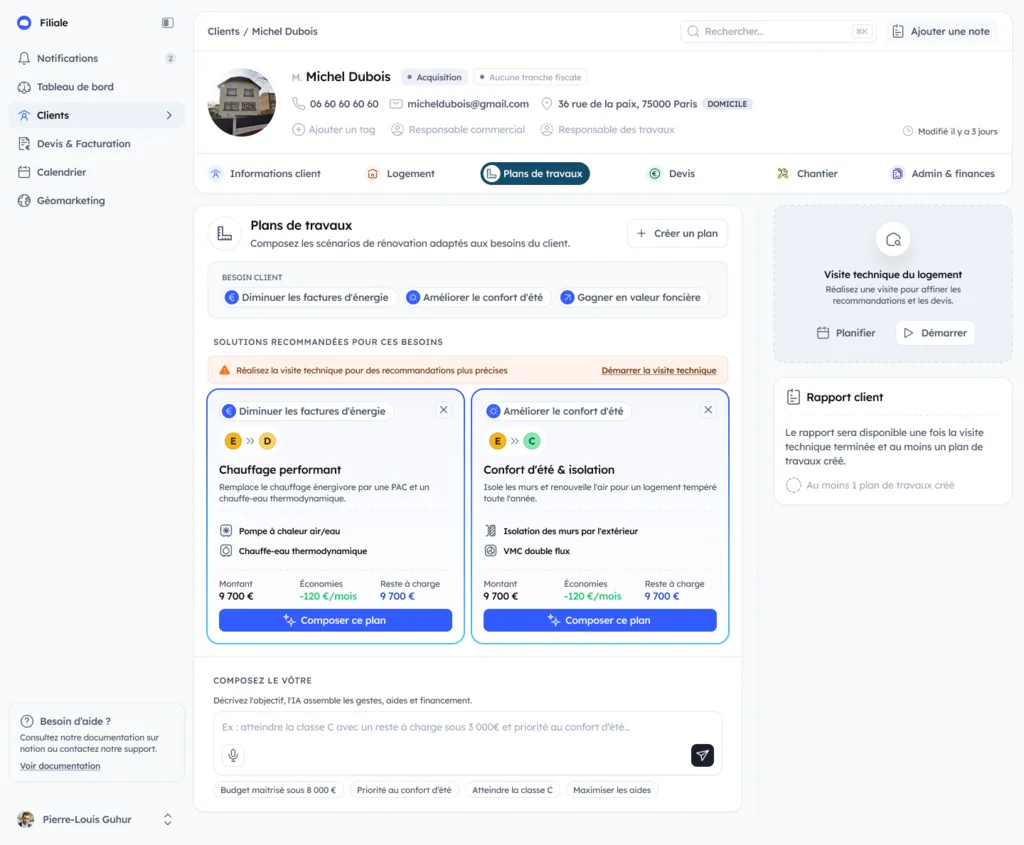
The energy audit acts as a compass when aiming for results that hold up over time. You address the envelope and ventilation first, then the heating system. Within a renovation pathway, this sequencing avoids oversizing the heat pump and secures a lasting gain. This order can be prepared upstream, with the relevant measures suggested from the property's characteristics and the client's objective.
Field talking points: selling energy independence without jargon or repetition
A costed before/after: translating geopolitics into measurable energy savings
On site, talk in kWh and euros, not in crises. A simple example. Before the works, a house consumes 18,000 kWh/year for heating. After loft insulation and replacement with a properly sized heat pump, it drops to 10,000 kWh/year. That's about 45% less. The result: your budget is less exposed to gas or heating-oil price hikes. That's independence, measured at the meter.
Answers to common objections: cost, noise, comfort, technical constraints
Respond with short facts and an on-site visit. Clear quote, scenario A and B.
- Cost. Calculate the remaining cost after subsidies, then a realistic payback period.
- Noise. Check the location, the distances, and plan for anti-vibration mounts if needed.
- Comfort. Talk about stable temperature, less dry air, and room-by-room settings where relevant.
- Constraints. Electrical panel, outdoor space, emitters. List what's blocking, then propose an alternative.
Typical renovation cases: a 1970s house, an apartment, a small co-ownership
1970s house. Priority to the envelope, then heating. Apartment. Focus on ventilation, interior-side insulation, and controls. Small co-ownership. Audit, collective decision, and works by package to avoid the "never-ending job site" effect. Simple plan, visible steps.