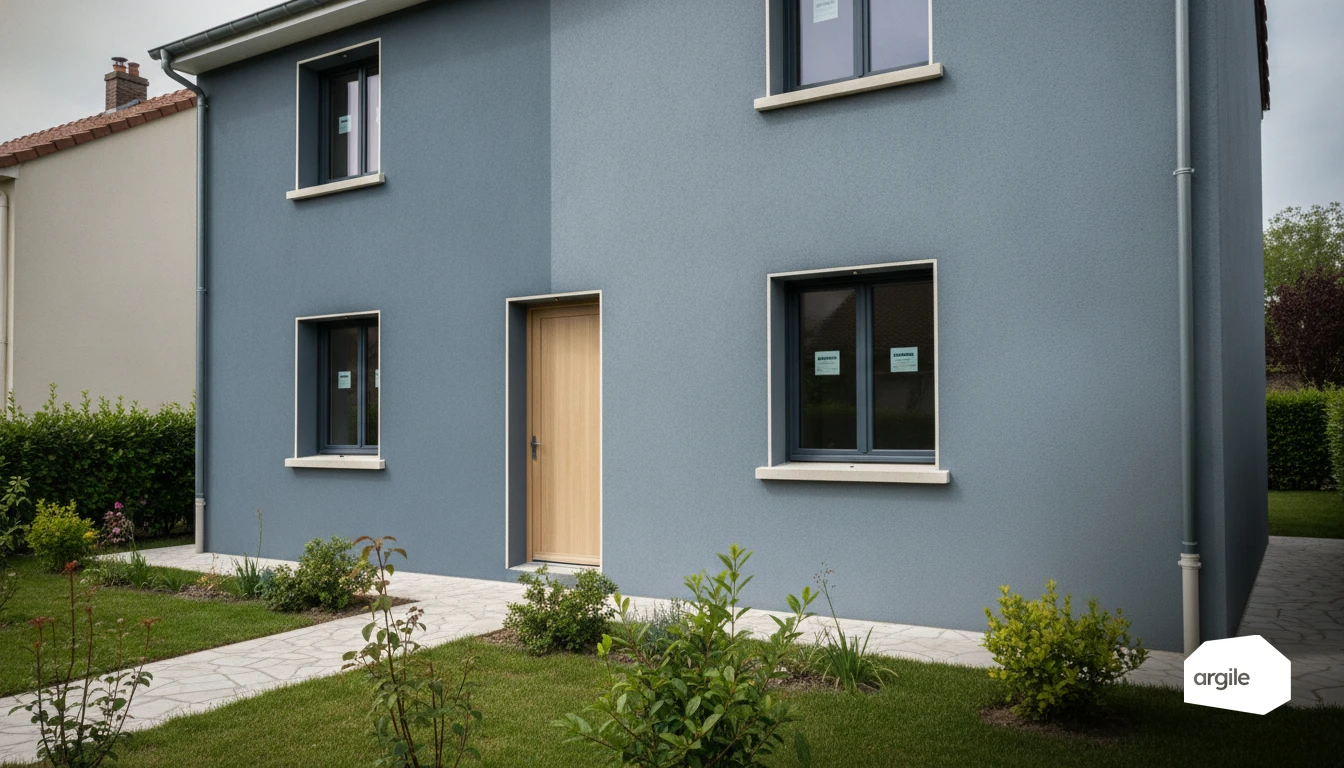
In external wall insulation, machine-applied render covers 40 to 60 m² a day per team, against 15 to 25 m² for hand application, with a base coat of 3 to 5 mm as standard. Machine-applied render imposes its own logistics: continuous feed to the machine, water and power on site, careful protection of the joinery, immediate working back into fresh areas. Traditional render is organised zone by zone, with drying times between passes that weigh on the programme and joins to be worked carefully at corners and reveals. Durability depends less on the technique than on the system installed: the manufacturer's base coat compatible with the insulant, an alkali-resistant glass fibre mesh properly embedded, overlaps respected and reinforcement at openings, failing which the job falls outside the system's technical approval.
Understanding the two render techniques in ETICS: what changes on site
Machine-applied render: principle, required equipment and pace of installation
Machine-applied render goes on with a spray machine. The mortar is sprayed then leveled to thickness, which gives an even coat and good output on large ETICS facades. You need a spray machine, a compressor depending on the system, water, electricity, and careful protection of window frames. The pace is more continuous, with a team synced to the machine's feed rate and immediate touch-up of fresh areas.
Traditional render: hand-applied steps, drying time and organization
By hand, the job proceeds more "zone by zone." You apply the base coat, embed the mesh, then level and finish. Drying time between coats weighs heavily on the schedule. You need to organize the scaffolding, protect from wind and rain, and plan ahead for touch-ups at corners and window reveals.
Compatibility with ETICS: insulation, base coat and reinforcing mesh
In external wall insulation, you don't mix products at random. The base coat must be the one specified by the system, compatible with the insulation (EPS, rock wool). The fibreglass mesh must be alkali-resistant, well embedded, with reinforcement at openings and corner profiles. Refer to the manufacturer's technical approvals and trade rules to avoid cracking and delamination. To go further on layers and finishes, see the base coat in ETICS.
Quality, durability and finishes: comparing machine-applied and traditional render
Impact resistance, micro-cracking and weather resistance depending on the substrate in ETICS
In render-finished ETICS, real-world durability mainly depends on the complete system (reinforced base coat, mesh, thickness, drying time) and the insulation substrate. Machine-applied render gives a more even thickness if the machine is well set up. Traditional render, applied by hand, sometimes allows finer adjustment of pressure and load on heterogeneous areas. In both cases, impact resistance is primarily managed through the right choice of reinforced base coat and compliant mesh overlaps.
Facade appearance: floated, scraped, ribbed... and consistency of finish
Floated, scraped or ribbed finishes are possible with both methods. Machine-applied render more easily gives an even texture over large areas, with fewer differences between passes. Traditional render can offer a more "handcrafted" look and make local touch-ups easier, but it's more sensitive to variations in technique and touch-up work. A test panel on site remains the best judge.
Sensitive points: corners, window reveals, base courses and thickness touch-ups
Critical areas come down to details. Corners and window reveals require suitable profiles and mesh reinforcement. Base courses need better protection from impact and splashing, with a compatible system and enough ground clearance. To go further on these details, see treating singular points in ETICS. Thickness touch-ups show up quickly with spraying if you overload an area. By hand, you control the material better, but you need to stay consistent to avoid waviness.
Rules, standards and requirements in 2026: securing your external wall insulation with the right render
Standards, technical approvals and insulation systems: checking product consistency
In render-finished external wall insulation, avoid "mixing and matching." The system is validated as a whole: insulation, adhesive, fixings, reinforced base coat, mesh, finish. Rely on the system's BBA Agrément certificate or its European Technical Assessment, and follow the specifications for substrates, thicknesses and singular points. This is what protects insurability and limits defects. The choice of insulation and of finish is then made from up-to-date external wall insulation catalogues, system by system.
Certification and funding: documents to keep for 2026 applications
For 2026 funding, keep a simple file. Detailed quote and invoice, certification mention, treated areas, targeted performance (the U-value achieved). Add the system reference, product data sheets, insulation certificates, and the signed client declaration where it applies. A clean file speeds up inspections.
Job-site checks and photos: evidence of proper ETICS installation
Plan for dated photos. Substrate before preparation, layout plan, adhesive dots/beads, fixings, corner reinforcement, treatment of window reveals, reinforced base coat, then finish. Note the trade packages and references. This evidence demonstrates proper installation if an inspection or dispute arises.
Choosing the right method for your ETICS projects: a field decision guide
Single-family home, co-owned building, major renovation: which render for which context?
Single-family home: on ETICS, thin render on insulation is often the easiest to manage, especially on regular facades. Co-owned building: mechanized spraying and careful layout planning to limit touch-ups. Major renovation: irregular substrates mean planning for corrections and treatment of singular points before starting. Substrate testing is mandatory.
Weather conditions and scheduling: anticipating drying and spraying constraints
Weather dictates the pace. Aim for phases free of rain, strong wind and frost. Netting, tarps and shade management prevent cracking and mottling. Sequence the coats to respect drying times, without stalling the job. Realistic scheduling.
Team and expertise: training, machine settings and key traditional-render techniques
Traditional render doesn't forgive improvisation. Machine settings, water flow, pressure, nozzle, then consistent technique and floating at the right moment. Run a test on a panel with each new batch. Stable settings.