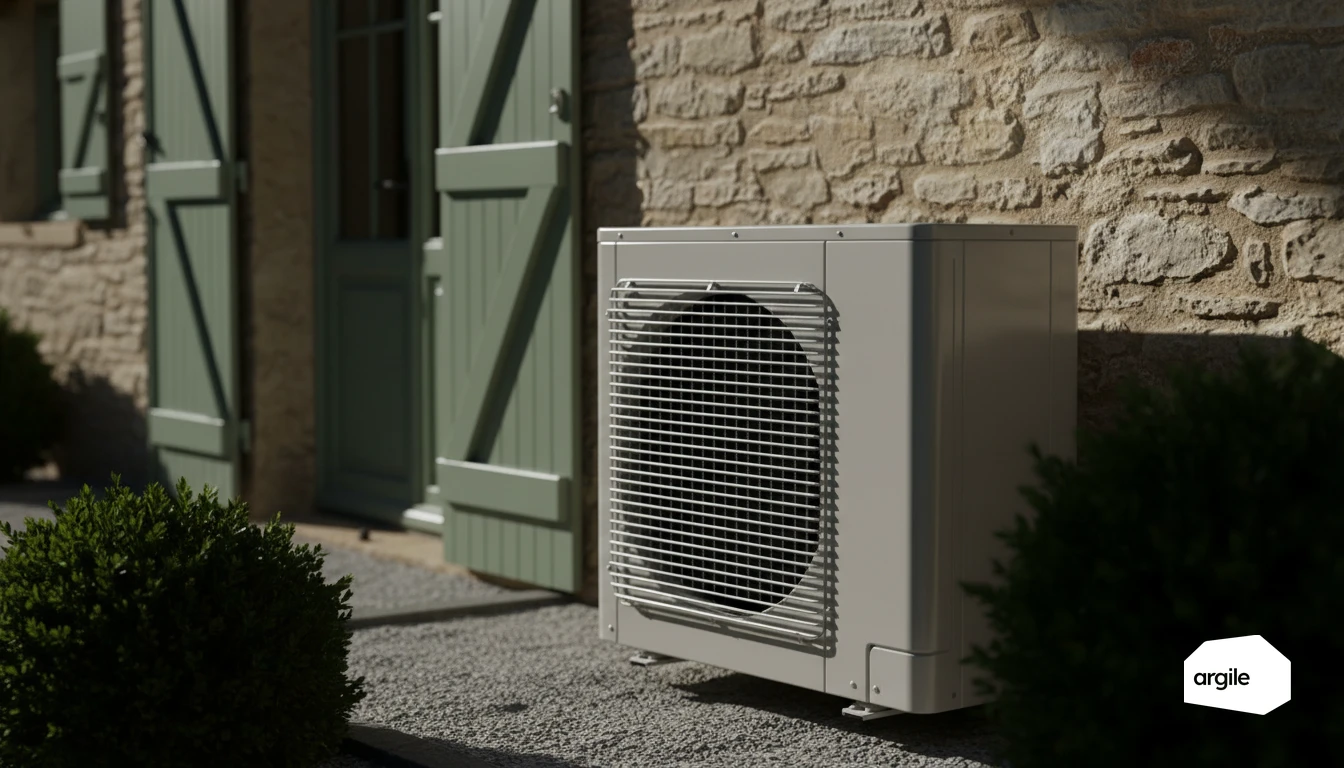
A microchannel exchanger replaces the copper tube and fin coil with flat aluminium tubes pierced by fine channels, which sharply cuts the internal volume and therefore the refrigerant charge. No quantified gain in weight, surface area or charge is published by a primary source, and the percentages doing the rounds are not defensible. What is defensible is the regulatory consequence of crossing a threshold: below 5 tonnes of CO2 equivalent the equipment leaves the periodic leak checks of Article 5 of EU Regulation 2024/573, but below 3 kg a split system falls under point 9(a) of Annex IV, which has banned a GWP of 750 or above since 1 January 2025.
What a microchannel condenser actually changes
The geometry, and what cannot be inferred from it
Flat aluminium tubes multiply the flow paths and cut the internal volume for a given exchange surface. That is a design fact, verifiable on a section. But no text and no declared dataset quantifies a performance gap between a microchannel condenser and a copper-fin condenser on the same machine: performance is declared on the complete appliance, through the seasonal space heating energy efficiency under Regulation (EU) 813/2013. Put that value on the quote, not a percentage improvement of the exchanger.
The repairability trade-off, to be stated before fitting
The flip side of the geometry is known to every service department: microchannel aluminium brazes badly in the field and a localised repair does not hold. On a leak, you replace the complete block. That information belongs in the conversation at specification stage, not when the repair quote lands, and it goes together with parts availability and the exchanger warranty term, two points to obtain from the manufacturer in writing.
Refrigerant compatibility, and why it is tightening
Microchannel exchangers appear on R32 and R410A ranges and on natural refrigerant machines, where the reduced charge is a direct advantage. For a comparison of the refrigerants themselves and their timetable, see refrigerants for heat pumps in 2026. Also check the material compatibility of cleaning products, since aluminium does not tolerate what copper puts up with.
The thresholds the charge makes you cross
The threshold table, and which way each one cuts
| Situation | Threshold | Consequence | Reference |
|---|---|---|---|
| Hermetically sealed labelled equipment, residential building | Under 3 kg of fluorinated gas | No leak check | Art. 5(1) |
| Hermetically sealed labelled equipment | Under 10 t CO2e | No leak check | Art. 5(1) |
| Equipment at 5 t CO2e and above | 5 t CO2e | Periodic check, 12 months at minimum | Art. 5(6) and R543-79 |
| Split system placed on the market | Under 3 kg of an Annex I gas | GWP ≥ 750 banned since 1 January 2025 | Annex IV, point 9(a) |
Read together, those lines often surprise: the exchanger that takes you below 3 kg removes the checking duty while simultaneously closing the door on R410A and R407C for a new machine. Converting a charge in kilos into tonnes of CO2 equivalent is set out in refrigerant charge.
What you record from the nameplate
The nameplate carries the refrigerant and the nominal charge in kilos. Those two values, together with the GWP taken from Annex I of the regulation, are what the tonne of CO2 equivalent is calculated from, and that figure commands everything else. Photograph the nameplate at commissioning and add it to the refrigeration engineer's job file: it is the item that lets an inspector redo your calculation without calling you.
What the hermetically sealed marking changes
The exemption applies only to equipment labelled as hermetically sealed. Without that marking on the equipment, the exemption falls away, whatever the technical reality of the circuit. This is a documentary check, not a technical judgement: inspect the label on delivery, before fitting, while a supplier exchange is still possible.
Fitting, cleaning and diagnosing a microchannel unit
What gets protected during the works
Keep the air clearance the manual imposes around the outdoor unit, avoid corners that recirculate cold air and obstacles in front of the discharge. Protect the block with a temporary guard during drilling, rendering and facade work: mortar splash on microchannels cannot be recovered by cleaning, it is paid for in a replacement exchanger.
The cleaning protocol that is allowed
Low pressure rinsing, from the inside out, with tepid water and an aluminium-compatible product at the pH stated by the manufacturer, then a thorough rinse. Rule out pressure washers, stiff brushes, solvents and any acidic or alkaline product. In coastal or polluted air, the factory anti-corrosion treatment is the only barrier, and an unsuitable product destroys it without anything showing.
- Coastal sites: confirm that an anti-corrosion treatment exists and what keeps it under warranty.
- Urban sites: rinse more often, at low pressure only, and monitor the air-side pressure drop.
- Tight courtyards and enclosures: check for air recirculation before concluding it is fouling.
Diagnosing a drop in performance
Start with fouling of the exchanger, the filters and the air intakes, then look for oil traces at joints and brazed points, and only then look at the charge. A top-up decided without measurement on a sound circuit is the leading cause of overcharging seen on service calls. To read declared performance correctly and understand the field gap, see seasonal and instantaneous efficiency.
What you settle before specifying a microchannel unit
The questions to put to the manufacturer, in writing
Ask for the exchanger warranty term, what it covers, parts availability and lead time, the approved cleaning protocol, whether an anti-corrosion treatment exists and what salt spray testing backs it. A written answer is a commitment, a sales answer is worth nothing in front of an expert. On routine servicing and its check points, see heat pump servicing.
The wording that makes the quote defensible
State the exact reference, the refrigerant, the charge in kilos, the output at the site design temperature and the declared efficiency with its temperature category, all values that a verified, up-to-date brand catalogue already carries for each range. Add a note on the specific cleaning protocol and on the exchanger not being repairable: those two lines will make the difference if a dispute turns on servicing or on an early replacement.
Justifying your price against a cheaper bid
Any extra cost sits in the anti-corrosion treatment and the cleaning requirement, not in the block itself. A competitor fitting the same machine without flagging those constraints is selling a running cost they have not priced. On the sizing mistakes that weigh far more than the choice of exchanger, see the five sizing mistakes.