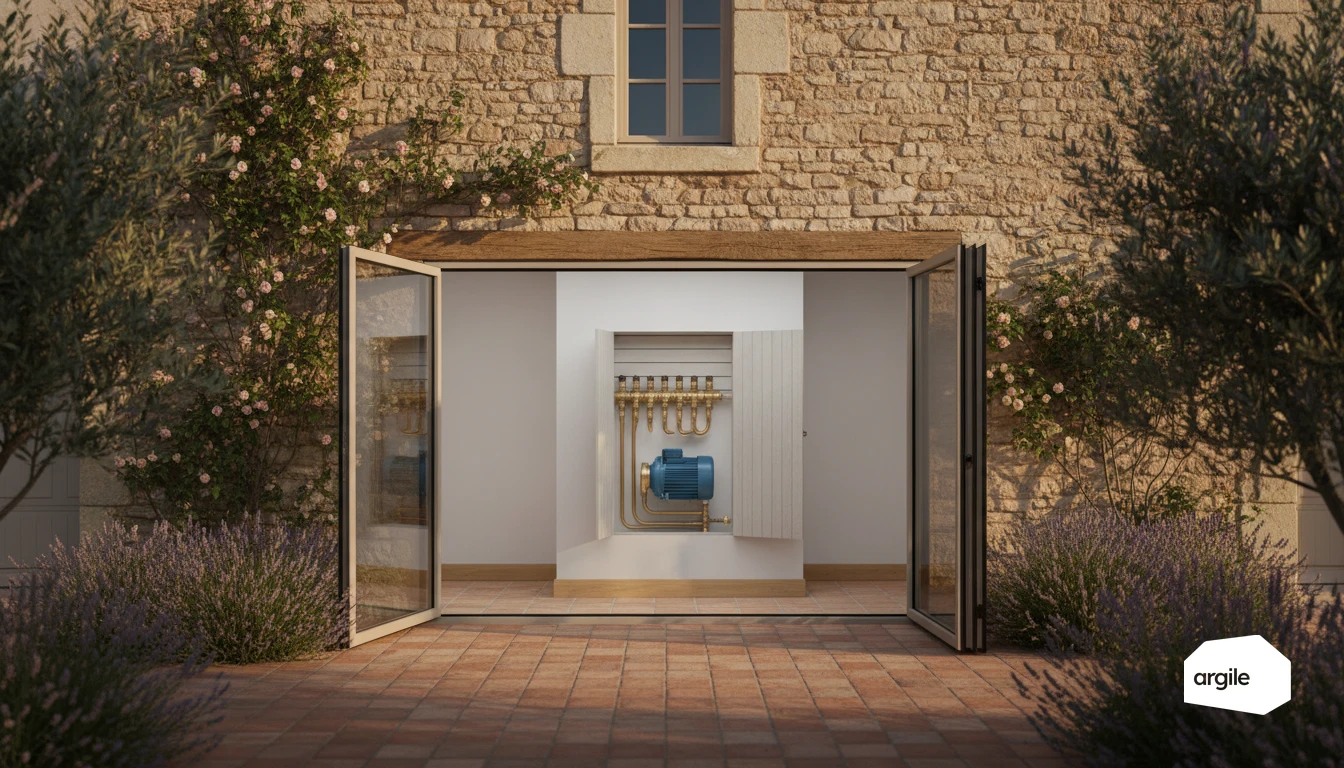
A variable-speed circulator matches its rotation speed to the real demand of the network, where a fixed-speed circulator pushes constantly as though every thermostatic valve were open. The gap is measurable: 80 to 150 W for an old three-speed model against 5 to 30 W for a circulator meeting an energy efficiency index EEI below 0.23, so 50 to 80% savings on an auxiliary that sometimes runs all year. The control mode is chosen on the network: proportional pressure on a radiator network with thermostatic heads, constant pressure on long loops or underfloor heating. Replacing the circulator without balancing the network only moves the problem, the flow redistributes itself and the temperature differences between rooms remain.
Understanding the role of the circulator and auxiliary consumption
What does a circulator do on a heating network (radiators, underfloor heating)?
The circulator is the small pump that circulates hot water through the network. It pushes water through the radiators or underfloor heating loops, against pressure drops, and helps maintain an even temperature across rooms. Without it, heat stays close to the generator and comfort becomes uneven.
Why auxiliary consumption weighs on the electricity bill
A circulator can run for long hours, sometimes year-round depending on the control settings. Even at modest power, the total shows up on the meter, especially if the equipment is old or set too high. And it's not the only auxiliary load, controls, motorised valves or a heat pump's pump can add to it.
Spotting the signs of an oversized or end-of-life circulator
Watch for abnormal noises, vibrations, hard starts, or a very hot pump body. On the heating side, whistling radiators, excessive flow, or temperature differences between rooms are signals. Adjusting the settings, balancing, and, if needed, a variable-speed model often get the system back on track.
Variable speed: how the circulator adapts flow and saves kWh
Flow, pressure, control curve: what changes compared with fixed speed
At fixed speed, the circulator pushes "as if everything were always open." The thermostatic valves close, pressure rises, and energy is dissipated as pressure drop and sometimes as noise. At variable speed, it adjusts its rotation to match actual demand. Thanks to the cube law, a small drop in speed causes a sharp drop in electrical power.
Useful functions on site: proportional pressure, constant pressure, night mode
Proportional pressure follows how open the emitters are. It's often the right setting for radiator networks with thermostatic heads. Constant pressure stabilises flow when loops are long or sensitive, as with some underfloor systems. Night mode automatically lowers the setpoint when demand drops off.
Examples of achievable savings depending on the installation and usage
When replacing an old 3-speed circulator, you often go from around 60 W, 90 W down to 10 W, 25 W in useful operation. Over 2,200 to 4,400 hours of annual operation, that typically represents 80 to 200 kWh saved. In multi-zone or highly modulating installations, the savings can climb higher, especially if the setting avoids overpressure.
Choosing a variable circulator well in 2026: power, flow and compatibility
Simple sizing: pump head, flow, pressure drop and a reasonable margin
A circulator is chosen based on an operating point. The useful flow comes from the needs of the emitters and the generator. The pump head corresponds to the network's pressure drop. Lengths, bends, manifolds, underfloor heating, radiators, it all counts. Take a reasonable margin rather than oversizing, otherwise you gain noise and lose efficiency.
Compatibility with thermostatic valves, balancing, loops and existing controls
With thermostatic valves, favour a variable Δp mode to avoid whistling when the valves close. With underfloor heating and manifold loops, balancing remains the foundation. Also check the available control signal: on-off, PWM, 0-10 V or boiler-driven control. And keep a minimum flow if the heat pump or boiler requires it, with a bypass or differential valve.
Points to watch: noise, cavitation, fouling, magnetite build-up and water quality
Noise often comes from excess speed, trapped air, or cavitation linked to too low a pressure. On steel networks, fouling and magnetite can block the rotor. Protect the installation with a sludge trap and magnetic separator, purge it, then treat according to the expected water quality.
Installation and on-site settings to maximise energy savings
Key steps: purging, mounting direction, filters/sludge traps and protecting the circulator
A clean installation means kilowatt-hours that aren't wasted. Check the mounting direction (arrow, shaft position), then purge air at all high points. Fit a filter and a sludge trap on the heating return, with isolation valves. The goal: keep the exchangers clean and protect the circulator from sludge and particles.
Settings at start-up: choosing the right mode and stabilising flow
At first start-up, begin with a mode suited to the network: variable pressure for circuits with thermostatic heads, constant pressure or fixed speed if the network is stable. Then stabilise the flow rates: open the components, balance, then progressively lower the circulator setpoint until comfort is restored, without water noise. To go further, balancing the heating network remains the foundation for stabilising flow and limiting auxiliary consumption.
Quick checks: flow/return temperatures, ΔT, comfort and auxiliary consumption
Check the flow and return temperatures, then the ΔT. A ΔT that's too low often signals excessive flow, meaning more auxiliary consumption. Too high, it's a lack of flow or under-supplied emitters. Validate comfort room by room and measure the circulator's auxiliary consumption (W) to lock in the savings.
2026 subsidies and sales arguments around the circulator and savings
Funded work: when the circulator fits into an eligible measure
In 2026, the circulator alone attracts nothing. However, it often fits into a coherent package: generator replacement (heat pump, boiler), balancing and controls, or renovation of a communal plant room. Your argument is simple: the circulator is one of the components that secures the announced performance. The file still has to be built, with the incentives calculated inside the financing plan and the supporting documents gathered measure by measure.
Quantifying the savings: a simple kWh/year method and running cost to convince
Compare the old and the new. Savings (kWh/year) = (old power in W − new power in W) × hours/year ÷ 1000. Over 4,000 to 6,000 h/year of operation, going from an 80 W circulator to 25 W quickly adds up to a few hundred kWh. Multiply by the price per kWh to give a clear annual cost.
Reassuring the client: reliability, warranties, maintenance and consumption tracking
Rely on the reliability of high-efficiency circulators. Check the manufacturer's warranty and parts availability. On maintenance, a filter check, descaling if needed, and a flow adjustment are often enough. Offer tracking via an energy meter or app to show the real gains after the work.