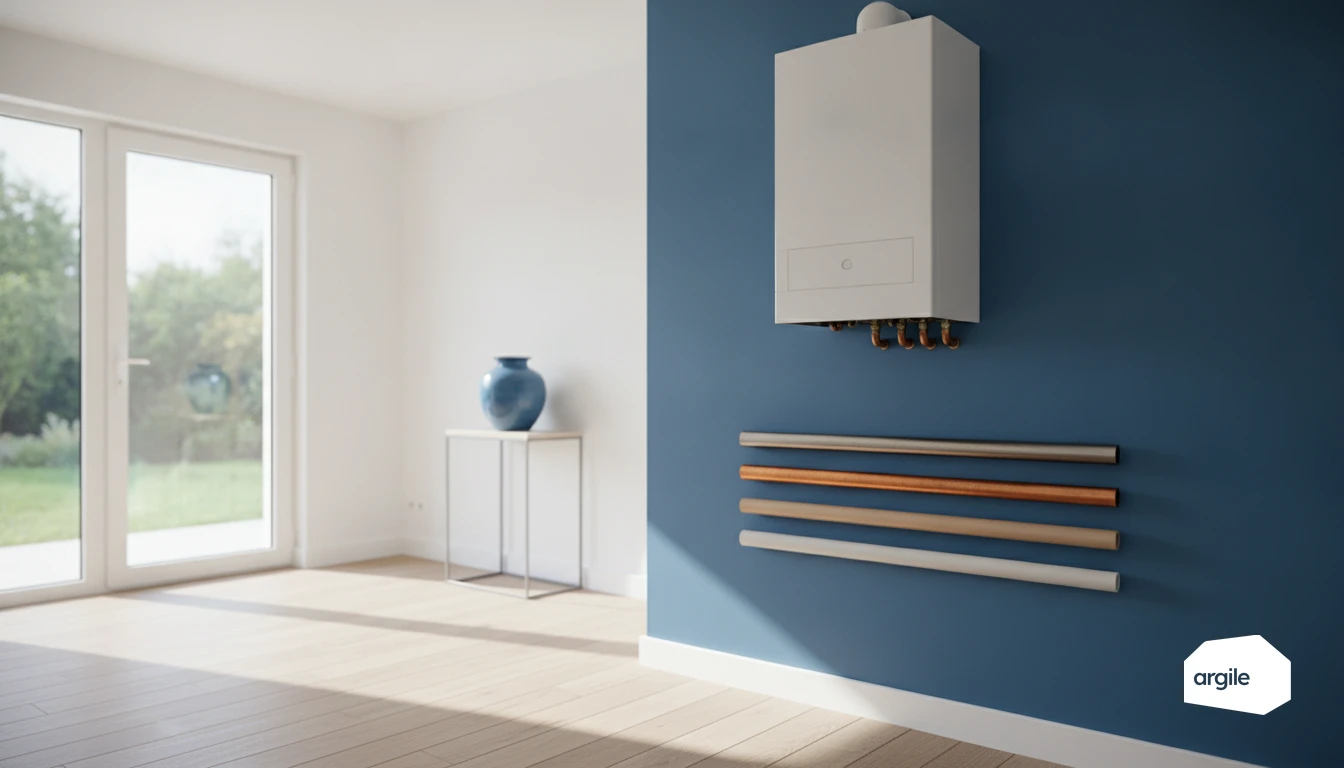
Three materials share domestic heating pipework: copper, lasting beyond 50 years and suited to heavy duty, PEX, flexible and quick to install in a retrofit, and multilayer, a compromise between mechanical strength and ease of installation, with steel kept for plant rooms, risers and large diameters. The choice of material comes after the route and the pipe sizing, themselves derived from the flow rate, so from the output and the temperature difference between flow and return. A diameter too small brings noise, imbalance and a straining circulator, a diameter too large costs in responsiveness and in materials. A heat pump working at 35°C flow calls for a higher flow rate than a boiler at 60°C, which can change the diameter at identical output and is checked before ordering.
Sizing your heating network correctly before choosing the material
Identifying the job's constraints: renovation, access, routing in slabs or wall linings
Before talking about copper, multilayer or PEX, start with the network's routing. In renovation, access dictates everything. Look at where you can run pipework, in the slab, in wall linings, in suspended ceilings, and where you'll need to open things up. Plan for bleed points, isolation valves and an accessible manifold to avoid a leak hunt later.
Calculating diameters and limiting pressure loss on the network
The right diameter is calculated from the flow rate, which itself depends on power and the temperature difference. Too small, and you build up noise, imbalances and a circulator that's straining. Too big, and you lose responsiveness and budget. Aim for simple runs, limit elbows, and keep a pressure loss compatible with the circulator.
Anticipating the flow temperature and the type of emitters (radiators, underfloor heating)
The flow temperature changes everything. Underfloor heating operates at low temperature, a radiator network may need to run hotter if the emitters aren't sized accordingly. The lower the temperature, the higher the flow rate, so diameters may need to change. Also consider the future generator, particularly a heat pump, which prefers low flow temperatures.
Steel: a robust network for high loads and boiler rooms
Where steel is most relevant: multi-unit buildings, plant rooms, risers
When the network has to withstand high temperatures, high pressure and shocks, steel is often the safest choice. It suits boiler rooms, plant rooms, risers and multi-unit buildings well, particularly on large diameters and heavily loaded zones.
Installing steel pipework: welding, press-fitting, anti-corrosion protection
In renovation as in new build, welding remains the reference in boiler rooms. Press-fitting also exists for steel, handy when you want to limit flame work. Consider anti-corrosion protection (paint, suitable pipe insulation, dielectric fittings depending on the case) and a compliant earth bond.
Points of caution: sludge, corrosion, noise and expansion on the network
On a steel network, sludge (magnetite) is managed with sludge removal, a dirt separator and air separation. Corrosion restarts quickly if oxygen enters the circuit. On the acoustic side, control velocities and water hammer. Plan fixed points, sliding supports and provision to absorb expansion.
Copper: reliable pipework for neat, accessible networks
Copper's strengths on a heating network: temperature resistance, durability, appearance
On an exposed heating network, copper remains a safe bet. It handles high temperatures and keeps good mechanical strength. Its longevity is well established, with a stable, recyclable material. And when the network is visible, copper's "clean" look, straight and neatly bent, immediately gives a neat installation.
Installation and connections: brazing, press-fitting, bending and crushing risks
Brazing gives a durable joint, but demands careful preparation (deburring, flux, controlled heating). Press-fitting is faster on site, provided you use the right jaw profiles and check the insertion depth, a difference in fitting time that your plumbing estimating tool should reflect. For bends, the bending radius must respect the minimum, or you risk crushing and a loss of flow rate in the network.
Limits to know: material cost, theft, compatibility and galvanic corrosion
Copper costs more and its price can fluctuate. It also attracts theft on site. On the technical side, watch metal compatibility. Contact between copper and galvanised steel or aluminium, without a dielectric fitting, can trigger galvanic corrosion. In a closed network, suitable water treatment and dielectric fittings limit unpleasant surprises.
PEX: pipework that's quick to install when it has to run everywhere
When to favour PEX: distribution in houses, underfloor heating, light renovations
PEX is the choice when you need a network that's very flexible and quick to run. It passes easily through wall linings, suspended ceilings, crawl spaces, and suits manifold-based distribution in houses well. It's also common in underfloor heating, and in light renovation when you want to limit wall chasing.
Fittings and tools: push-fit, press-fitting, manifolds and bending radii
On the fittings side, press-fit or push-fit solutions dominate. Have the right tool, the correct calibres, and check the insertion. In distribution, the manifold simplifies balancing and interventions. Respect the bending radius stated by the manufacturer to avoid kinking, using a spring or a bending tool if needed.
What to watch: long-term durability, oxygen, fixings and installation rules
For heating, check for an oxygen barrier, or watch out for corrosion of metal components. Protect PEX from UV and impacts, and take care with fixings to limit noise and movement. Avoid fittings in inaccessible areas, and carry out a pressure test according to standard practice.
Making the right choice in 2026: weighing your network on performance, cost and compliance
Comparing steel, copper and PEX over time: maintenance, repairability and network scalability
For a network, think over time first. Copper remains very repairable and stable, but it weighs on the budget. Steel handles high loads well, but demands vigilance on corrosion and sludge build-up. PEX and multilayer pipe are fast in renovation and cost less, but require accessible fittings and good expansion management. To stay upgradable, plan for valves, access hatches and a labelling diagram.
Matching the pipework to the generator: boiler, heat pump, hybrid and lower temperatures
With a heat pump or a hybrid system, low-temperature regimes are often the target. The network needs to follow with suitable flow rates, controlled pressure loss and careful pipe insulation. Also check material compatibility with inhibitors, sludge and water quality, or performance drops quickly. In the quote, reworking the network is priced alongside the other plumbing items, in the same works plan as the machine.
Checking current rules and documents in 2026: DTU, technical approvals, insurer requirements
In 2026, secure compliance before closing up the wall linings. Rely on the standards and the manufacturer's documentation.
- DTU and standard practice applicable to heating and plumbing.
- Technical approvals, DTA, system data sheets (PEX, multilayer, fittings).
- Documents for the insurer: photos, network diagram, tests and commissioning with water.