Diagnosing before starting the renovation: understanding your half-timbering and the old building
Identifying common pathologies: moisture, cracks, insect attack and deformation
Before any renovation, observe what the house "tells" you. Stains, salt efflorescence, a musty smell or dark timber often signal persistent moisture. Also watch for cracks around posts, render chips, and floors that "give." For timber, look for holes, worm damage and soft zones. Deformation of the half-timbering can sometimes be seen with the naked eye, like a facade that bulges.
Checking existing materials: wattle-and-daub, brick, renders and structural timber
Identify the infill (wattle-and-daub, brick, stone) and the existing render. Old buildings favour breathable materials. A render that is too hard (cement) can block water vapour and worsen moisture. On the structure side, check the joints, post bases and areas close to the ground. If in doubt, a targeted opening and a carpenter's opinion avoid surprises.
Knowing when to arrange a heritage opinion: ABF, protected sector and local constraints
If you are in a protected sector, near a historic monument, or in a perimeter subject to ABF review, plan ahead. A simple change of render, colour, joinery or external insulation can require approval. The right reflex is to consult the local plan at the town hall and settle the project upstream, for a renovation that moves forward without administrative blockages. Where the building itself changes use, the applicable consent regime is set out in our article on agricultural building conversion.
Choosing an insulation strategy compatible with heritage: gaining comfort without trapping moisture
In an old-building renovation, the goal is simple. Improve comfort, without preventing the walls from drying out. You are looking for a balance between insulation, water-vapour management and ventilation.
Internal insulation: breathable solutions for half-timbered walls (lime/hemp renders, plant fibres)
On half-timbering, favour breathable materials such as lime-hemp render, plant-fibre panels or wood fibre. On the interior side, a hygrovariable vapour barrier can help, provided continuity is carefully maintained. Avoid sealed linings that trap moisture and weaken the timber.
External insulation: possible cases, points of caution and finishes respectful of the half-timbering
External insulation can be considered if the facade is not constrained by heritage protection. The challenge is to keep compatible finishes. Discreet cladding or a lime render over suitable insulation, while treating sensitive points. Roof overhangs, sills, foundations and water drainage must remain consistent.
Treating thermal bridges: wall/floor junctions, party walls and window reveals
Thermal bridges hide at wall-floor junctions, on party walls and around windows. Plan for insulation returns in the reveals, continuity at the floor base, and controlled air sealing. Every junction matters, especially on a building that moves a little.
Ensuring airtightness and ventilation: the key to a high-performance renovation in an old house
Airtightness: where to intervene without damaging the building (floors, hatches, joinery)
In an old house, the goal is to treat the small leaks without blocking how the building functions. Priority to junctions that are easy to fix. For floors over a crawl space, take care with duct penetrations. For hatches, add a compressible seal and regular locking. On joinery, redo the seals, seal the reveals and limit parasitic air inlets.
Suitable ventilation: single-flow mechanical ventilation, humidity-controlled, or case-by-case solutions
The more you improve airtightness, the more you need to secure fresh air. A single-flow mechanical ventilation system is sometimes enough in a light renovation. The humidity-controlled version adapts flow rates to moisture and avoids ventilating for nothing. In some cases, spot extractors or decentralized ventilation are simpler to install, especially if ductwork is complicated.
Managing moisture day to day: drainage, rising damp and choice of renders
To keep healthy walls, start outside. Water drainage, gutters, ground slope, drainage if needed. In case of rising damp, avoid overly sealed cement renders. Prefer breathable renders compatible with the substrate, and adjust usage. Tumble dryer, kitchen, showers, everything counts.
Modernizing heating without altering the building's character: effective solutions compatible with a half-timbered renovation
Heat pump: conditions for success in an old building (emitters, temperatures, settings)
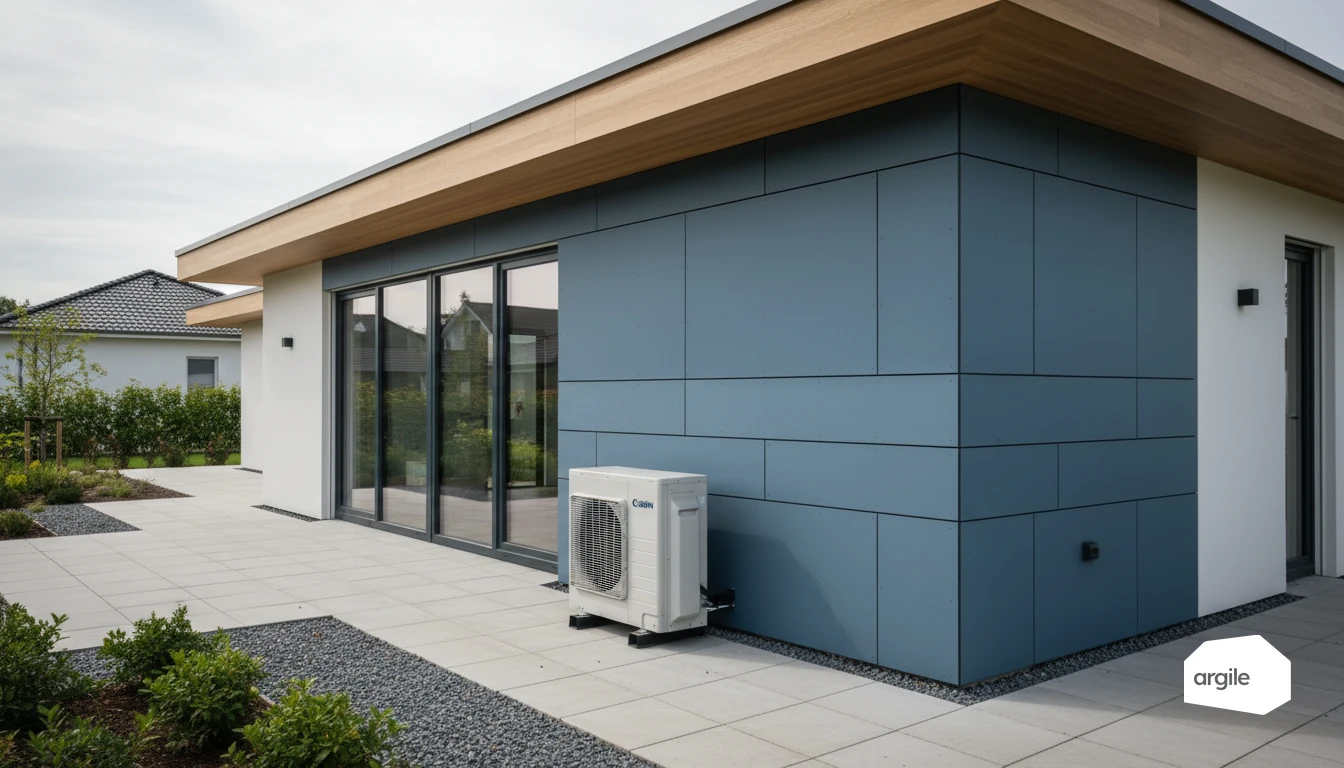
In a half-timbered house, a heat pump works if your emitters keep up. Aim for "low-temperature" radiators or underfloor heating, and have it sized on actual losses. The right reflex in a renovation is to set the water temperature as low as possible, with a heating curve and hydraulic balancing. Otherwise, consumption rises and comfort drops. That sizing on actual losses is calculated from the survey readings, with the equipment picked from up-to-date catalogues.
Biomass boiler and stoves: relevance, placement and safety
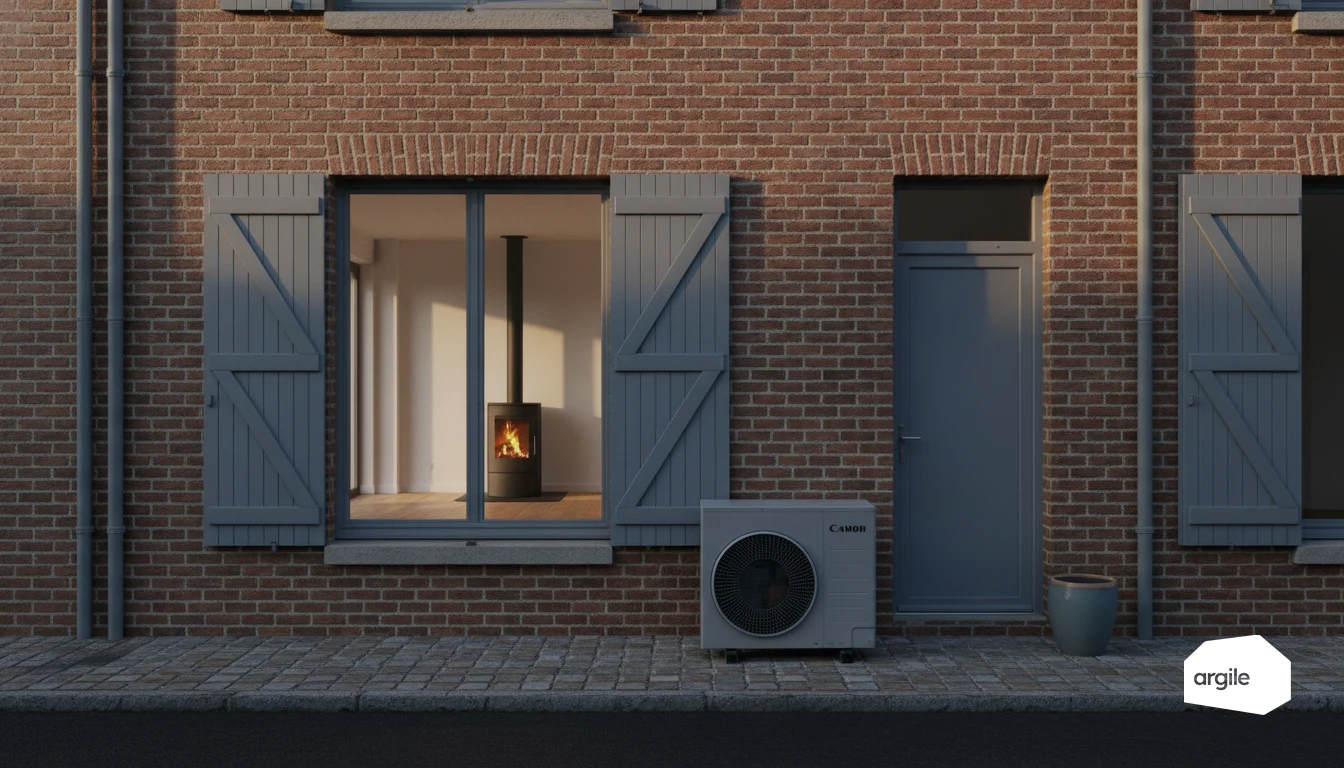
Biomass is often a good fit when you want to keep "radiant" heat without major work. Pellet boiler or stove, everything depends on the flue, air supply and safety distances. Also plan for a dry space for the fuel and regular maintenance.
Hot water and controls: improving performance without heavy work
Before demolishing anything, optimize. Pipe insulation, tank lagging, time-based programming, thermostatic valves, and a modulating thermostat if compatible. A small temperature adjustment and room-by-room control often deliver an immediate gain, without touching the half-timbering.
Securing the job and 2026 grants: file, phasing and RGE requirements in a heritage renovation
Phasing the work: structure, envelope, ventilation, then heating (the winning order)
In heritage work, start with the structural work and treating problems (moisture, cracks). Then secure the envelope in the renovation with compatible insulation (finishes, breathable materials). Ventilation comes right after, to avoid mould as the building becomes more airtight. Heating is sized last, once actual needs are known.
Building a grant file in 2026: MaPrimeRénov', CEE and documents not to forget
File the application before signing and starting. Keep a detailed quote, the tax notice, the exact address, the equipment specifications, and, depending on the pathway, a DPE or an energy audit. On the CEE side, validate the bonus offer upstream, then keep invoices and certificates.
Quality and compliance: RGE points, checks, site photos and handover of the work
Check the active RGE mention in the correct scope, at the date of the quote and the invoice. Document the job (before, during, after photos, labels, thicknesses, settings). At handover, have reservations resolved, and collect instructions, technical data sheets and proof of performance.