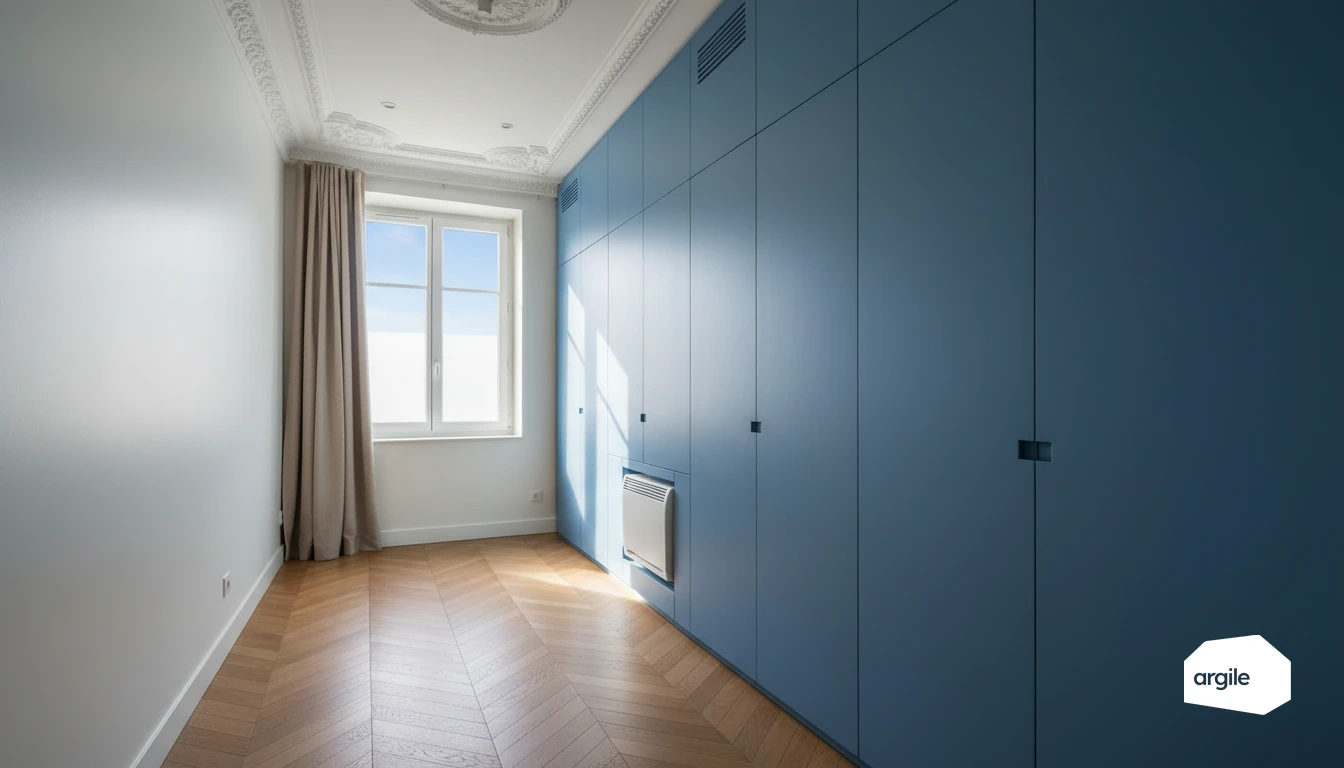
Framing your T1 studio renovation project without losing space
Diagnosing weak points: insulation, ventilation, heating, moisture
In a studio, every flaw is quickly felt. Identify cold walls, drafts, condensation on glazing, or mould traces behind furniture. Check the insulation of exterior-facing walls, the ceiling under the roof, and the windows. On the air side, make sure ventilation is working and that air inlets are not blocked. For heating, note the output, location and your actual comfort.
Optimizing the layout: short circulation paths, storage, light partitions
Before demolishing anything, sketch the use zones. Reduce corridors, keep passageways simple, and rely on full-height storage. A sliding door and a light partition can create a "bedroom" without eating into the light. Avoid cupboards that block radiators. Think vertically to free up floor space.
Prioritizing the work based on your budget and site constraints
Set a clear order. When you improve airtightness and insulation, plan suitable ventilation at the same time, otherwise moisture takes hold. Then size the heating to the new need. Group dusty work into a single phase. To activate grants (CEE, MaPrimeRénov'), go through an RGE-certified company and keep the supporting documents. To go further on bonuses and procedures, see our guide on activating grants (CEE, MaPrimeRénov').
Insulation and airtightness: gaining comfort in a compact format
Insulating walls, ceiling and floor with low thickness: solutions suited to a studio
In a studio, every centimetre counts. In a renovation, favour high-performance insulation with low thickness, such as rigid panels (polyurethane, phenolic) or, when space is truly lacking, vacuum insulation panels. On the ceiling, a thin suspended ceiling limits losses to the neighbor above. On the floor, an insulating underlay and a floating covering improve comfort without raising the floor level too much.
Treating thermal bridges and airtightness without stalling the job
Thermal bridges hide at wall-floor junctions, around windows and shutter boxes. Continuous insulation, with sealing tape, sealants and membranes at junctions, cuts drafts. Also think about cable runs and electrical boxes. Planning for these points from the quote stage avoids rework and keeps the schedule on track.
Choosing high-performance joinery and correctly adjusting air inlets
For windows, look at the Uw coefficient and the quality of installation. High-performance joinery poorly installed lets heat escape. Keep air inlets compatible with the mechanical ventilation system, and adjust them rather than sealing them shut. If noise is an issue, acoustic air inlets exist.
Heating, hot water and ventilation: compact, high-performance equipment
Air/air heat pump, high-performance radiators or boiler: what to choose in a T1?
In a T1, the goal is simple. Heat quickly, without eating up half the volume. An air/air heat pump is often suitable if the co-ownership allows an outdoor unit and if noise is controlled. It heats quickly and can be finely controlled. Otherwise, thermal-mass or electronically controlled radiators remain a reliable option, with little maintenance. A boiler, especially gas, only makes sense if the home is already equipped for it and ventilation is consistent. In a renovation, the goal is the right compromise between space, use and building constraints. That choice can be justified room by room when the indoor units are placed on the plan and the coverage rate is calculated for each room.
Domestic hot water in a small volume: compact, flat or thermodynamic tank
For hot water, a compact or flat tank fits more easily into a cupboard. It pairs well with an off-peak-hours contract and a temperature set to the right level. A thermodynamic water heater can reduce the bill, but requires a suitable location, condensate drainage and attention to noise. Above all, look for space savings without sacrificing access for maintenance.
Effective ventilation in a studio: mechanical ventilation, vents, flow rates and avoiding mould
In a studio, humidity rises quickly. Check that the mechanical ventilation system extracts properly in the bathroom, that the vents are clean and that the air inlets are not blocked. A properly undercut door helps air circulate. Without continuous ventilation, a spot extractor and airing can help as a stopgap, but watch for condensation and odors. The right reflex is circulating air to limit mould.
Electrical renovation and lighting: safety, comfort and efficiency in a small home
Bringing wiring up to code: protections, circuits, outlets, and common mistakes in a studio
In a studio, the electrical renovation starts with making things safe. A panel with 30 mA residual-current devices, suitable circuit breakers, separate circuits for outlets, lighting, cooking. In the bathroom, compliance with safety zones and earthing. To avoid: daisy-chained power strips, too few outlets, and mixed circuits.
Functional lighting: multiplying fixtures without over-consuming
Multiply light points rather than power. Ceiling light, wall lights, strip lights. Efficient LEDs are enough, with a warm tone in the living area and a more neutral one over the worktop. A dimmer limits bright lighting when it is not needed.
Simple controls: heating programming, sensors, and useful habits
Simple controls deliver quick gains. Program the heating to your schedule, lower it when away. Add occupancy sensors for the entrance and toilet, a timer in the bathroom, and standby-cutoff outlets for the router and TV. Also think about unplugging chargers.
2026 grants and obligations: securing your studio renovation
MaPrimeRénov' and CEE: eligible work and points of caution in a small home
In 2026, MaPrimeRénov' and CEE mainly finance insulation, ventilation and heating. In a studio, watch the insulation thickness and the space for ductwork. Keep in mind that paint, furniture and simple décor remain outside the grants. Aim for measurable gains, not just comfort. Those gains are easier to present when the grants and incentives are deducted from the remaining cost right inside the pricing.
RGE and supporting documents: avoiding rejected files and smoothing the client relationship
For most grants, the work must go through an RGE-certified company. Anticipate the documents. Dated quote, detailed invoice, product references and proof of installation. A simple checklist helps avoid rejected files and secures the renovation.
Energy audit and target performance: cases where it is relevant for a T1 studio
An energy audit becomes useful if the studio is very poorly rated, if the owner is aiming for a comprehensive renovation, or if there is a plan to rent it out. In a small volume, the audit mainly helps prioritize items and avoid isolated work.