Understanding the client "profile" in energy retrofit: ECO or COMFORT, what does it change?
Typical expectations of the ECO profile: controlled budget, maximized incentives, priority work
The ECO profile wants a well-framed project first. They compare quotes, quickly ask about the out-of-pocket cost, and expect a step-by-step work plan. Your role: prioritize whatever delivers the most gain for the budget. Targeted insulation, coherent ventilation, then heating if needed. With a clear costing of MaPrimeRénov' and CEE incentives, they move forward with more confidence.
Typical expectations of the COMFORT profile: comfort gains, performance, peace of mind in daily use
The COMFORT profile talks less about euros and more about how it feels. Cold in winter, overheating in summer, humidity, drafts. They're looking for everyday comfort and a solution that just works without thinking about it. They're more willing to accept a coherent bundle of work: full insulation, thermal bridge treatment, controls, a properly sized heat pump. With a clean job site and simple day-to-day use.
Signals to spot from the first conversation to qualify the profile without getting it wrong
A few simple signals save time. Listen to the first questions and rephrase them.
- "How much will it cost me after incentives" or "what grants are there", usually ECO.
- "I want a house that's warm everywhere" or "less noise", usually COMFORT.
- "Let's do it fast and minimal" vs "let's do it once, properly" to settle it.
Building a quote that fits the profile: structure, service levels and options
Quote for an ECO profile: split into lots, phase it, justify the choices (insulation, ventilation, heating)
For an ECO profile, keep it simple and readable. Break the work into lots (insulation, ventilation, heating) and propose phasing. Phase 1: cut losses and secure air quality. Phase 2: size the heating system after the envelope work. Highlight the quick wins, the constraints spotted during the visit, and the out-of-pocket cost with MaPrimeRénov' and CEE.
Quote for a COMFORT profile: complete scenarios, "peace of mind" options, finishes and warranties
For a COMFORT profile, sell a coherent scenario, with peace-of-mind options: room-by-room controls, commissioning, a maintenance contract, acoustic treatment, finishes. Add what reassures them: timelines, the intervention schedule, manufacturer warranties and a reminder of the ten-year liability insurance.
Presenting two scenarios without confusing the client: "essential" vs "optimized" (and when to propose a comprehensive renovation)
Present two columns, same line items, same measurements. "Essential" to reach the target. "Optimized" to go further on the envelope and controls. Bring out the visible differences: comfort, estimated consumption, maintenance. Propose a comprehensive renovation when several measures are needed and the client is targeting an enhanced incentive with support.
Costing and incentives in 2026: combining eco, comfort and the quote without risky promises
Including MaPrimeRénov' and CEE in the quote: what you can state, and how to phrase it
Show estimated amounts, not "guaranteed" grants. Clearly state the basis of calculation (work items, area, equipment, target performance) and specify that MaPrimeRénov' depends on the household's profile and the rules in force on the filing date. For CEE, tie each work item to a standardized operation and mention that the incentive is conditional on going through the obligated party or its delegate.
Highlighting out-of-pocket cost, energy savings and payback time: keep it simple, with clear figures
Present a brief summary: cost including tax, indicative incentives, out-of-pocket cost, then a savings range (kWh and euros/year) with the energy price assumption used. For payback time, give a range (e.g. 8 to 12 years) rather than a single figure, and remind the client that comfort and property value aren't fully captured by a calculation.
2026 points to watch: conditions, documents and timelines that affect your schedule and the signature
Anticipate the required documents (DPE, audit if requested, tax notice, proof of residence) and the steps involved. In practice, the application must be filed before work starts, and CEE requires proof of incentive before the work is committed to. Also plan for inspection and payment timelines. A simple schedule, shared with the client, avoids signing "on a hunch." To secure this point, also see proof of incentive before work is committed to.
Field method for qualifying the profile during the technical site visit and securing the quote
The "profile" question grid: usage, discomforts, constraints, priorities and work horizon
During the visit, start by framing the profile. Who lives here, at what hours, which rooms are actually used. Get them to describe concrete discomforts, for example cold walls, drafts, noise, overheating in summer. Note the constraints: budget, presence during the work, timelines, and the horizon, resale, rental, phased work. You turn impressions into measurable criteria.
Spotting the technical constraints that change everything: moisture, ductwork, volumes, accessibility
On site, track down the constraints that can derail a job. Moisture, odors, mould, staining at the base of walls, missing or clogged ventilation. Locate the ductwork, drains, electrical panel, gas, flues, and sensitive areas. Check the volumes, loft, rafters, crawl spaces, ceiling height. Confirm accessibility, hatches, roof access, where an outdoor unit could go, routing for ducts.
Formalizing the trade-offs in the quote: what's included, what's optional, and why
In the quote, write down in black and white what's included, with the assumptions, surfaces, thicknesses, performance figures, and points still to be confirmed. Make optional whatever depends on a client choice or an unforeseen issue: moisture treatment, electrical reinforcement, ductwork rework. Explain the impact on comfort, consumption, incentives. You secure both your margin and the signature.
How Argile helps you go from profile to quote: saving time and increasing the signing rate
You start from a simple housing profile, then move toward a clear, costed proposal, without spending the evening on spreadsheets.
Quick energy diagnosis and scenarios: compare ECO vs COMFORT in a few minutes, with a priority logic
Argile assesses the home's performance and proposes structured scenarios. You compare ECO and COMFORT, with a priority logic that's easy to explain to the client, usually insulation then systems. In a few minutes, you can see the impact on consumption, the energy label and the budget.
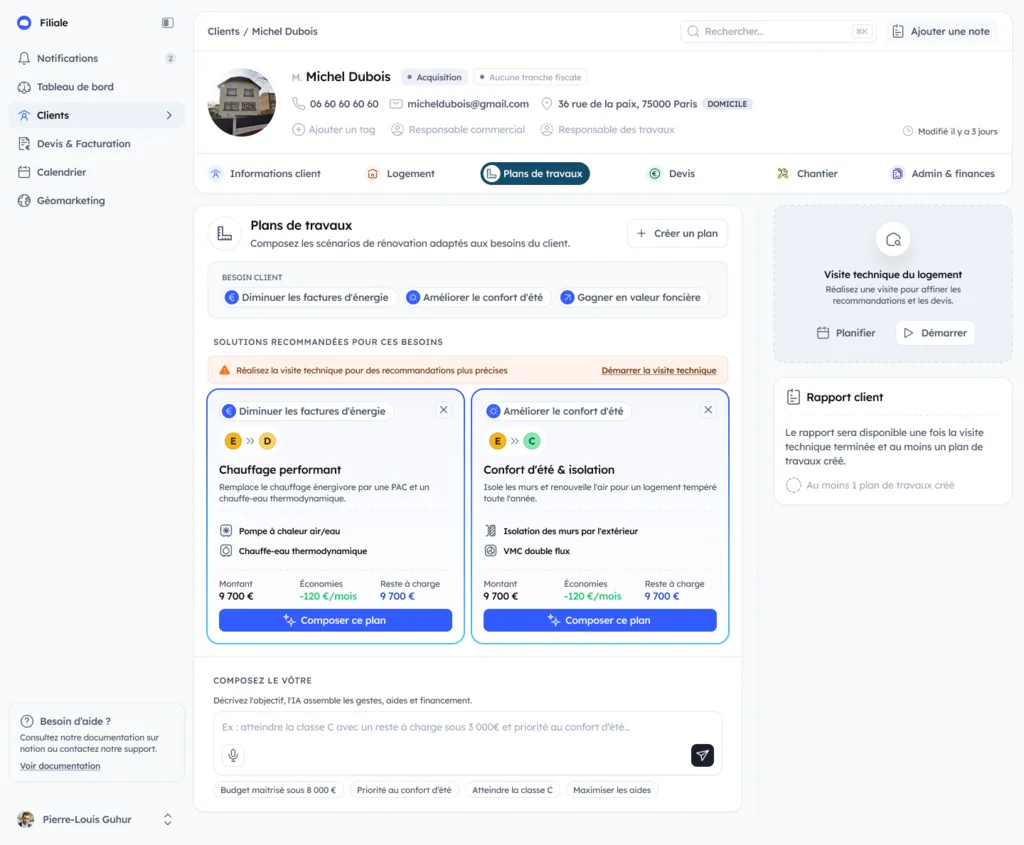
That priority logic is built in the tool, where the works plan is composed by objective, from the home to the measures retained.
Feasibility analysis and support for the technical visit: anticipating constraints and limiting oversights
Before and during the visit, Argile helps you spot the points that can derail a job: loft access, room for an outdoor unit, condition of the emitters, ventilation, routing constraints. The goal is zero oversights, so fewer back-and-forth trips and fewer quotes to redo.
Quote generation with incentive calculation: a coherent, readable quote ready for the paperwork
From the scenarios and quantities, Argile generates a readable quote, with a MaPrimeRénov' and CEE estimate based on the rules in force, and a list of documents to prepare. You present a credible out-of-pocket cost, with line items aligned with RGE requirements. Incentives built in, smoother paperwork, and if you're looking to reduce the time spent on paperwork, good RGE practices often make the difference.
Going from work plan to document takes no re-keying, equipment, labour and ancillaries carried over line by line with the applicable VAT.