Clarify your goals and margins to sell better, not more
Calculate your actual margin per job (materials, time, travel, after-sales)
On a job, margin is not decided by the quote, but by the actual cost. Set a simple rule. For each job, record your materials, subcontracting, hours spent (installation, prep, admin), travel and after-sales work. Multiply the hours by your fully loaded hourly cost (including overheads). You get a net margin, job by job.
Set a simple target: average basket, conversion rate, billable days per month
If your question is "how to grow your revenue without hiring", start from 3 dials. A target average basket, a conversion rate and a number of billable days per month. Track them every week. You will quickly see whether the problem comes from the volume of leads, the price, or unbilled time. To go further, also work on your conversion rate.
Spot the jobs that "eat" time and the ones that truly pay off
Sort your jobs by margin per hour. Some small "urgent" jobs eat up travel and after-sales time. Others, like a full insulation job or a well-scoped heat pump, secure profitability. Then decide. Raising the price, grouping visits, or declining the job, that is also selling better.
Increase the average basket with useful add-on sales
Offer coherent bundles (insulation + ventilation, heat pump + controls, joinery + airtightness)
A well-performing job is a team effort. Insulation and ventilation go together to avoid dampness. A heat pump gains comfort with well-matched controls. New windows and doors reach their full potential with good airtightness (seals, sills, boxes).
Standardise 3 clear offers: Essential, Comfort, Performance
To move forward on "how to grow your revenue without hiring", simplify the sale. Offer 3 tiers with a clear scope, well-framed options and a visible difference in the energy bill and comfort. Your teams install the same solutions, faster, with fewer omissions.
Justify the value with proof: photos, technical sheets, client feedback, before/after
An add-on sells better when it is visible. Take 3 key photos (before, details, finished). Hand over a product sheet and proof of registration. Add 1 client testimonial and a simple before/after (ventilation flow rates, settings, thermal bridges addressed). This turns the quote into field proof.
Speed up your sales cycle by reducing unnecessary visits
Set up quick pre-qualification (budget, housing type, urgency, subsidies)
Before travelling, set a clear frame in 10 minutes. You filter out requests outside your budget range, you spot homes suited to the works, and you know whether the funding schemes can enter the equation. At this stage, the most relevant measures already follow from the characteristics of the home and the client's objective, which saves sending someone out for nothing.
- Address and housing type (house, flat, condo association).
- Current heating, surface area, approximate age.
- Envisaged budget and desired timeline.
- Status of the file. Quotes already obtained, actual urgency, subsidies targeted.
Use a questionnaire and a checklist to prepare each visit
An effective visit is a prepared visit. Ask for 5 photos, an energy bill, and any access constraints. You arrive with the right assumptions, avoid back-and-forth, and secure your technical choices.
- Existing insulation, ventilation, visible dampness.
- Access to the attic, basement, location for a heat pump outdoor unit.
- Electrical panel, drains, space for the tank.
Send quotes faster with ready-made templates and priced options
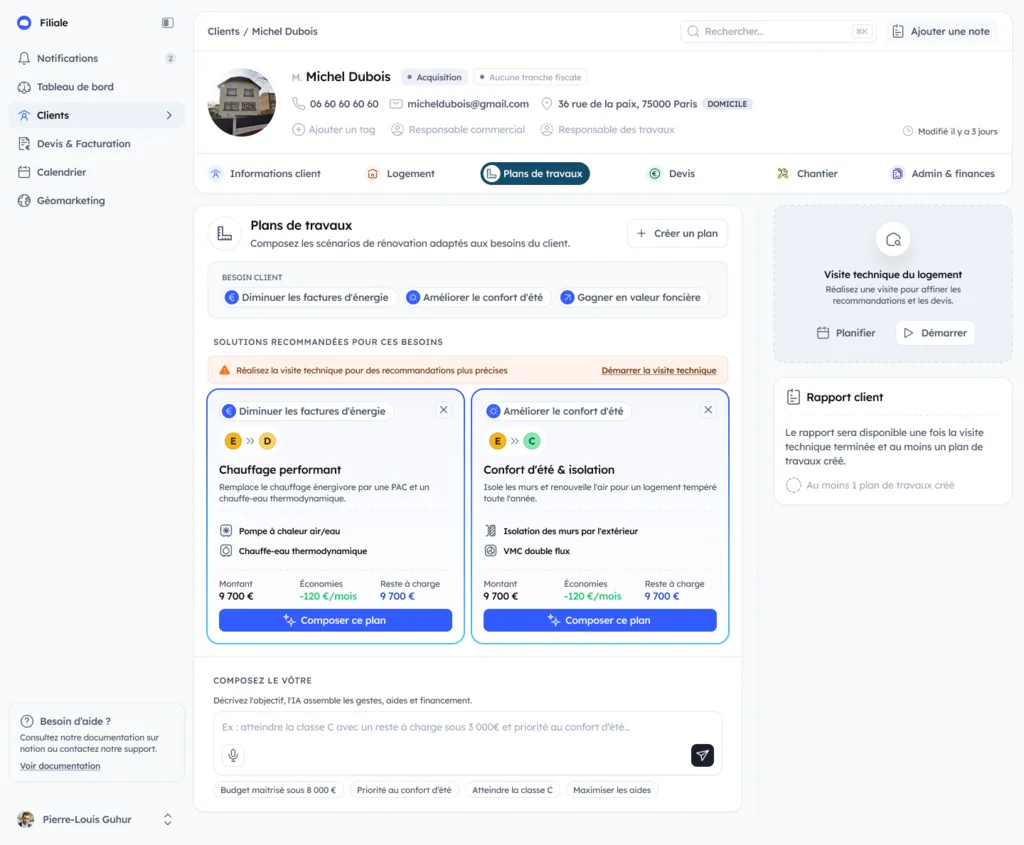
Save time with templates by work package (insulation, heat pump, ventilation) and 2 priced options. You show a simple path, without overwhelming the client. This is a concrete way to answer the question how to grow your revenue without hiring. With materials, labour and accessories carried over line by line from the works plan, the template fills itself and the options duplicate in one click.
Save time on execution with simple on-site processes
Prepare your job sites: ordering, scheduling, access, protection, checkpoints
Before starting, set up a site checklist. Material orders with a clear delivery date. A schedule shared with the client. Access, parking, storage areas, floor and furniture protection. Add 3 simple checkpoints. Measurements, spacing, drilling locations. You limit surprises and move faster.
Reduce rework: reliable surveys, photos, staged client sign-off
A laser survey, then photo evidence before closing up. Insulate, seal, then photograph the details and the product references. Get sign-off in 2 stages. After preparation and before finishing. Less back-and-forth, and a client who stays engaged. This is also a concrete lead for how to grow your revenue without hiring.
Secure your quality to stay registered: traceability, documents, end of job
Keep a compliance file per job. Technical sheets, instructions, invoices, diagrams, photos, and reports where applicable (commissioning, tests). At the end of the job, do a written sign-off with any reservations noted. In case of an audit, you have everything in the right place, and to go further, see preparing your sites and documents.
Secure the funding in 2026 to avoid blockages and get paid faster
Anticipate the application: documents to request from the first contact
From the first call, list what is most often missing. Identity, proof of income or benefits, address, and written authority if you submit the application. Also prepare the client declaration and proof of the household's situation. You avoid the back-and-forth that delays validation.
- Dated, signed quote, with the registration mention and precise description of the works.
- Photo of the nameplate (heat pump), insulation measurements, and technical sheets.
Coordinate with the energy audit when required (house, condo association)
When an audit is required (guided pathway, full-scale renovation, or a condo association project), schedule it before finalising the quotes. The audit sets the order of the works and avoids funding an isolated measure that will not be approved.
Avoid common mistakes: dates, signatures, quote wording, invoices, certificates
The trio that blocks things. Quote signed before approval, invoice without references, incomplete certificate. Keep a checklist of dates and signatures, and check the wording (surface area, output, resistance, product references). This is a concrete lever if you are looking to avoid mistakes on your applications.