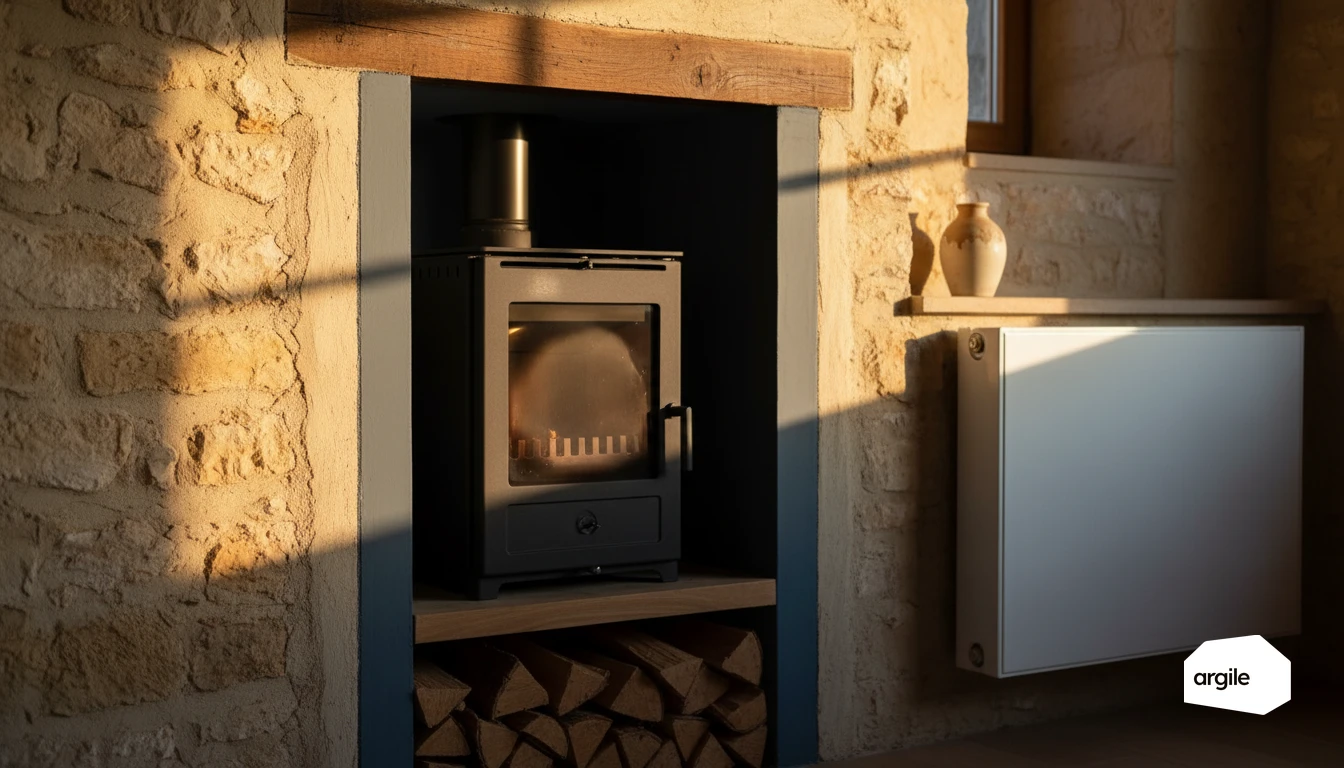
In a low-energy or new-build home, a wood stove runs into its minimum output long before it runs into its efficiency. A high-performance envelope loses in the order of 25 to 35 watts per square metre at the design outdoor temperature, that is 2.5 to 3.5 kW over 100 m², whereas the smallest log stove on the market is rated at 4 to 5 kW. The appliance therefore covers the whole demand on its own, and the only way left to temper the room is to throttle back, precisely the regime Regulation (EU) 2015/1185 does not measure: its ecodesign requirements, in force since 1 January 2022, are established at rated output and set 65% seasonal efficiency and 40 mg/Nm³ of particulates for a log appliance. Room sealing solves the second problem, the combustion air that a dwelling with low air permeability no longer supplies through its own defects.
The real issue in a high-performance home: minimum output
What the building asks for, what the appliance delivers
The demand is calculated, not estimated. The orders of magnitude below are there to frame a conversation during a survey, never to replace a heat-loss calculation carried out to EN 12831.
| Heated floor area | Heat loss at design temperature, low-energy envelope | Smallest common rated output, logs | Output to demand ratio |
|---|---|---|---|
| 80 m² | 2.0 to 2.8 kW | 4 to 5 kW | 1.4 to 2.5 |
| 100 m² | 2.5 to 3.5 kW | 4 to 5 kW | 1.1 to 2.0 |
| 140 m² | 3.5 to 4.9 kW | 6 kW | 1.2 to 1.7 |
The ratio stays above 1 in every case. That is a feature of the market, not a selection error, and it forces one conclusion: the stove will be a comfort appliance, never the sizing heat generator, unless overheating is accepted.
That calculation is done once and for all when the heat losses are worked out room by room to EN 12831-1 and issued as a sizing note.
Why throttling back is the wrong control
Cutting the combustion air to temper a room drops the firebox temperature, combustion becomes incomplete, carbon monoxide and particulates rise, the flue loads with tar and the glass blackens. The same appliance, certified compliant at rated output, has left its validated domain. In a high-performance dwelling, the fire is controlled by the charge loaded and the frequency of firings, not by closing the air.
Position and heat distribution, before choosing the appliance
In an open, compact volume, excess output dilutes. In a partitioned living room, it concentrates and ends with windows being opened. Place the appliance at the centre of the volume it serves, away from air paths, and check that doors and circulation actually allow distribution before settling on an output. That is a design decision, taken on the drawing.
What the ecodesign regulation guarantees, and what it does not
The values in force since 1 January 2022
Regulation (EU) 2015/1185 applies to solid fuel local space heaters, Regulation (EU) 2015/1189 to biomass boilers. The values below are the regulatory minima and ceilings currently in force.
| Type of appliance | Minimum seasonal energy efficiency | CO | Particulates | OGC | NOx |
|---|---|---|---|---|---|
| Log local space heater, stove, insert, closed fire | 65% | 1500 mg/Nm³ | 40 mg/Nm³ | 120 mg/Nm³ | 200 mg/Nm³ |
| Pellet local space heater | 79% | 300 mg/Nm³ | 20 mg/Nm³ | 60 mg/Nm³ | 200 mg/Nm³ |
| Manually fed boiler | 75% up to 20 kW | 700 mg/Nm³ | 60 mg/Nm³ | 30 mg/Nm³ | 200 mg/Nm³ |
| Automatically fed boiler | 77% above 20 kW | 500 mg/Nm³ | 40 mg/Nm³ | 20 mg/Nm³ | 200 mg/Nm³ |
Those values are a floor for placing on the market. A compliant appliance is not thereby suited to the dwelling: the regulation says nothing about minimum output, which is the decisive parameter in a high-performance home.
Reading a data sheet without being caught out
Three lines matter, and two of them are rarely put forward. The rated output, which carries the marking. The output range, which gives the low setting that can actually be held. And the firebox volume, which determines the minimum load needed for a clean burn. A large firebox rules out small charges, and therefore rules out tempered use. Ask for those three values in writing before ordering.
The evidence for the file
Keep the declaration of performance, the rated and minimum outputs, the seasonal efficiency and declared emissions, and the installation manual stating the accepted air supply arrangement. Add the exact reference of the model and of the accessories fitted, air connector, flue components, penetrations. That set of documents is what proves, years later, that the appliance matched the building.
Handling combustion air in a tight envelope
Connected appliance and room-sealed appliance, the distinction that binds you
A connected appliance draws its air from outside but its firebox stays open to the living space: negative pressure in the room can still reverse the flow. A declared room-sealed appliance is tested with a closed combustion circuit, with a leakage rate declared by the manufacturer at a stated test pressure. In a high-performance home that declaration is what counts, not the wording printed on the brochure.
Simultaneous depressurisation: ventilation, cooker hood, tumble dryer
Ventilation regulations require continuous whole-dwelling ventilation, and that ventilation runs while the stove runs. Add an extract cooker hood and a vented tumble dryer, and the combined depressurisation becomes the real operating point. Measure it at commissioning, with every extract running and doors closed, and compare it with the value the manufacturer declares as acceptable. A dated reading beats an assumption: it is what protects you if backdraught is reported later.
Air supply and envelope penetrations
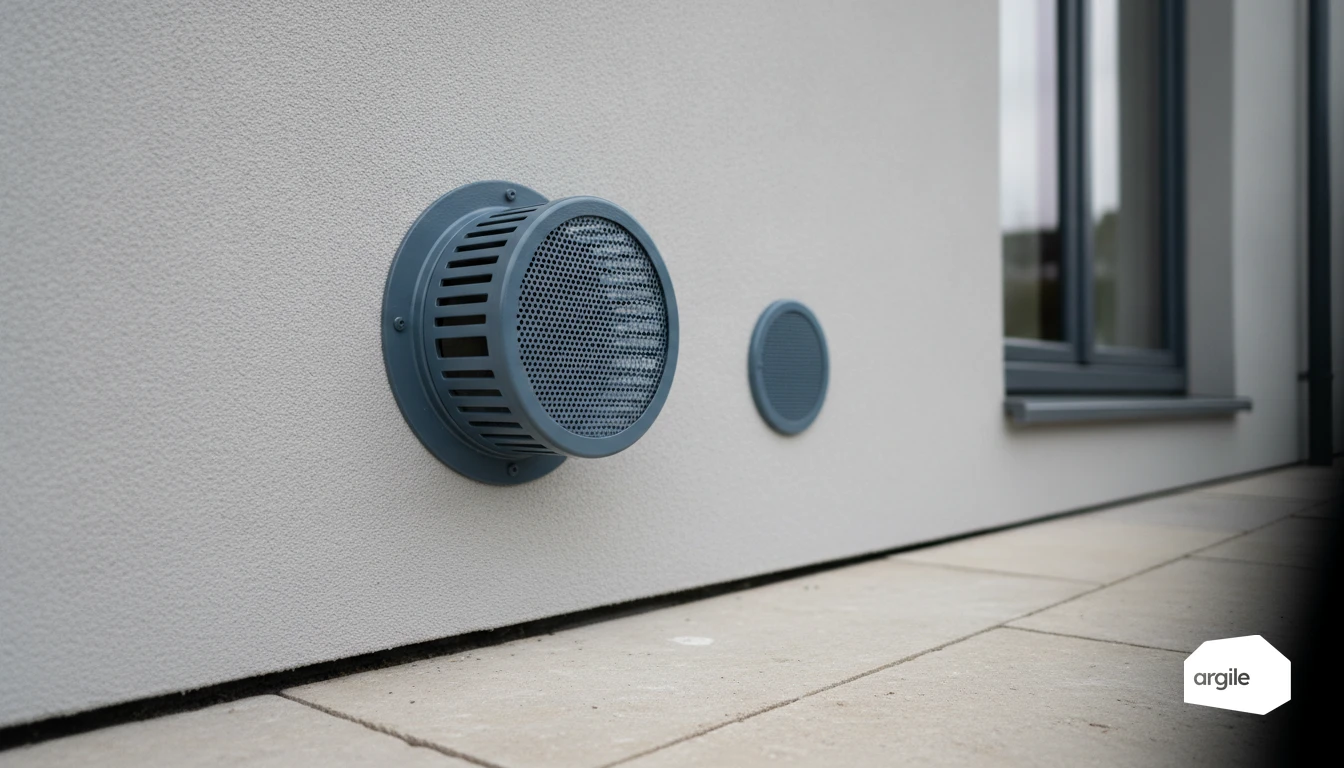
The air supply has to stay continuous and of constant cross-section from the outside terminal through to the appliance, with no tight bend and no crushing. At every wall penetration, a suitable membrane, a sealing sleeve and a compatible sealant, without obstructing the air duct itself. An air terminal opening on the prevailing windward facade produces draught variations the occupant will blame on the stove. That point is settled on the elevation drawing, not when the hole is cut. For the dwelling's air change requirements, see the air renewal rate, and where a heat-recovery ventilation system is fitted, check the balancing before the first fire.
Flue, installation and handover
Designate the flue before ordering it
A flue is designated, not picked by diameter. The designation carries the temperature class, the gas tightness, the suitability for condensing operation, the corrosion class for the fuel, the soot fire resistance and the clearance to combustible materials. On solid fuel, soot fire resistance is not optional. How to read that designation, and the mistakes it prevents, is set out in our article on chimney flue lining.
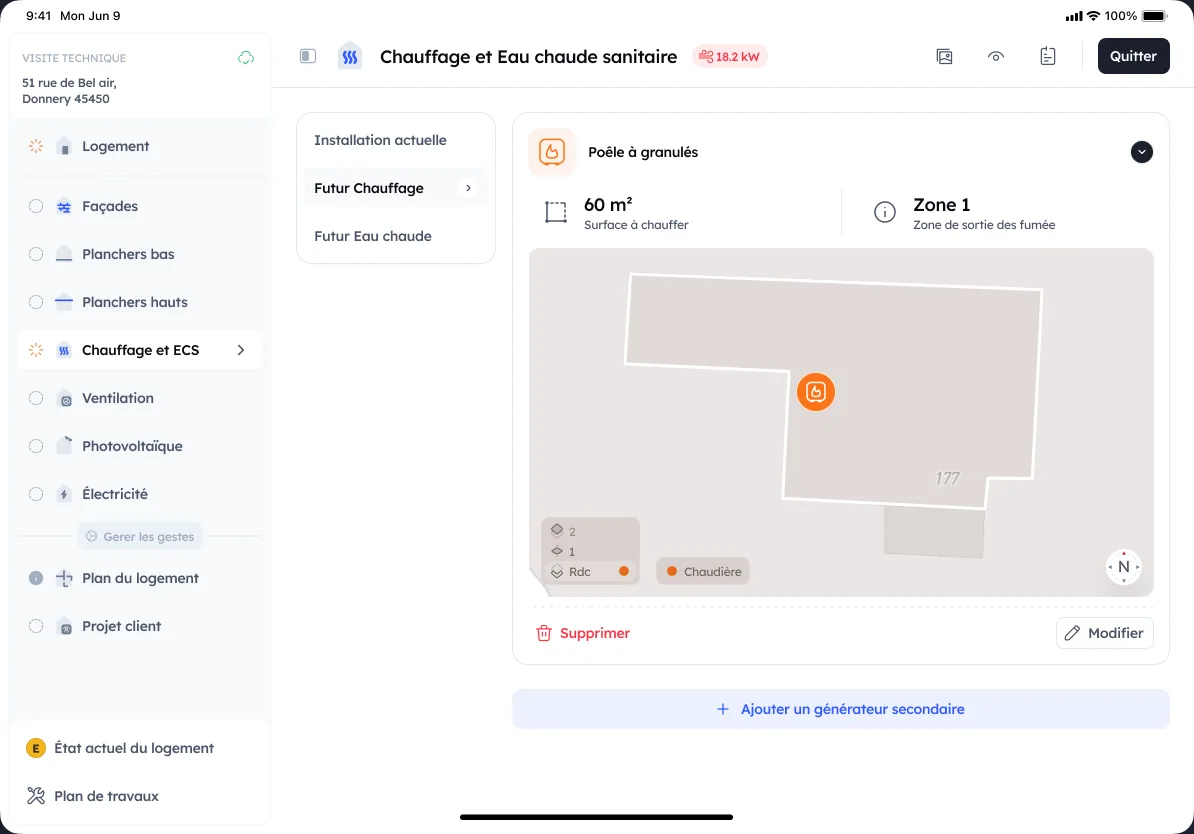
The designation is fixed when the appliance is chosen, as the stove project is documented step by step, position and flue outlet included.
Connection and safety clearances
The connection follows the manufacturer's manual and the fumisterie standard: components, seals, clamps, assembly direction. The clearance to combustible materials is the one carried by the flue designation, and it has to be held at floor penetrations and in the loft, including after insulation has been laid. Preserve sweeping access through an inspection point reachable without dismantling.
Commissioning checks
- Visual inspection of seals, fixings and wall and roof penetrations.
- Smoke test and depressurisation reading with ventilation and cooker hood running together.
- Draught and flue gas temperature recorded under stabilised conditions, entered in the report.
What you write on the quote and what you take on
Stating the output and its role
Put the rated output, the minimum output and an explicit statement of the appliance's role on the quote, comfort appliance or primary heat generator. That single line heads off the most common complaint in a high-performance home, the client who finds the room overheating and blames the installation. An output quoted without its role is an implied promise.
What the structural warranty covers, and what it does not
The flue, its penetrations, the airtightness of the envelope openings and the connection belong to the works. The fuel used, the way the fire is run and adherence to sweeping intervals belong to operation. That boundary is set in writing at handover, with the instructions handed over and signed, otherwise it gets argued in court.
Reservations and instructions handed over
Record every reservation on the state of the chimney stack, on sweeping access or on an insufficient air supply, even where the client refuses to act on it. Hand over written instructions on the minimum charge, the operating setting and the acceptable wood moisture content. An unresolved written reservation is worth more than a flawless file with none.