Understanding infrared heating: the principle and what your clients feel
Infrared radiation vs convection: what changes in the feeling of warmth
With infrared heating, you're mainly heating surfaces and people, not just the air. The feeling is close to sunshine through a window. The heat seems more direct, with less of the "warm air at the ceiling" effect in tall rooms. The result: your clients often describe immediate warmth, even when the room temperature hasn't risen much yet.
Responsiveness and comfort: when infrared really makes sense
Infrared makes sense for occasional or zone-based use. Bathroom, home office, workshop, a lightly occupied room. You switch it on, enjoy it, switch it off. It's also a good answer when you want to avoid overheating an entire home for the sake of a single space, with well-tuned targeted comfort.
Common pitfalls: misconceptions about electric heating and "gentle warmth"
No, "electric" doesn't automatically mean expensive. The cost depends on the price of electricity, insulation and controls. And "gentle warmth" isn't a technology, it's often just a marketing term. What matters is the placement of the panels, the output, and a reliable thermostat, for stable warmth with no sudden swings.
Choosing the right electric infrared heating panel for the job
Output, surface area, ceiling height: sizing without overconsuming
On site, infrared mainly heats people and the surfaces in its line of sight. To avoid overconsumption, start from a simplified heat-loss calculation. Surface area, insulation, corner rooms and especially ceiling height all matter. The higher the ceiling, the more you should plan for ceiling mounting or several well-distributed panels, rather than a single oversized unit. That calculation is done room by room from heat losses worked out to NF EN 12831-1, which gives the output to install without a pointless margin.
Formats and finishes: wall, ceiling, framed, glass... adapting to each room
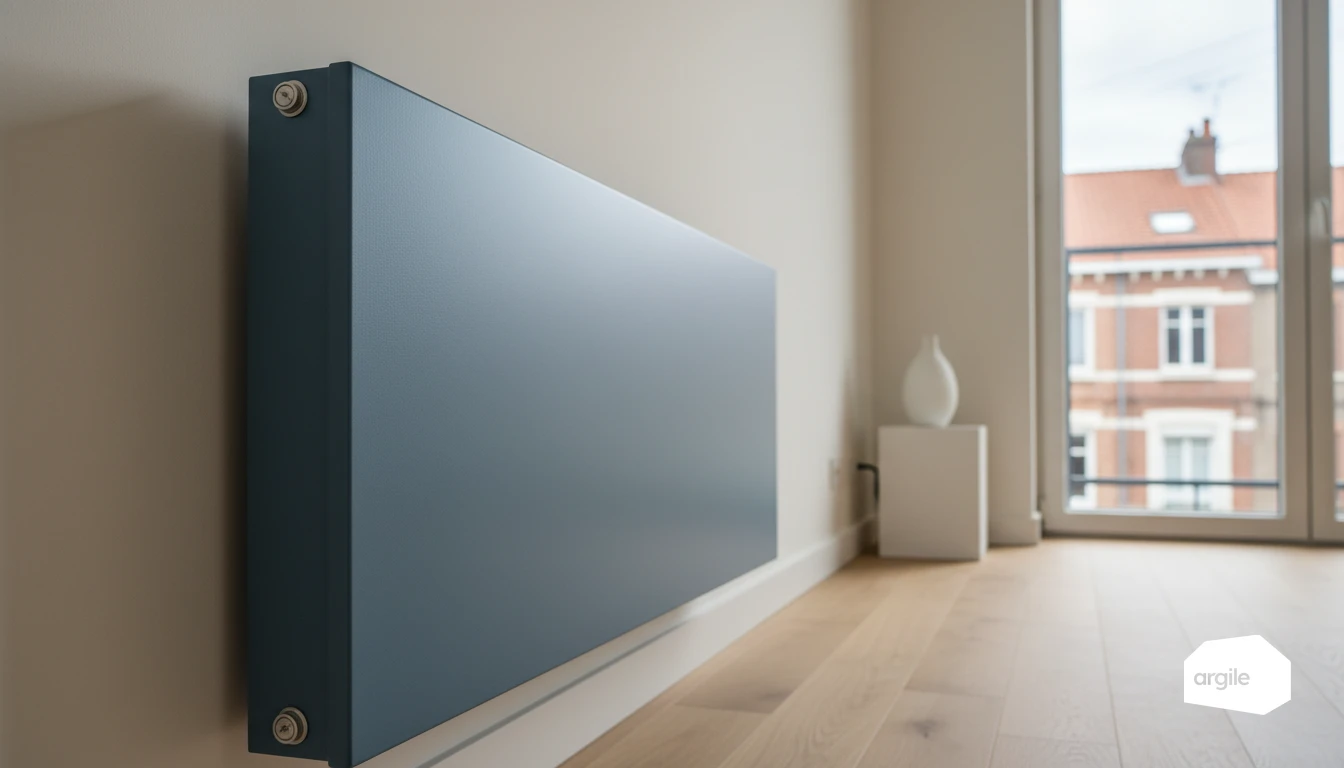
In renovation, the format is chosen like a light fitting. Wall-mounted for a bedroom, ceiling-mounted for a vaulted living room, framed or glass for a living space. Check the footprint, the radiation zone and the safety clearances around the panel.
Controls: thermostat, programming, zoning and everyday use
Good comfort comes from control. Aim for an electronic thermostat, weekly programming and room-by-room zoning. In 2026, favour "open window detection" features and fine adjustment, to limit unnecessary heating hours.
Installation and integration: succeeding with an infrared heating panel installation
Location and orientation: avoiding thermal shadow zones and obstacles
An infrared heating panel mainly heats what it "sees." Aim for a clear line of sight toward the living area. Avoid the back of a sofa, thick curtains, a bookcase, or a recess. On a wall, place it fairly high to better cover the room. On a ceiling, centre it over the occupied zone, not above a tall piece of furniture.
Electrical safety: dedicated circuit, protections, basic rules in renovation
Treat it like an electric radiator. Plan for a dedicated circuit sized to the output, with protection at the consumer unit and a suitable 30 mA RCD. Connections in an accessible junction box, correctly sized conductors, and compliance with the manufacturer's instructions. In a bathroom, check the safety zones and the required IP rating before installing anything.
Field tips: light renovation, damp rooms, rentals and aesthetic constraints
In a light renovation, a surface-mounted trunking channel avoids redoing the walls. In a damp room, choose a model with a suitable IP rating and keep it out of prohibited zones. In a rental, favour a reversible mounting and simple controls (a discreet wall thermostat) to avoid an "all or nothing" setup.
Performance, consumption and client messaging in 2026: talking honestly about infrared
Real consumption: what drives it (insulation, settings, intermittent occupancy)
The bill for infrared heating isn't decided by a product promise. It's decided by heat loss. Walls, loft, glazing, thermal bridges. Then by the fine-tuning of the thermostat, the programming, and switching off when away. A home occupied intermittently can get by with short boosts. Continuous occupancy in a poorly insulated home will push the kWh up.
Comparing use cases: electric infrared vs convector vs heat pump (depending on the need)
Infrared and convector heaters are both electric resistance heating. For the same heat demand, they consume roughly the same. Infrared can improve perceived comfort and let you lower the setpoint a little. A heat pump, on the other hand, delivers more heat than the electricity it consumes thanks to its COP. It becomes the logical choice as soon as you're heating for long periods and several rooms.
2026 talking points: immediate comfort, heated zones, and limits to state clearly
In 2026, the right message is light without dazzling. Yes, infrared gives immediate comfort and works well in heated zones. No, it's not a shield against poor insulation. State the limits clearly. Required output, placement, the risk of overconsumption as a primary heating system, and the value of pairing it with insulation and controls (see the importance of the building envelope).
Grants, compliance and best practices: what to check before proposing infrared
RGE certification and grants: when an electric infrared heating panel is (or isn't) eligible
In 2026, an infrared electric heating panel remains, in most cases, outside MaPrimeRénov' and outside the CEE sheets dedicated to heat generators, because it's resistive (Joule-effect) heating. Grants instead come into play for comprehensive renovation, insulation, ventilation, or controls. Before promising a grant, check the official list of eligible works, and if a CEE operation targets controls, the company must hold RGE certification in the right trade. To secure your process and avoid disputes, rely on the best practices for RGE and CEE.
Compatibility with a comprehensive renovation: insulation, ventilation, moisture management
Infrared can make sense as a top-up or in well-insulated rooms. But it doesn't compensate for an energy sieve. Priority goes to insulation, then to effective ventilation to limit condensation and mould. In a comprehensive renovation, watch for thermal bridges, humidity levels, and consistency with the existing system.
Quote checklist: questions to ask, points to measure, and realistic commitments
- Measurements: surface area, height, insulation, target temperature, power available at the consumer unit.
- Usage: living room, bathroom, intermittent use, zones to treat.
- Controls: thermostat, programming, room-by-room control.
- Commitments: consumption estimate, limits in extreme cold, warranties.