Understanding expanded cork: a natural insulator built for renovation
Origin, manufacturing, and composition: what makes expanded cork unique
Expanded cork comes from cork oak bark, harvested without felling the tree. The granules are heated. Cork's natural resin acts as a binder, with no added glue in the so-called pure versions. The result is dark brown panels or blocks, lightweight and easy to cut.
Key performance figures in 2026: thermal, acoustic, thermal mass, and durability
In 2026, it's chosen mainly for its balance. Its thermal conductivity is often quoted around 0.037 to 0.040 W/m.K depending on density. It also helps with noise and brings summer comfort thanks to its thermal mass. Well protected from UV and impacts, it retains its performance over time.
Strengths and limits on site: moisture, fire, rodents, dimensional stability
On site, it handles occasional moisture well and stays vapour-open, which limits condensation risk. As for fire, it burns and must be protected by a facing suited to the room. Rodents can nest in it if access points exist. Take care with edges and joints to maintain dimensional stability.
Choosing the right cork for your use case: walls, roofs, floors
Interior wall insulation: cork panels, useful thicknesses, and points to watch
On walls, cork is often installed as rigid or semi-rigid panels, glued and screwed. In renovation, aim for a useful thickness that matches the available space, without forgetting insulation returns at window reveals to limit thermal bridges. Check the substrate's flatness, and choose a complete system with a suitable facing. Cork tolerates moisture fluctuations well, but it doesn't replace a sound wall.
Roof and loft insulation: over-rafter, sloped roofs, insulation continuity
On roofs, cork works in over-rafter or sloped-roof applications, provided you take care of the continuity between roof sections, rafters, and specific points. The priority is airtightness on the interior side, then managing water vapour consistently with the assembly's composition. For over-rafter insulation, factor in load transfer and the roof underlay.
Floors and basements: comfort, sound reduction, and moisture management
Under screed or under parquet, cork improves walking comfort and acoustics. Choose a product with suitable compressive strength, especially under a floating screed. In basements, address moisture first. Insulation doesn't fix rising damp. Plan for a moisture barrier and proper ventilation. To go further on this point, see basement insulation via the ceiling or the walls.
Installing cork: methods, details, and mistakes to avoid
Glued, mechanically fixed, or loose-fill: choosing the right technique for the substrate
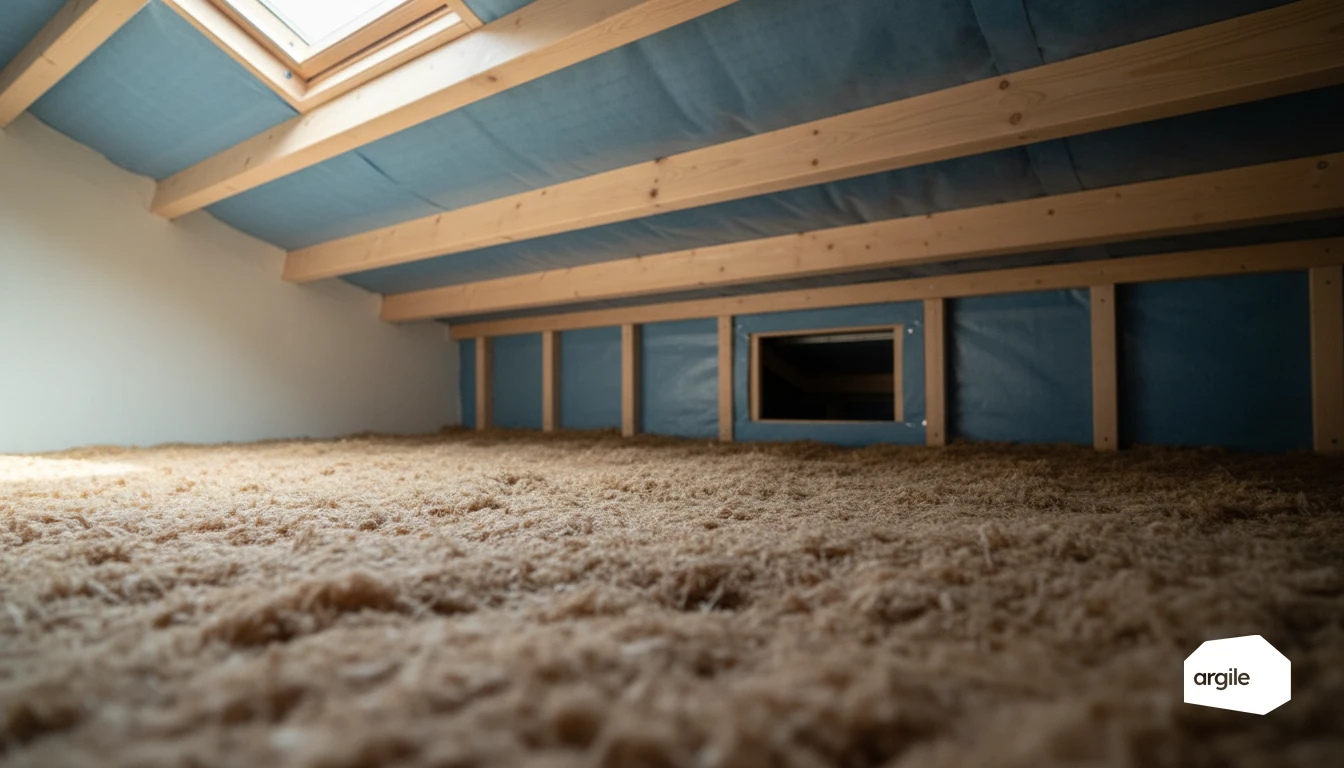
On a flat, sound substrate, cork panels are often glued indoors, with a compatible adhesive and careful marouflage. On facades or ceilings, prefer mechanical fixing when the substrate is uneven or exposed to wind. Loose-fill cork granules suit boxed-in areas, loft floors, or floors, as long as you can guarantee it stays in place and avoid settling.
Airtightness and vapour barriers: getting water vapour right without mistakes
Cork is vapour-permeable, so don't block vapour at random. In internal insulation, treat airtightness on the warm side with membranes and tapes, then choose a vapour barrier or a smart vapour-variable membrane depending on the wall, moisture level, and ventilation. A classic mistake is sealing a damp old wall between two airtight layers.
Treating thermal bridges: reveals, junctions, and specific points in renovation
Take care of specific points. Return insulation into window reveals, align the junctions between wall, floor, and roof, and limit breaks caused by rails and fasteners. Around penetrations, sleeve and tape to maintain continuity of insulation and airtightness.
Compatibility with 2026 aid schemes: what the tradesperson needs to check
MaPrimeRénov' 2026: eligibility criteria, thermal resistance, and performance requirements
Check the household's and the home's eligibility conditions, then the performance thresholds required for the measure (thermal resistance, efficiency). Ask for the technical data sheets as early as the quote stage.
CEE 2026: standardized operation sheets, supporting documents, and common checkpoints
Identify the matching CEE standardized sheet, check the technical criteria, then prepare the expected proof (certificate, invoice, product references, photos).
RGE certification and documents to provide: quote, technical data sheets, DTA/technical opinions when needed
Make sure the RGE certification covers the job. Attach a complete quote, the technical data sheets, and, if needed, a DTA or a technical opinion.
Selling points on site: sell cork without overselling it
Concrete benefits for the client: winter comfort, summer comfort, and acoustics
Cork genuinely insulates. In winter, it limits cold walls and drafty sensations. In summer, its density helps with thermal phase shift, keeping the home more stable, with real summer comfort. A bonus that's often visible from the first days is improved acoustics, especially against airborne noise and the sounding-box effect.
Comparing cork to other insulation materials: strengths, limits, and cases to avoid
- Strengths. Durable material, low sensitivity to moisture, good acoustic behaviour.
- Limits. For equivalent thermal performance, it can require more thickness and it's often more expensive.
- To avoid. If you're constrained by limited thickness, a tight budget, or specific fire requirements, it's better to validate the choice case by case.
Frequently asked questions in renovation: smell, dust, thicknesses, finishes, and price
Smell. A "woody" smell is possible at first and fades over time. Dust. Like any insulation, cutting it generates dust, so use a mask and dust extraction. Thicknesses and finishes. Panels on facades under render or cladding, as interior lining, or under screed depending on the system. Price. Expect a price per m² that's higher, to weigh against longevity.