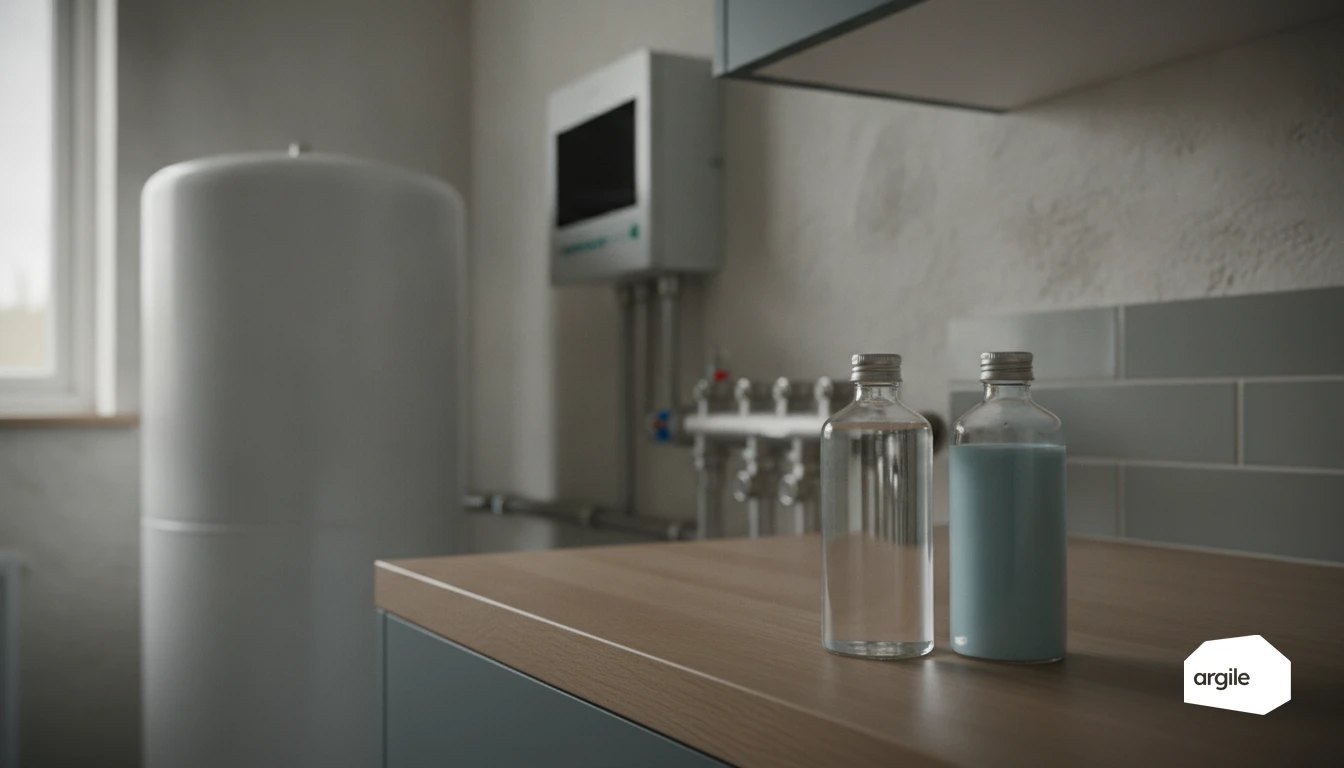
Glycol water becomes necessary as soon as part of the circuit can drop below 0°C: solar primary circuit, ground loop, external pipe runs or passage through unheated spaces. Usual concentrations run from 20 to 40% propylene glycol, giving protection of the order of -15°C at 30% and -25°C at 40%, to be confirmed on the manufacturer's curve. The price of glycol water is an efficiency loss of 5 to 15% and a higher viscosity when cold, which collapses the flow rate as soon as the mix is overdosed. The concentration is checked with a refractometer after filling and after every top-up, because a top-up with clear water dilutes the mix and raises the freezing point with nothing to signal it.
Understanding the role of the heat transfer fluid in your installations
What a heat transfer fluid does: heat transport and overall performance
The heat transfer fluid is the "messenger" that picks up calories in a heat exchanger, circulates through the circuit, then releases them to the emitters. Its ability to carry heat, its stability and its freezing point all affect overall performance and circulator power consumption.
Circuits involved on site: heating, solar, heat pump (depending on configuration)
In hydraulic heating, it's often water, sometimes a water-glycol mix when part of the network can drop below 0°C. In thermal solar, the primary circuit almost always uses an antifreeze mix, with its own concentration limits and its service-visit inspection grid. On a heat pump, the main topic is refrigerant, but some setups have a water or water-glycol circuit on the emitter side, or even a "brine" geothermal loop depending on the setup.
Points to watch on site: viscosity, purging, corrosion and material compatibility
On site, the right fluid depends as much on the technical datasheet as on the actual handling. Keep these key points in mind:
- Viscosity. The "thicker" it is when cold, the more flow drops.
- Purging. Trapped air blocks heat exchange and speeds up oxidation.
- Corrosion. Check pH, inhibitors and concentration, avoid mixing products.
- Compatibility. Watch out for seals, aluminium, copper, and maximum temperatures.
Pure water: when this fluid is the right choice
Advantages: simplicity, cost, ease of filling and maintenance
Water remains the simplest fluid to manage. It requires no dosing, is available everywhere, and its heat-carrying capacity is excellent. On budget, you avoid buying additives and periodically replacing a glycol-water mix. Filling and purging are done with standard tools, which limits repeat trips to the job site.
Limits: freeze risk, scale and oxidation depending on water quality
Points to watch. At 0°C, water freezes. In an exposed circuit, this can crack the exchanger, pipes or circulators. Depending on hardness, scale can foul components and reduce heat exchange. Water that's overly oxygenated or poorly treated also promotes oxidation and sludge.
Common use cases: circuits protected from frost and heated technical rooms
This choice works well in a closed circuit installed in a heated volume, or when sensitive parts are protected from frost. Also a good fit for technical rooms kept frost-free and short networks that are easy to drain or flush during maintenance.
Glycol water: managing glycol to secure the fluid in difficult conditions
Why add glycol: frost protection and operating safety
In an outdoor circuit or an unheated zone, a temperature drop can block the heat transfer fluid. Adding glycol lowers the crystallisation point, limits freeze risk and protects exchangers, piping and collectors. This is common on geothermal-loop heat pumps, rooftop networks or long runs.
The trade-offs: performance loss, higher circulator consumption and fluid ageing
Glycol makes the mix more viscous and less effective at carrying heat. The result is a drop in efficiency and the need for a more powerful circulator, meaning more electricity. Over time, chemical ageing can acidify the mix and speed up corrosion and deposits. Annual monitoring and checking pH and inhibitor levels avoid unpleasant surprises.
Choosing the right glycol ratio: a simple method based on the expected minimum temperature
Start from the actual minimum temperature possible on site, with the municipality's outdoor design temperature as a first benchmark, add a safety margin, then choose the percentage using the manufacturer's chart (propylene glycol recommended in residential settings). Common benchmarks: around 30% for protection down to about -15°C, 35% toward -20°C. Avoid overdosing, it's like insulating with too thick a jacket: you're protected, but you lose energy comfort.
How to choose between glycol water and pure water for your job site in 2026
The right choice based on frost exposure: outdoors, lofts, unheated network sections
When part of the network runs outdoors, through a cold loft or an unheated technical room, freeze risk becomes the number one criterion. On these sections, a properly dosed glycol water mix protects the installation. In a heated volume with a short network, pure water often remains simpler and more efficient, provided there is genuine frost protection (insulation, pipe lagging, temperature maintenance).
Accounting for 2026 obligations and practices: maintenance, traceability, manufacturer recommendations
In 2026, what makes the difference is maintenance tracking. Record the fluid type, concentration, fill date and brand in the job file. Regularly check pH and corrosion inhibitor, and follow the manufacturer's instructions. Some warranties require a specific antifreeze, or advise against glycol on certain exchangers.
Weighing the overall cost: fluid purchase, maintenance, breakdown risk and callbacks
On overall cost, pure water wins on purchase price, but a freeze mistake can quickly cost a circulator, an exchanger or a mid-winter callout. Glycol costs more and requires checks and top-ups. On exposed job sites, it mainly reduces breakdown risk and callbacks.
Implementation: best practices for a reliable fluid over time
Filling, purging and pressurising: avoiding air and concentration errors
Fill slowly, with the circuit cold, using a fluid prepared according to the instructions. If you're using glycol water, measure the concentration with a refractometer before and after filling. Purge at the high points, run the circulator in sequences, then purge again. Finish by pressurising to the planned value to avoid cavitation and corrosion.
Regular checks: pH, freezing point, appearance and replacing at the right time
An annual check is enough in many cases. Check the pH test, freezing point, colour and presence of sludge. Drift in the freezing point or a cloudy fluid often signals lost inhibitors or contamination. Replace when values fall outside the manufacturer's ranges, after overheating, or after several top-ups.
Managing incompatibilities: aluminium, seals, exchangers and top-up products
Before adding anything, validate material compatibility. Some aluminium alloys, seals and exchangers don't tolerate mixing brands, nor "miracle" additives. Avoid topping up at random. Flush if you change fluid type, and only use top-up products approved by the manufacturer.