The augmented tradesperson in 2026: what’s really changing on energy-retrofit job sites
In 2026, the workload keeps growing. Certification requirements are rising, and clients want proof, short lead times and funding that actually lands. The result: you spend more time justifying your work than doing it. Whole-house retrofit is becoming a real opportunity, because it locks in performance and keeps the client's remaining cost under control. But only if you can keep pace with coordinating work packages, phasing and inspections. The friction always comes back to the same steps: incomplete technical visits, site surveys that need redoing, quotes with too many moving parts, funding calculations, missing documents, endless back-and-forth. The challenge fits in one sentence: save time without losing quality, and close deals faster.
- Site visits and surveys, often redone.
- Quoting and scenarios, with variants.
- Grants and paperwork, a source of delays.
From rough guesswork to a fast, clear energy diagnostic
When a client is torn between “a small fix” and a more coherent renovation, a fast energy diagnostic becomes your compass. In under 5 minutes, you can estimate the home’s performance, spot the biggest sources of loss, and frame the discussion around facts rather than impressions. You can then simulate several renovation scenarios without starting from scratch. You compare, for example, insulation, ventilation and heating, while keeping the same underlying data and adjusting only the variables. For the client, it’s easier to understand: you show orders of magnitude, the impact on energy ratings and emissions, and explain what really changes day to day.
- Comparable scenarios, costed and easy to explain.
- EPC bands and consumption made clear for fast decisions.
Securing technical feasibility before quoting: avoiding bad surprises
Address-based feasibility analysis
Before quoting, an address-based analysis helps you spot what's likely to cause problems without waiting for the site visit. You cross-reference the available data (building type, floor area, exposure, planning constraints, risks, neighbourhood) to anticipate an overly noisy heat pump, ductwork that can't be routed, or insulation that would affect ventilation. You then prioritise the work based on the building and how it's used: treat the envelope first, then heating, avoiding oversized equipment. Finally, to cut down on back-and-forth before a preliminary quote, you check job-site access, equipment locations (outdoor unit, hot water cylinder), sensitive points (damp, loft, consumer unit), and registration and funding eligibility. That information comes together from the address alone, from the plot to the year of construction and the EPC, before the visit even happens.
Technical visit and design: gaining precision without adding to your day
Structuring the on-site visit
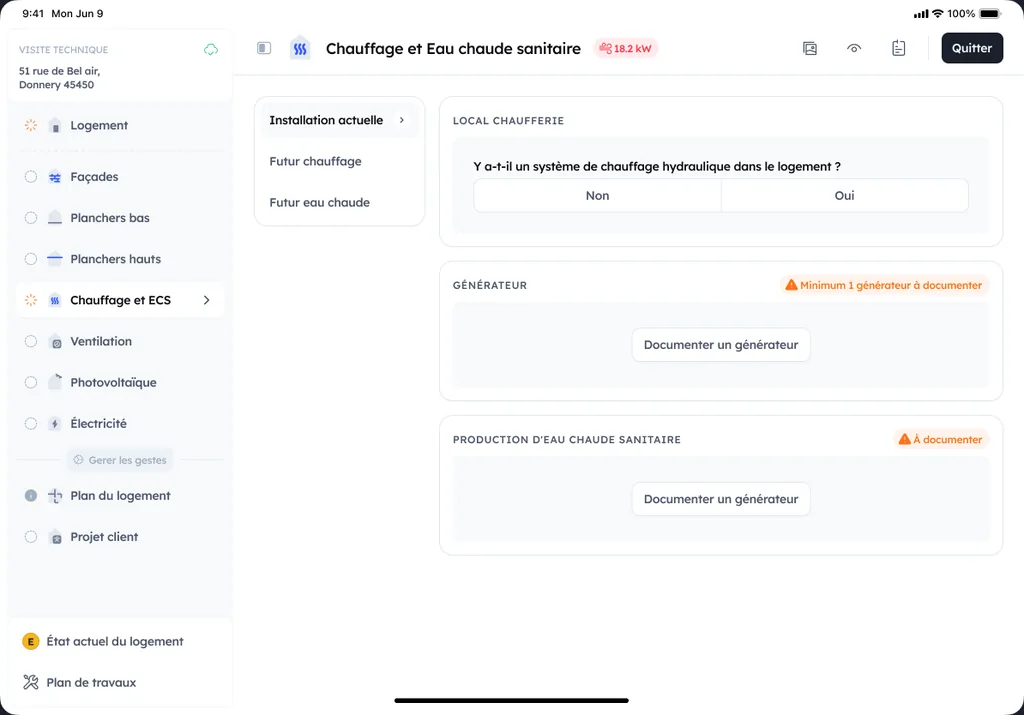
On site, focus on what’s useful. Record the surfaces that can be insulated, the condition of the substrates, any unusual points, the existing ventilation, access, and safety constraints. Take dated photos of equipment labels, ductwork and pipe runs, the loft, electrical panels and façades. Also keep proof of measurements, sketch plans and client sign-offs. With Argile, you centralize all of this and cut down on things falling through the cracks. The guided site-visit flow, one path per measure records those readings, photos and sketches straight into the file.
3D reconstruction and coordination
- 3D reconstruction to capture volumes, heights, openings and potential clashes.
- A shared model for aligning insulation, heat pump, ventilation and electrics without redoing three site visits.
- Clear sharing with other trades, fewer back-and-forths and job-site surprises.
In this logic, the 3D model and the supporting evidence turn a whole-house renovation into a better-managed, more relaxed job site. For real-world examples, take a look at successful renovations with Argile.
Quotes and financial aid: quoting faster while staying rigorous
Preliminary costing and a detailed quote
With Argile, you set up a simple framework to pre-cost the job and then produce a detailed quote with no gaps. Standardized line items, quantities, supplies, labor, options, everything is structured to reduce oversights and keep the same logic from one job to the next.
Making grants easy to understand
The quote can include the funding with dedicated line items and clear assumptions, so the client understands what's the price, what's the estimated funding, and what will be left to pay. You gain clarity without weighing down your documents. To go further on this point, find out how to simplify the funding calculation day to day.
Remaining cost and decision-making
- Present an estimated remaining cost and a conservative scenario.
- Talk about profitability in euros, without promising a guaranteed grant amount or savings.
Paperwork and compliance: keeping up the pace without sacrificing quality
Centralize, delegate, steer
Centralising quotes, invoices, instructions, dated photos and signed certificates is your safety net in the event of an inspection. A single file per job, with versions and correspondence, avoids the inconsistencies (address, company number, product reference) that hold up a funding file. On the funding side, you can delegate collecting client documents, filing and follow-ups. You keep control over which measure specification applies, the technical specifications, compliance and final sign-off on the documents. To measure the gain, track 3 indicators: administrative time per file, the rate of complete files on first submission, quote signature rate. This is where the augmented tradesperson earns their keep.
- Average time to build a file (min)
- Completeness rate on first submission (%)
- Signature rate after sending (%)
Embedding the "augmented tradesperson" in your organization: methods and best practices
From first contact to signed quote
To build a reliable process, set up a simple workflow: qualifying the request, site visit, surveys, choosing a scenario, quoting, applying for funding if needed, then signature. For large-scale retrofits, the process is more structured, with a retrofit coordinator and an assessment upfront before validation and quoting. With Argile, you standardise the information you collect and avoid quotes that are put together blind.
- On site, you collect the useful data: photos, constraints, access, ductwork.
- In the office, you prepare variants and sizing: heat pump, insulation, ventilation.
- Administration secures the paperwork, the registrations, the declarations and the follow-ups.
- Common cases. Heat pumps with settings and emitters. Insulation with continuity and thermal bridges. Dual-flow ventilation depending on the building. Whole-house renovation in coherent work packages.