Understanding the finned tube and its role as an emitter in renovation
Operating principle: tube, fins and heat transfer
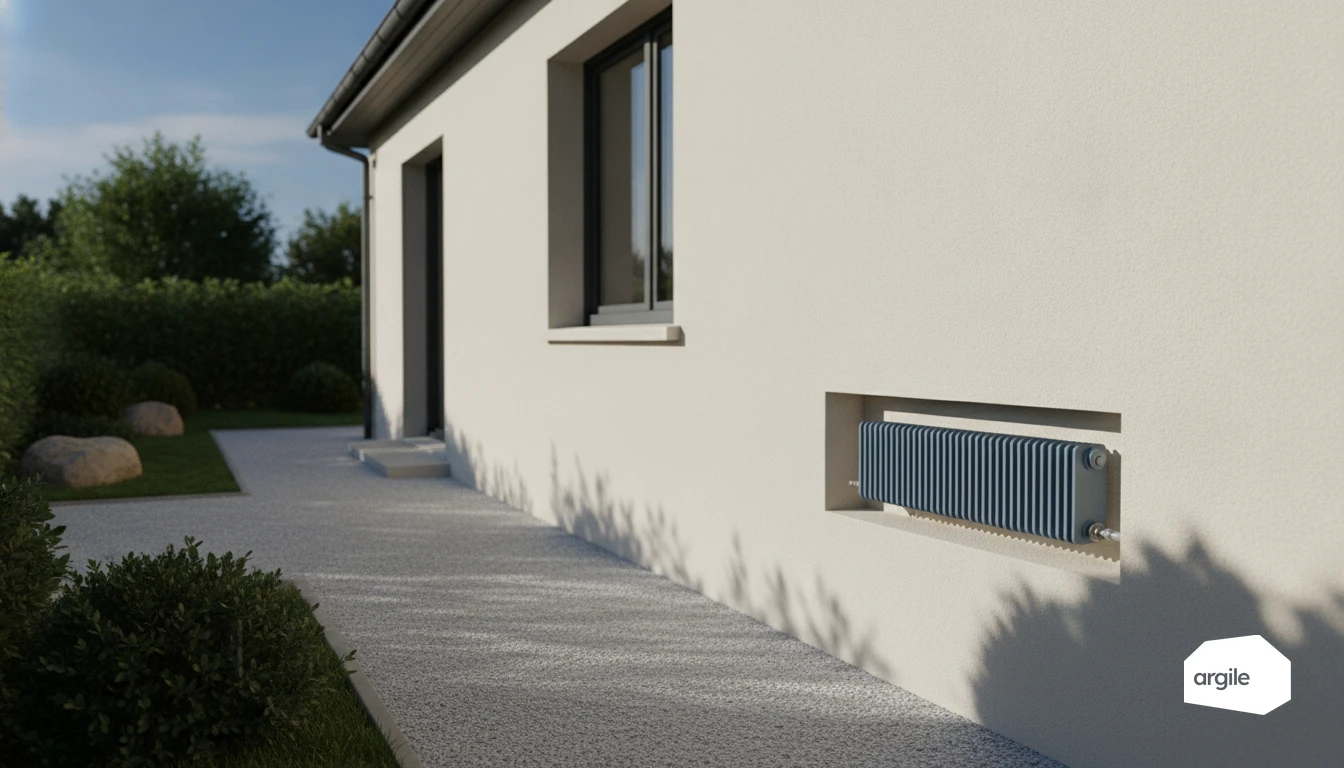
The finned tube is a hydraulic emitter. Hot water circulates in a metal tube. The fins increase the exchange surface. Heat spreads mainly by natural convection, with a little radiation. The result is a fast rise in temperature, useful in renovation when targeting lower flow temperatures with a heat pump.
Which buildings and workshops this emitter suits best
It suits workshops, garages, warehouses, ancillary rooms or extensions where a linear spread along a wall is needed. It handles long runs, and can be installed low or high depending on traffic. In an older, poorly insulated building, it helps cover significant heat losses without multiplying the number of units.
What the finned tube offers compared with radiators and unit heaters
Compared with conventional water radiators, it is lighter and more responsive. It delivers steady output with low thermal mass, which suits modulating heat generators well. Compared with unit heaters, it avoids the draught, noise and dust stirring. You gain in comfort and maintenance, especially in occupied spaces.
Choosing the right finned tube for your site constraints
Steel, copper, stainless steel: which tube for which environment (humidity, dust, corrosion)?
In a dry, non-aggressive space, a steel tube remains the simplest choice. In a humid or saline environment, stainless steel, often in 316L grade, holds up better over time. Copper offers very good conductivity, practical on hot-water networks, but it requires monitoring metal pairings and avoiding genuinely corrosive atmospheres.
Fin density and geometry: aiming for the right balance between output and footprint
The closer together the fins, the greater the exchange for the same length. But on a dusty site, this fouls quickly and output drops. Aim for a fin spacing that stays cleanable, and a robust geometry, with easy access for maintenance. When space is tight, higher density can compensate, provided cleaning is planned for.
Hot water, steam, low temperature: compatibility with your existing network
First check the temperatures and pressures. At low temperature, more exchange surface is often needed to maintain output, so a longer or more heavily finned tube. With steam, plan ahead for expansion and condensate drainage, with the correct slope and suitable fittings. On the connection side, keep compatible materials and consistent anti-corrosion protection: if you need to go further on this point, see our article on protecting the network against corrosion.
Sizing and layout: avoiding costly mistakes
Power calculation: heat losses, ceiling height and cold zones
A well-sized radiator starts from actual heat losses, not a rule of thumb per m², and heat losses are broken down zone by zone in a report compliant with EN 12831-1. Ceiling height matters, because you're heating a volume. Identify cold zones (gable walls, glazed bays, entrances) and adjust room by room. Too tight, and you push up the water temperature, with the bill following. Too generous, and you lose comfort and control precision. To go further, rely on a heat-loss-based sizing method.
Placement and spread: walls, under windows, perimeter, mechanical protection
Place emitters on external walls or under windows to counter the cold-wall effect and encourage convection. Leave air space around them, avoid furniture pushed up against them. Perimeter installation helps even out the temperature. In traffic areas, plan for mechanical protection to avoid impacts and leaks.
Connections, venting, balancing: points of attention on long runs
On long runs, a suitably sized tube diameter limits pressure losses. Reduce the number of bends, take care at high points, vent after filling and check the pressure. Finish with balancing, otherwise the first radiators take everything and the last ones stay lukewarm.
Installation, maintenance and durability of the finned tube in an industrial setting
Fixings, expansion and vibration: securing the emitter over time
A finned tube is installed as an emitter that lives and moves. Plan for rigid supports and sliding points to maintain expansion clearance without twisting the network. In a vibrating area, add anti-vibration mounts, suitable clamps, and avoid spans that are too long. Regularly check tightening, alignment and the absence of rubbing on the fins.
Fin fouling: cleaning, access and maintaining performance
Dust, fibres and oily mist lodge between the fins. The result is reduced heat exchange and greater pressure losses. Plan for direct access for air blowing, gentle brushing or low-pressure washing, without crushing the fins. Adjust the frequency to the actual fouling level on site.
Safety and compliance: surface temperatures, protection and site requirements
A tube can present hot surfaces or sharp edges. Install guards, casings or insulation where there's a risk of contact, and keep sufficient airflow clearance. Apply site rules (ATEX, lock-out, PPE) and the requirements linked to pressure equipment where applicable.
2026 aid and requirements: integrating the finned tube into an energy renovation project
When changing the emitter can be included in a heating/production package
When you replace a boiler or install a heat pump, the emitter is part of the equation. A finned tube can be included in the same package if sizing shows adequate output at the target water temperature, with balancing and controls. On the aid side, MaPrimeRénov' and CEE mainly look at the heat generator and overall performance. Changing emitters remains relevant when it secures low-temperature operation.
RGE and paperwork: documents to prepare to secure your jobs in 2026
In 2026, the rule stays simple. Without RGE certification for the relevant trade, no aid. To avoid file rejections, keep a clean record.
- Detailed quote and invoice (brands, references, areas, output, controls).
- Technical data sheets for the emitters and the heat generator, with operating temperatures.
- Signed CEE sworn statement, plus before/after photos if requested.
- Commissioning note. Settings, balancing, instructions.
Concrete cases: workshop renovation with a heat pump or boiler and matching emitters
A poorly insulated workshop needing responsiveness. With an air/water heat pump, well-distributed finned tubes and a stable weather compensation curve avoid overheating. The path runs from the technical visit to the required output, then to equipment picked from an up-to-date catalogue. Another case: a gas condensing boiler as a replacement, with the same emitters but revised valves and controls. In both, the audit or calculation note justifies the choice. And you secure the aid.