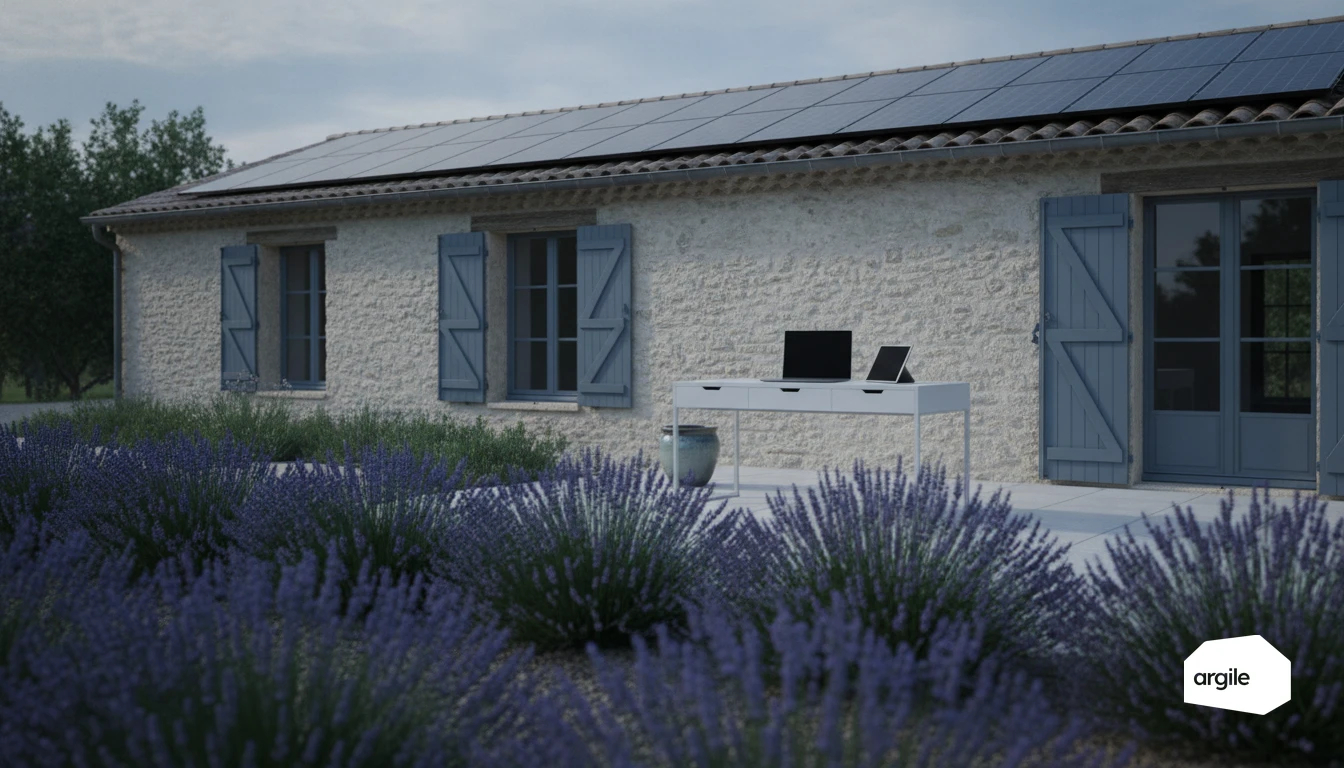
Understanding integrated solar roofing: principles, uses and limits on site
Difference between integrated solar roofing (in-roof) and on-roof mounting: what you're really selling the client
With an in-roof system, the solar roofing replaces part of the covering. The system becomes a roofing element, with an aesthetic promise and sometimes a thickness gain. With on-roof mounting, the modules are installed above the tiles or slate. You're mainly selling a simpler, more reversible installation, and one that's often more tolerant of small irregularities in the substrate.
Compatibility with tiles, slate and substrates: slope, orientation, shaded areas
Compatibility first depends on the mounting system and the manufacturer's technical documents. Check the admissible slope, the continuity of the substrate, and the specific points. On the production side, a favourable orientation and the absence of nearby shading make the difference, even with careful installation.
Points of attention for waterproofing and ventilation: roofing underlay, air gap, verges and ridge
With an in-roof system, the priority is durable waterproofing. Take care with the roofing underlay, flashings, verges and ridge. Keep a consistent air gap to limit overheating and moisture. On site, a poorly treated detail shows up quickly, like a leak that always finds the shortest path.
Choosing between PV tiles and solar slates: decision criteria for a reliable installation
Aesthetic result and local constraints: ABF, local zoning plan and protected areas (common cases in 2026)
Before talking technical details, check the local rules. In a protected area, the ABF's approval can steer the choice toward a more discreet solar slate, or impose a specific colour and layout. Outside heritage zones, the local zoning plan (PLU) can still govern the appearance of solar roofing.
Power, output and usable area: sizing without overpromising
For the same area, the power mainly depends on the share that's actually active and on shading. A PV tile involves more joints and non-productive zones. A solar slate can optimise the layout, but requires a well-flat covering. Aim for realistic power, then adjust based on orientation, under-roof ventilation and losses, starting from output estimated by orientation and tilt.
Availability, accessories and maintenance: planning for parts, the array and replacements
The right choice is also one that can be maintained. Check the availability of hooks, verge pieces, ridge pieces, underlays and waterproofing kits. Require a clear parts list and compatible components to replace a single unit without redoing an entire slope.
Installing solar roofing: method, key steps and mistakes to avoid
Surveys and layout: array, spacing, cable runs and technical zones
Before installing solar roofing, start with a clean survey. Measure the rafters, locate the rafters and battens, then lay out an array that respects the fixing spacing. Reserve the cable runs, the inverter or micro-inverter zone, and the routes to the panel right away. A common mistake: laying out the array "by feel" and ending up with unnecessary cuts, cast shadows or visible cables.
Treating specific points: valleys, chimneys, roof windows, verges and eaves
Specific points determine the waterproofing. Treat them like a conventional roof covering. Flashings around chimneys and roof windows, upstands at verges, drainage at the eaves. Keep a safety distance and maintenance access. Avoid piercing an existing flashing or blocking roof ventilation.
Checks before energising: tightening, continuity, waterproofing and evidence photos
Before energising the system, check the torque on fixings, earth continuity, polarity and string insulation. Check waterproofing under simulated rain if possible. Take dated photos of the fixings, cable runs and labelling. These serve as evidence at handover and for after-sales service.
Safety, standards and insurance: securing your solar roofing job in 2026
DTU and best practice in roofing: what applies to PV tiles and slate
On solar roofing, you start from the roofing DTUs suited to the substrate. Series 40.2 for tiles, series 40.1 for slate. A PV tile or an integrated system must also comply with the manufacturer's requirements and, where applicable, a Technical Approval or DTA. Key points: fixings, ventilation, water drainage, wind and snow zones.
Electrical and fire safety: DC/AC protection, routing, emergency shutoff and labelling
On the electrical side, align with UTE C 15-712-1 and NF C 15-100. Plan for DC and AC protection, a surge arrester if required, and clean cable routing. Limit DC loops, avoid chafing, and protect penetrations. The emergency shutoff must be accessible, clearly identified, with durable labelling at the panel and as close as possible to the PV array.
Warranties, ten-year insurance and job file: traceability, manuals, handover report
Before starting work, check that your ten-year insurance covers both roofing and photovoltaic. Then your job file must hold up. Plans, diagrams, product references, serial numbers, manuals, required certificates (including electrical safety depending on the case), then signed handover and commissioning reports. This is your best safeguard in case of a dispute.
Grants and client procedures: how solar roofing fits into 2026 schemes
Feed-in tariff and VAT: the useful benchmarks to explain
For solar roofing with self-consumption and sale of the surplus, your clients benefit from a purchase obligation contract, but there's no longer an investment grant. Since the order of 5 June 2026, support has been limited to a single feed-in tariff of 1.1 c€/kWh (installations with P+Q ≤ 100 kWp), indexed by 2% per year for the whole contract duration. On the tax side, VAT mainly depends on the installed power and the type of building. For a home over 2 years old, a reduced rate may apply in certain cases, otherwise the standard rate applies.
CEE, MaPrimeRénov' and full renovation: cases where solar roofing combines (or doesn't)
In 2026, CEE and MaPrimeRénov' mainly target insulation, ventilation and heating. Photovoltaic is often outside their scope. However, solar roofing can be added onto a full renovation to lower the bill and secure the energy budget, without replacing the funded measures.
Connection and declarations: Consuel, Enedis, town hall, and timelines to anticipate
Warn the client early. Prior declaration to the town hall, then an Enedis application. If feeding into the grid, a Consuel certificate and a connection agreement. Then a purchase contract and commissioning. Timelines vary by grid and season. It's best to plan for several weeks, sometimes a few months.