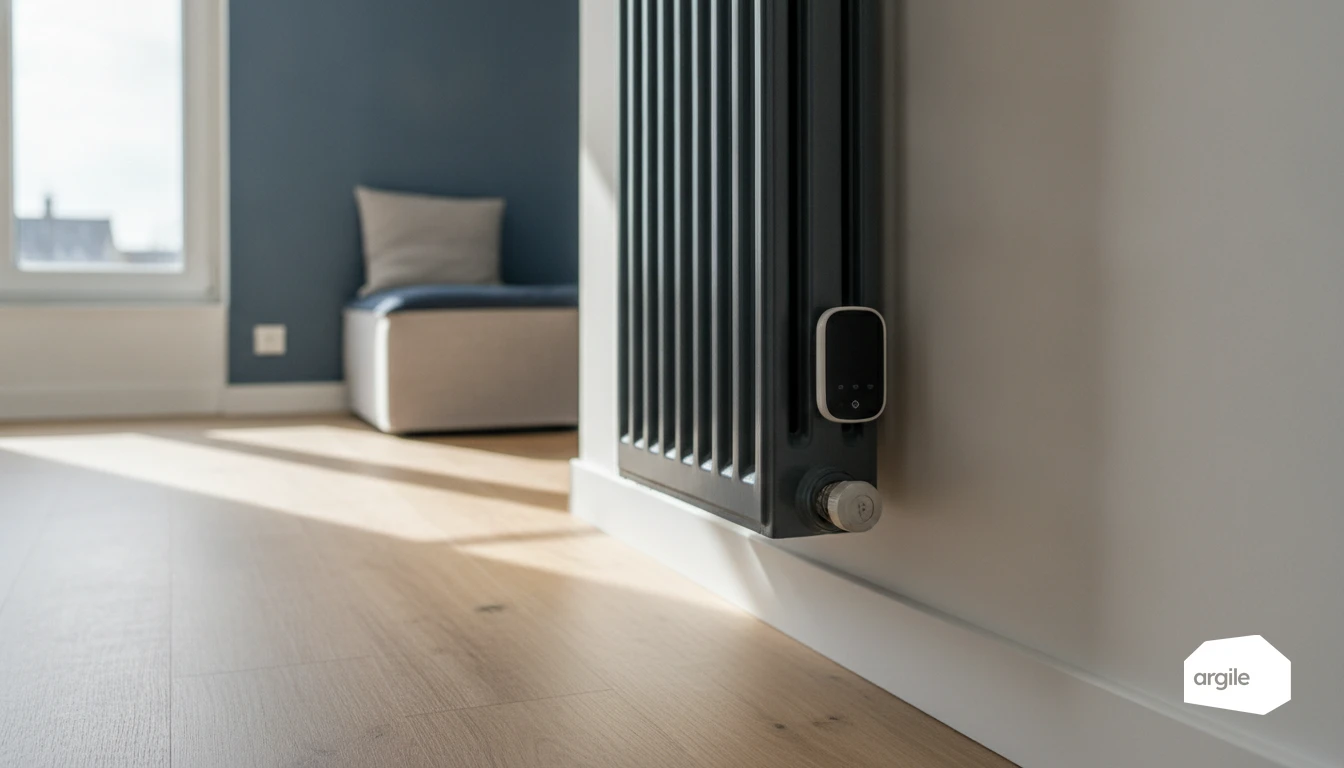
The programmable thermostatic head is no longer just a comfort argument, it is the cheapest way to meet an obligation. The French decree of 20 July 2020 requires an automatic temperature control system room by room, or by heated zone where that is not feasible, and in existing buildings the requirement is triggered as soon as work to install or replace a heat generator is committed, from one year after the decree was published. The only way out is a study showing that installation cannot be achieved with a payback of under six years, and that is a study you produce, not a claim you make. On a boiler or heat pump replacement, the question is therefore not whether you fit heads, but how you evidence it.
| What the 2020 decree sets out | Content |
|---|---|
| Subject of the obligation | Automatic temperature control system |
| Level required | Room by room, or by heated zone as a fallback |
| Existing buildings | Triggered by installing or replacing a heat generator |
| Starting point for existing stock | Work committed one year after publication |
| Only exemption | Study showing payback over six years |
| Evidence to keep | The study, failing which the installation is treated as required |
Understanding the programmable thermostatic radiator valve and room-by-room control
Thermostatic: operating principle and the role of the head
A thermostatic valve adjusts the radiator's water flow according to the temperature measured nearby. The head contains a sensor (often wax or liquid based) that expands when it gets warmer. It then pushes the pin and gradually closes the valve. The result is that the room stabilises without cutting off the heating completely.
Programmable: modes, time slots and limits depending on the radiator
A programmable head adds automatic setpoints. You define time slots and modes, for example Comfort, Reduced, Frost protection. Be careful, precision depends on the radiator. A model with high thermal mass or poor clearance reacts more slowly. And if the radiator is hidden behind furniture or curtains, the reading is thrown off.
Fine-tuned control: comfort, temperature stability and realistic savings
Room-by-room control avoids heating everywhere the same way. You keep bedrooms cooler and living rooms more stable. The gain mainly comes from consistency, not a miracle. With coherent setpoints and good insulation, you can aim for realistic savings while reducing overheating.
Choosing the right thermostatic equipment for the existing installation
Compatibilities to check: valve type, threading, two-pipe/single-pipe systems
Before replacing a thermostatic head, check the valve body already in place. The key point is the connection. Some models use M30x1.5, others use proprietary standards and require an adapter ring. Also identify the direction of flow, especially on single-pipe systems, where an unsuitable valve can unbalance the whole loop.
Programmable and connected: useful criteria on site (battery life, range, display)
On site, favour equipment that's simple to install and explain. Look at the actual battery life, the radio range in a partitioned home, and a display that's readable without having to crouch in front of the radiator. If the system is connected, check compatibility with the gateway and the number of zones it can manage. The model you settle on then goes into the quote by picking it from an up to date catalogue, with checked references and specifications.
Common pitfalls: radiators under a shelf, curtains, alcoves and false readings
A radiator under a shelf or behind a curtain creates a microclimate. The head reads too hot and cuts off too early, resulting in a lukewarm room and complaints. In an alcove, a remote sensor or a head with an external probe limits false readings. Also think about draughts near a door or window.
Installation and commissioning: achieving effective control from the first visit
Preparing the network: bleeding, pressure, balancing and flow rate
Before installing anything, secure a stable flow rate. Bleed the air, check the cold pressure, then flush out sludge if the network is dirty. Then balance each emitter with the lockshield valves to avoid one radiator being over-served and another staying lukewarm. Check the circulator and confirm that flow rates stay consistent once all the valves are open. To go further on this point, see balancing each emitter.
Fitting the body and the thermostatic head: direction, sealing, torque and accessibility
Follow the direction of flow indicated by the arrow on the body. Take care with sealing, using the seal suited to the connection, without forcing the pipework. Tighten to the torque recommended by the manufacturer. Fit the thermostatic head with good accessibility, ideally horizontally, away from curtains or casing that would distort the reading.
Programmable settings: setpoints, night setback and anti-seize function
Start with realistic, stable setpoints, then adjust after 24 to 48 hours. Limit the night setback to avoid overly aggressive reheating. Activate the anti-seize function if it exists and test full opening and closing. Note down the settings, and explain to the client how to make corrections without upsetting the balancing.
Troubleshooting and optimisation: fixing unstable or ineffective control
Common symptoms: rooms too hot, temperature swings, noise, lukewarm radiators
When control goes off the rails, the warning signs tend to recur. Some rooms overheat while others stay cold. The temperature swings up and down, with a boiler or heat pump restarting too often. You hear banging or gurgling. The radiators are lukewarm, sometimes only hot at the top, and the thermostatic heads seem to "do nothing".
Likely causes: imbalance, air, sludge, oversizing and poor placement
The classic causes tend to be on-site issues. A poorly balanced network favours the first radiators at the expense of the last ones. Air in the circuit disrupts flow and creates noise. Sludge reduces heat exchange and partially blocks the system. Oversizing increases short cycling. Finally, a thermostat or sensor placed badly, near a heat source, a draught or behind a curtain, distorts the reading.
On-site actions: balancing, power-flushing, adjusting the water temperature and testing
To restore stable control, work through on-site actions. Bleed, check the pressure, then balance room by room (or by riser) using the lockshield valves. If the water is black or the returns are too cold, plan a power-flush and fit a suitable filter. Then adjust the water temperature or the heating curve in small steps, and test for 24 to 48 hours between each adjustment.
Job site and 2026 regulations: best practices for work that adds value
2026: where thermostatic control fits into regulatory control requirements (renovation cases)
In renovation, control is no longer limited to "on or off". In 2026, the programmable thermostat and thermostatic components (radiator heads, zones) fit into the logic of fine-tuned management, expected by aid schemes and, above all, by national requirements that will soon make automatic temperature control mandatory. Plan ahead on site with a clear zone layout and a setpoint suited to each room, bearing in mind that in collective heating these heads drive the very indices read by heat cost allocators.
Making the case to the client: programmable control vs room thermostat, when to combine them
The room thermostat manages the "average" temperature of a level. Programmable control adds time slots and reduces waste. The combination works well in a house where rooms are used differently. A central thermostat for the boiler or heat pump, and thermostatic valves to smooth out the differences, bearing in mind that a connected thermostat wired into the heat pump bus is not driven like a standalone radio head. The result: comfort and a clearer bill. To go further, you can also detail how to adapt the time slots to how the home is used.
Traceability: photos, product data sheets, settings handed over to the client and usage advice
- Before and after photos, and a photo of the installed product with a visible reference.
- Product data sheet, instructions, and proof of settings (time slots, setpoints, zones) handed over to the client.
- A simple usage memo: setpoints, away mode, and who to call if something drifts off.