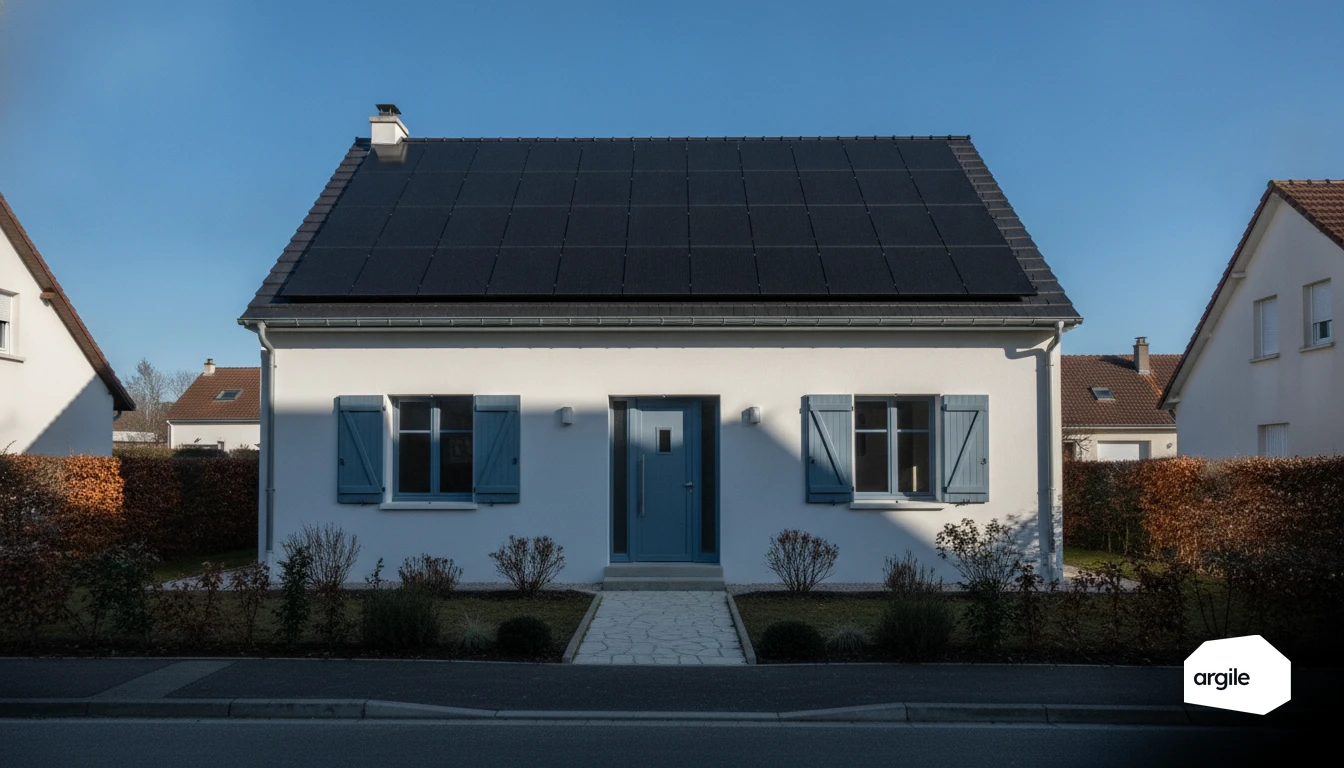
Between self-consumption and full resale, the arbitration shifted in 2026: for applications filed from 5 June 2026, full resale is paid at the French feed-in tariff of 1.1 c€/kWh on a 20 year contract indexed 2% a year and with no investment premium, where every self-consumed kWh avoids around €0.25 of purchase from the grid. The annual gain is calculated as kWh self-consumed times the price of the kWh bought, plus kWh sold times the purchase tariff, the same 1.1 c€/kWh applying to injected surplus as to full resale up to 100 kWp. Sizing is therefore set on the load curve of the home, all-electric house, heat pump heating or small consumer, and not on the roof area available. In both models, the grid connection request, the Consuel certificate and the purchase agreement are finalised after commissioning, which is planned from the quote so as not to push back invoicing for the job.
Understanding the two solar PV models: full resale and self-consumption
Full resale: principle, metering and billing
In full resale, all solar PV production is fed into the grid. Metering is done via a dedicated meter or separate metering depending on the configuration. You don't consume the energy produced. The sale goes through a purchase agreement. The readings are taken and billing follows the scheduled frequency.
Self-consumption with or without surplus resale: what changes on site
In self-consumption, the solar PV energy first powers the home. The injected surplus can be sold, or capped depending on the choice made. On the job site, this affects the connection to the panel, the protections, and sometimes controlling usage to consume at the right time.
Administrative and grid points of attention (grid operator, Consuel, purchase agreement)
In both cases, anticipate the grid connection request, the diagrams, and the Consuel certificate when it's required. For full resale or surplus sale, the purchase agreement is finalised after commissioning. To frame surplus resale, keep an eye on the timelines and the declared power.
Comparing the economic value in 2026: what really weighs in the calculation
Investment, payback period and tradesperson's margin: how to reason simply
To compare, start from the installed cost, then estimate the annual gain. Gain = self-consumed kWh x price per kWh + sold kWh x purchase rate. The payback period is then read in years, without forgetting your margin as a solar installer and after-sales service. A clear estimate is worth more than an overly tight promise.
Electricity price, purchase rate and trends in 2026: impact on profitability
In 2026, solar PV profitability mainly depends on the price of purchased electricity. Every kWh consumed on site avoids a bill at the current rate. The surplus is paid according to a purchase rate set by decree, on a 20-year contract: for requests from 5 June 2026 onwards, a single rate of €0.011/kWh (P+Q ≤ 100 kWp) indexed by 2% per year, with no investment incentive. If electricity prices rise, self-consumption carries more weight, even if the purchase rate doesn't always move at the same pace.
Example client profiles: all-electric house, heat pump heating, small consumer
- All-electric house. High consumption, often during the day. Sizing fits well, especially with controlled water heater and EV charging.
- Heat pump heating. Strong need in winter, strong production in summer. The challenge is shifting usage and smoothing it out.
- Small consumer. Little usage during the day. The surplus dominates, the payback is longer, a smaller power output is often more consistent.
Choosing based on the project: roof, power and building use
Solar PV sizing: avoiding oversizing in self-consumption
In self-consumption, as ADEME recommends, size the solar PV system as precisely as possible to your daytime consumption. Too many panels means more surplus to sell, often less profitable. Measure the usage (DHW, mechanical ventilation, heat pump) and anticipate how the site will evolve. Argile simulates the self-consumed share, the exported share and the effect on the bill before the capacity is fixed.
Roof and orientation constraints: when full resale becomes more logical
A small, broken-up roof, with cast shadow or a single unfavourable slope. In these cases, the choice can tip towards full resale, especially if the building consumes little during the day. You make the most of the most productive area and secure a revenue stream. To go further on the impact of shade on production, see cast shadow.
Special cases: commercial buildings, agricultural buildings, second homes
In commercial settings, the usage profile often matches the production hours. Self-consumption frequently wins out. In agricultural settings, large surfaces and seasonal needs. Also check the connection constraints. For second homes, full resale or controlled usage (water tank, EV charging) limits lost kWh.
Financial aid and regulatory framework worth knowing to sell the right model
Purchase rate and purchase obligation: conditions and limits in 2026
To be verified according to 2026 regulations. No more investment incentive since 5 June 2026; single purchase rate under the purchase obligation scheme, subject to conditions (power, date of connection request).
VAT, taxation and contract: what the client needs to anticipate from the quote stage
To be verified according to 2026 VAT and tax rules. Contract, connection, timelines.
RGE solar PV certification: certifications and documents to prepare to secure the file
To be verified according to RGE requirements. Insurance documents, qualification.
Making the case as a tradesperson: how to guide the client without getting it wrong
Your role is to inform the project, not to sell a dream. In solar PV, good advice starts from the household's daily reality, then secures the paperwork and the schedule.
Questions to ask the client: consumption, hours of presence, upcoming projects
- What is the annual bill and in which months does it climb the most.
- What hours is the house occupied, remote work, weekends, holidays.
- What changes are coming, thermodynamic water heater, heat pump, electric vehicle, extension.
Clear costing: presenting two economic scenarios without overwhelming the client
Present two options, with the same cost line items: equipment, installation, paperwork, connection, follow-up. Option 1: "lean" sizing, priority to self-consumption. Option 2: more power, surplus resale. For each option, give an order of magnitude for production, savings, and a payback period, without promising a single figure.
Common mistakes to avoid: promises of gains, forgetting the connection, underestimating timelines
Avoid "guaranteed" gains. Don't forget the grid connection and any required approvals, or the job will stall at the worst possible moment. Finally, anticipate administrative timelines, equipment availability, and coordination with other trades. A realistic schedule is trust that holds.