Regulation (EU) No 813/2013 calculates the seasonal space heating efficiency ηs, the ETAS, of a heat pump by dividing its SCOP by a conversion coefficient of 2.5, then subtracting corrections for controls: a SCOP of 4 gives an ηs of about 160 % before corrections. A boiler’s ETAS is read on the gross calorific value (PCS), which makes it comparable with a heat pump’s in primary energy, but never with a COP or a SCOP. The COP describes one test point, the SCOP a heating season on the Strasbourg reference climate: each indicator is compared with its own kind, at the same water temperature.
Four indicators, four different questions
A thermal efficiency is always a ratio between useful energy and energy consumed. What changes from one indicator to the next is the period covered, the energy basis and the document where it is read.
| Indicator | What it relates | Period | Unit | Where to read it |
|---|---|---|---|---|
| COP | Heat delivered over electricity consumed | One test point | kWh/kWh, no unit | Technical data sheet, machine certificate |
| SCOP | Heat delivered over electricity consumed, off and standby modes included | One heating season, reference climate | kWh/kWh, no unit | Product fiche, machine certificate |
| ηs (ETAS) | Seasonal efficiency in primary energy | One heating season | % | Product fiche and energy label |
| Combustion efficiency | Share of the fuel’s energy not lost in the flue gases | The moment of measurement | % | Analyser printout, service certificate |
The first three are declared by the manufacturer under standardised conditions. The fourth is measured on the installation, to adjust a burner: a combustion analysis validates a setting, it says nothing about the season.
Heat pump ETAS: the SCOP converted into primary energy
The regulation’s formula
Regulation (EU) No 813/2013 calculates a heat pump’s ηs as its SCOP divided by the conversion coefficient CC, then corrected by contributions that account for temperature controls and, for a water/water or brine/water heat pump, for the consumption of the ground water pumps. The regulation sets CC at 2.5, which corresponds to an average electricity generation efficiency of 40 % in the Union. A SCOP of 4 therefore gives an ηs of about 160 % before corrections, a SCOP of 3 an ηs of about 120 %.
Two water temperatures, two ETAS
A heat pump’s ηs is declared for a low-temperature application, at 35 °C at the indoor heat exchanger outlet, and for a medium-temperature application, at 55 °C. The same machine therefore shows two ETAS, and the value to use depends on the emitters: underfloor heating and fan coils are read at 35 °C, radiators at 55 °C.
The thresholds in force
| Text | Requirement on ηs | Scope |
|---|---|---|
| Regulation (EU) No 813/2013 | 110 % minimum, 125 % for a low-temperature heat pump | Placing on the market since 26 September 2017 |
SCOP: the heating season as seen by standard EN 14825
The SCOP relates the reference annual heating demand to the annual electricity consumption needed to cover it. The EN 14825 calculation splits the season into outdoor temperature bins, applies the machine’s part-load COP to each and adds the electric back-up below the bivalent temperature. It also counts what the machine consumes without heating: thermostat-off mode, standby, off mode and crankcase heater. The regulation’s average climate conditions are those of Strasbourg.
Two SCOPs only compare at identical climate and water temperature: for the same machine, the SCOP at 35 °C is higher than the SCOP at 55 °C. What the SCOP measures and what it leaves aside is detailed in our article on the SCOP and COP of a heat pump.
COP: one test point, to be stated with its conditions
The COP is measured at an operating point standardised by EN 14511, defined by an outdoor air temperature and a water temperature. It varies with both temperatures, the flow rate and the load ratio. A COP therefore only means something with its test conditions written next to it: compare two COPs at the same point, and never present a COP as an annual performance.
Boiler: ETAS on the PCS, the manual often on the PCI
Regulation (EU) No 813/2013 calculates a boiler’s ηs on the gross calorific value, which includes the condensation heat of the water vapour in the flue gases. Manuals often state useful efficiency on the net calorific value, which leaves it out: a condensing boiler exceeds 100 % there with no anomaly, while its ηs stays below 100 %. Always put two values on the same basis before comparing them.
The ETAS thresholds for gas, oil and biomass boilers, and how to read their product fiche, are covered in our article on boiler ETAS.
What compares, and what does not
- ηs with ηs: comparable between two boilers, two heat pumps, or a boiler and a heat pump, since both are in primary energy, provided the heat pump’s ETAS is taken at the right water temperature.
- SCOP with SCOP: comparable between two heat pumps at the same reference climate and the same water temperature.
- COP with COP: comparable only at the same test point.
- SCOP with boiler ETAS: not comparable, one is in final energy, the other in primary energy.
- Combustion efficiency with ETAS: not comparable, one is an instant, the other a season.
To estimate a bill, none of these indicators is enough on its own: you need the dwelling’s heating demand, the final energy consumed by each generator and the price of each energy.
Readings to take before comparing two generators
- The water temperature of the existing emitters, to choose the ETAS at 35 °C or at 55 °C.
- The product fiche of each generator, with its ηs and energy class.
- For a heat pump, the SCOP at the same reference climate and the output available at the site’s design temperature.
- For a boiler, the basis of each efficiency quoted, PCS or PCI.
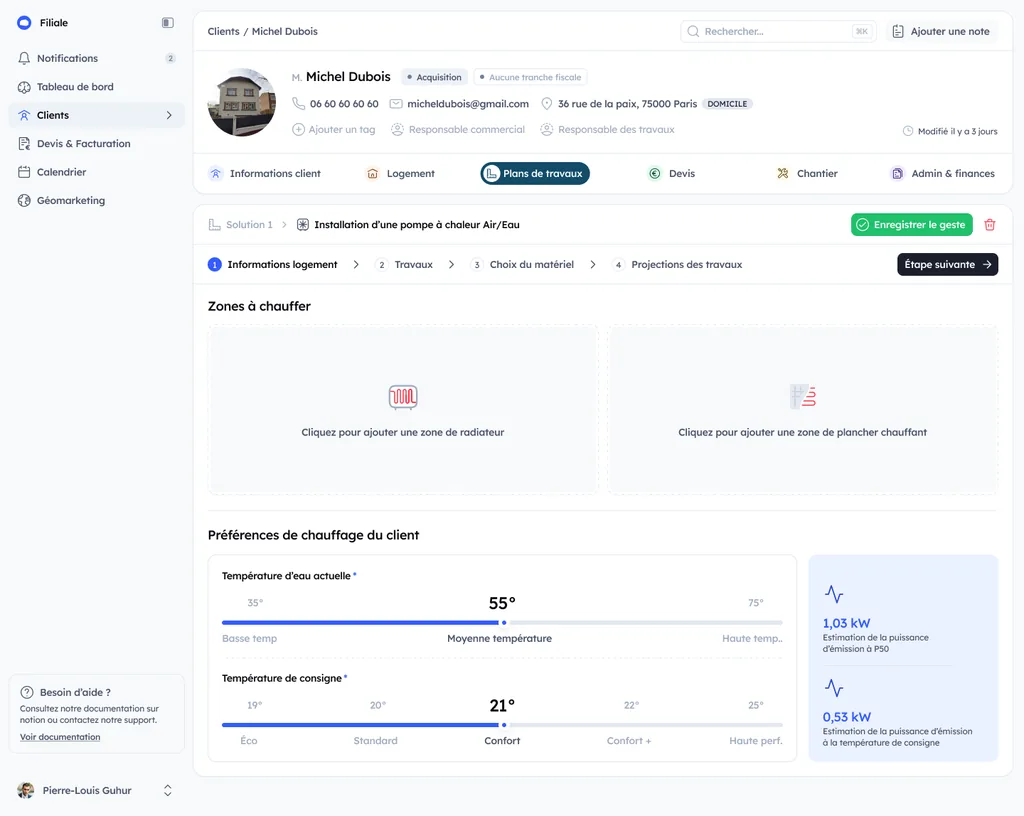
The ETAS at 35 °C and at 55 °C, the COP and the output by temperature of every machine in your catalogues are shown side by side in Argile’s air-to-water heat pump sizing.