The overall efficiency of a heating system is the product of four efficiencies in series: generation, distribution, emission and control. Usual orders of magnitude run from 75 to 109% on generation depending on the appliance, 85 to 98% on distribution and 88 to 98% on emission. Four links at 0.90 do not give 90% but 66%, which is why a new appliance fitted onto an uninsulated, unbalanced network disappoints on the client's bill.
The 4 heating efficiencies: what exactly are we talking about?
When talking about a heating system's efficiency, you don't just look at the appliance. In practice, overall efficiency is a four-link chain. Generation, distribution, emission, control. If one link gives way, heat is lost along the way.
Generation efficiency: boiler, heat pump, stove... what the appliance actually converts
Here, you measure what the purchased energy actually becomes as useful heat. A boiler is judged on its efficiency, often expressed on a seasonal basis. A heat pump is read instead via the COP and above all the seasonal efficiency (SCOP). A stove also depends on the draft and the fuel.
Distribution efficiency: network losses, circulator, balancing
Between production and the rooms, the network can eat into kWh. Uninsulated pipes, unnecessary lengths, poorly adjusted circulators, balancing defects. Reducing network losses is often a matter of common sense and a few adjustments.
Emission and control efficiency: radiators, underfloor heating, thermostats and control
Emission is the ability of the emitters to deliver heat at the right level. Control is maintaining the right temperature, at the right time, room by room. Thermostat, thermostatic valves, heating curve. Good control avoids overheating and stabilizes efficiency. The values used for each type of emitter are set out in the emission efficiency table.
Overall efficiency: how the efficiencies multiply and where losses hide
Simple overall efficiency formula and a "field" reading for your projects
Overall efficiency of a system is a multiplication rule. Generation efficiency x distribution x emission x control. On the ground, a small performance leak at each step ends up weighing heavily. Example. 0.90 x 0.90 x 0.90 x 0.90 = 0.66. You thought you were "good everywhere," and you're already losing a third.
Orders of magnitude by configuration (house, apartment) without overpromising
In a house, distribution losses climb fast if the networks run through unheated volumes. Overall efficiency of around 0.55 to 0.80 is common, depending on insulation, balancing and flow temperature. In an apartment, networks are shorter and the envelope sometimes shares walls with neighbors. The orders of magnitude tend to sit around 0.60 to 0.85. To be confirmed project by project.
Spotting weak points during a visit: visual clues and questions to ask
Clues. Uninsulated pipes, lukewarm radiators at the end of the line, temperature variations from room to room, damp marks, air leaks. Questions. Setpoint and schedules, domestic hot water, maintenance, circulation noise, rooms that are "impossible to heat." You quickly target the hidden losses.
Calculating efficiency in 2026: a practical method to cost accurately and convince the client
Data to collect: consumption, output, temperatures, usage and maintenance
To estimate a real efficiency, start from the field. Gather 12 months of bills, the energy type and the uses (heating only or with hot water). Note the heated surface, the visible insulation, the type of emitters and the temperature setpoints. Add the local reference outdoor temperature, occupancy schedules and maintenance status.
Quick calculation: a concrete example and common pitfalls (oversizing, settings)
Example. The dwelling consumes 18,000 kWh/year of gas, of which 14,000 is for heating. With a heat pump and a seasonal COP of 3, the electrical heating need is around 4,700 kWh/year. The classic pitfall is oversizing, which multiplies on-off cycles. Another pitfall. A heating curve set too high or poorly placed thermostats cause efficiency to drop.
Translating efficiency into euros and comfort gains: a jargon-free pitch
Translate efficiency into euros using the client's bill kWh prices. Compare current spending to projected spending, then add subsidies (CEE, MaPrimeRénov') to talk about the remaining cost. On the comfort side, emphasize more stable heat, fewer swings, and a lower flow temperature when the system is well tuned. That's where your accurate costing makes the difference.
Works to prioritize to improve overall heating efficiency (and secure performance)
First reduce the needs: insulation, airtightness, coherent ventilation
The best efficiency starts with the building shell. Insulate the loft, roof and walls first. Treat air leaks at hatches, joinery, and network penetrations. Then align the ventilation. A suitable mechanical ventilation system prevents humidity and stabilizes airflow after airtightness work, otherwise performance degrades.
Optimizing the system: sludge removal, pipe insulation, balancing, control
Before changing the appliance, secure the circuit. Sludge removal and a filter protect the pump and the heat exchanger. Insulating networks in unheated spaces limits losses. Balancing and simple control (outdoor sensor, thermostatic valves, programming) improve seasonal efficiency, without heavy works.
Choosing the right heating solution: heat pump, boiler, hybrid, and impact on efficiency
A heat pump reaches its best efficiency with low-temperature emitters and good sizing. A condensing gas boiler performs well when the return temperature stays low. In renovation, hybrid can smooth out cold peaks. In all cases, consistency between the envelope, emitters and settings makes the difference.
How Argile helps you estimate, calculate and sell higher-performing renovations
Energy diagnosis in under 5 minutes: identifying losses and comparing scenarios
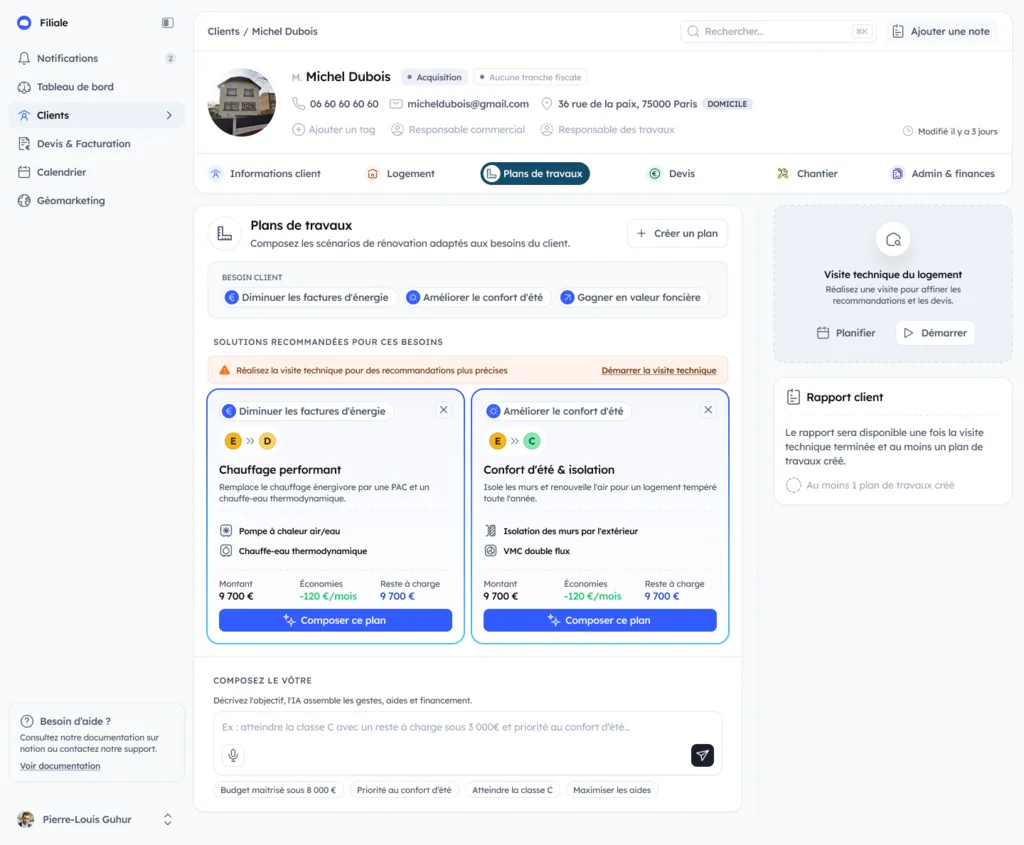
With Argile, you make a reliable diagnosis in a few minutes. You visualize the heat-loss zones, then compare several works plans: insulation, ventilation, heating, with the measures derived from the dwelling's characteristics and the client's objectives. The impact on consumption and comfort is immediately readable. You keep control over the assumptions, to stay consistent with the dwelling and your way of working.
Pre-costing and quotes with subsidies (MaPrimeRénov', CEE): factoring efficiency into the gain calculation
The chosen scenario moves into pre-costing, then into a quote, with integrated subsidies MaPrimeRénov' and CEE depending on the project. Argile helps you translate the technical side into concrete gains, taking into account the expected efficiency of the equipment and correct sizing. You sell credible performance, not a spec sheet.
Technical and administrative visit: securing assumptions and limiting back-and-forth
The technical visit is guided to lock in solid assumptions. Readings, photos, points of attention, everything is structured. The documents and supporting evidence are gathered to reduce unnecessary exchanges with the client and the agencies. In the end, your files move faster, and so do your projects.