Laying the groundwork for a solid client relationship from handover onward
End-of-work checklist: photos, manuals, warranties and documents to hand over
On handover day, a complete file avoids misunderstandings and secures what follows, including for MaPrimeRénov' and CEE.
- Dated, signed handover report, with snags listed if needed.
- Before, during and after photos. Plans and routing diagrams.
- Equipment manuals and references. Settings applied.
- Commissioning and compliance certificates where they exist.
- Warranties and insurance. Parfait achèvement (one-year), biennial, decennial.
Site walkthrough with the client: explaining the settings, confirming comfort, clearing up doubts
Do a room-by-room walkthrough. Show the simple settings for the thermostat, the heat pump, the mechanical ventilation. Check noise, temperature and ventilation together. Note questions and snags on the report. A clear explanation now is worth ten calls later.
Maintenance log: simple instructions and useful contacts to avoid emergency calls
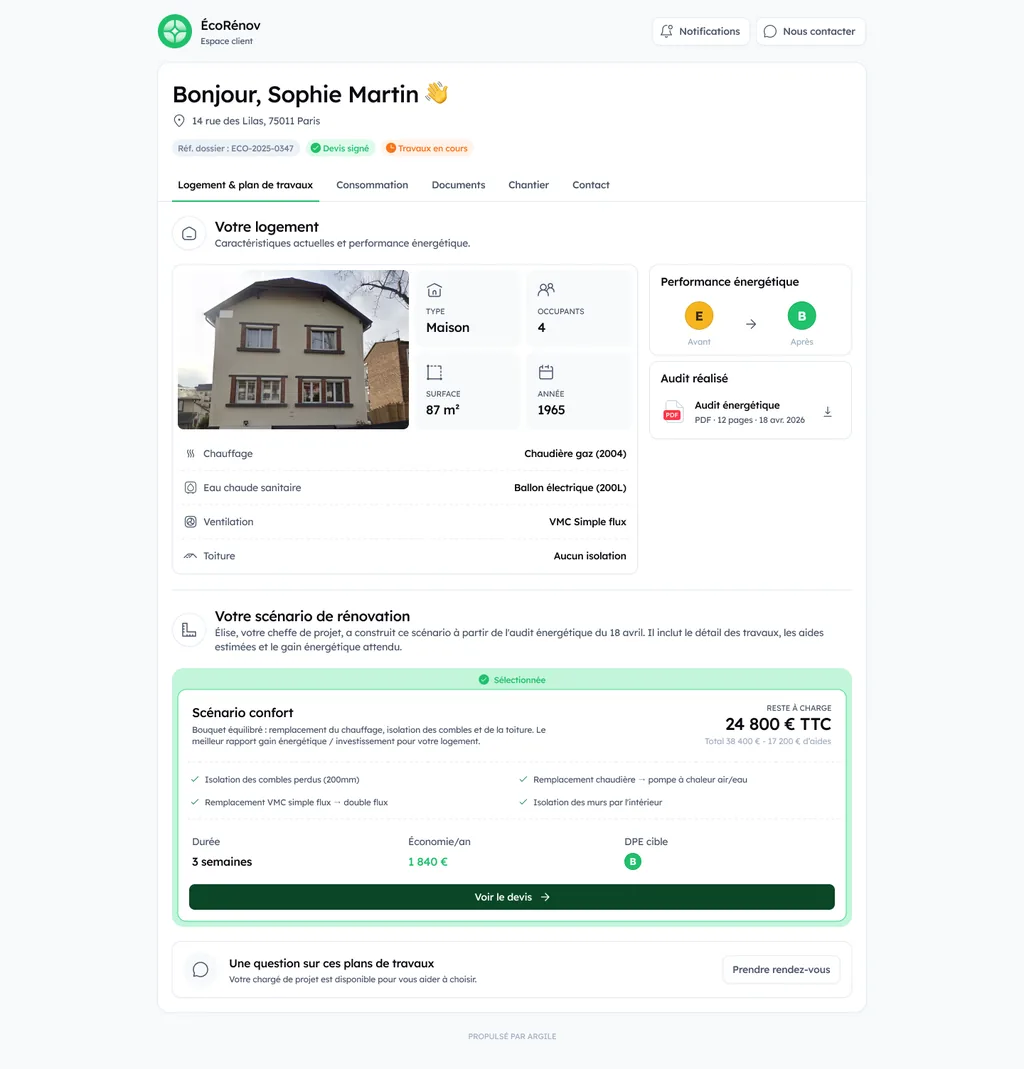
Hand over a one-page maintenance log. The right everyday habits, how often to clean the filters, which indicator lights to watch, and what to do before calling. Add the after-sales contact, the usual timeframes, and a link to the manuals. Your client relationship stays warm, even in the depths of winter. Those instructions and documents stay available to the client from their own dedicated space, which saves the Saturday morning phone call.
Setting up simple, regular post-work follow-up, without eating into your evenings
Follow-up schedule: day 7, day 30, end of the 2026 heating season (and after a heatwave if needed)
Block out 3 appointments from handover onward. At day 7, you check that the client has taken the settings on board, and you pick up on early warning signs. At day 30, you confirm usage and compare consumption with the "before," not aiming for perfection, just a trend. At the end of the 2026 heating season, do a comfort and bills check-in. After a heatwave, add a check if the client has cooling or is dealing with overheating.
Choosing the right channel: call, text, email or visit depending on the client's profile
Adapt the channel to the client, the way you'd adapt insulation to the building. A call for clients less comfortable with writing, or when reassurance is needed. A text for a quick response to a closed question. Email to keep a clear record of instructions and attachments. A visit only if a technical doubt persists.
Recording every exchange: client relationship file, photos, interventions and decisions
Note everything in a client relationship file. One line per exchange. Add 2 useful photos, the key settings, the interventions, and the decision made. This shared record avoids misunderstandings, secures your warranties, and speeds up future jobs. To go further on organisation and traceability, you can rely on a job tracking and compliance solution. Contact, home, quotes, job and exchanges all sit in the same place, from the first call to the end of the job.
Managing after-sales service with a method, to protect your client relationship and your online reputation
Spotting early warning signs: discomfort, noise, humidity, rising consumption
After-sales service starts before the breakdown. After insulation work, a heat pump or mechanical ventilation installation, note early warning signs: colder rooms, new noises, damp smells, rising bills. Ask for a photo, a video, a reading of the setpoint and, if possible, a consumption history. An alert handled early avoids the public comment that arrives like a leak through the ceiling.
Clear procedure: timeframes, responsibilities, parts, subcontractors and manufacturers
Set up a simple, written, shared process. Confirm an announced timeframe, the point of contact, then who does what between your team, the subcontractor and the manufacturer. Plan for parts management, serial number traceability and the applicable warranties (parfait achèvement, biennial, decennial). You protect the client relationship by giving visibility.
Handling complaints without conflict: listening, a written solution, a report and follow-up on resolution
When things heat up, cool the temperature down. Restate the need, propose a solution and formalise a written record. Send an intervention report, the likely cause, the action taken, then a follow-up check date. A call 7 days after closing the case secures satisfaction and limits negative reviews.
Turning follow-up into loyalty and local referrals
Asking for a review at the right time: after settings have stabilised and satisfaction is confirmed
A review requested too early is like a house handed over without its final coat of paint. Wait for the settings to stabilise, then confirm with the client that everything is fine (comfort, noise, setpoints, programming). A short check-in call at day 15 or day 30 helps secure the client relationship. Only then, offer a simple 2-minute review, with a single link.
Highlighting results: before/after, estimated savings, perceived comfort, finishes
What shares best is the concrete stuff. Prepare a clear mini summary.
- Before/after photos. Insulation, airtightness, finishes.
- Estimated savings. Based on the audit, the surfaces treated, or consumption compared under similar weather.
- Perceived comfort. More stable temperature, less humidity, quiet.
Referrals and word of mouth: simple rules, transparency and acceptable incentives
For referrals, keep the rule easy to understand. An incentive announced in advance, the same for everyone, and no pressure. A reasonable gesture works well. For example a maintenance visit at a preferential rate, or a discount on an accessory. And if you publish reviews, make sure you follow the transparency rules on how they're collected.
Turning client feedback into better work and more signed jobs in 2026
Field feedback: points to improve on insulation, heat pumps, ventilation and airtightness
After handover, reconnect at day 30 and then after the first winter. This client relationship brings concrete insight. The client talks about comfort, noise, humidity, bills. You spot what deserves an adjustment or rework.
- Insulation. Thermal bridges, hatches, seals, loft.
- Heat pump. Water curve, schedules, noise, defrosting.
- Ventilation. Flow rates, air inlets, filters, clogged vents.
- Airtightness. Air leaks, condensation, network penetrations.
Updating your 2026 documents: grant information, RGE, warranties and usage instructions
In 2026, your job files must reflect the current rules. Add a MaPrimeRénov' and CEE memo, your RGE proof, the manuals, and a clear end-of-job file. The client knows what to do and what to keep for their applications and warranties.
Useful follow-up: annual maintenance, settings check, further complementary work
Plan a follow-up at 6 or 12 months. Offer a settings check, cleaning of the ventilation components, and regulatory maintenance where it applies. Then suggest consistent add-ons. Pipe insulation, thermostatic valves, insulating a weak point. A useful follow-up, not a hard sell.