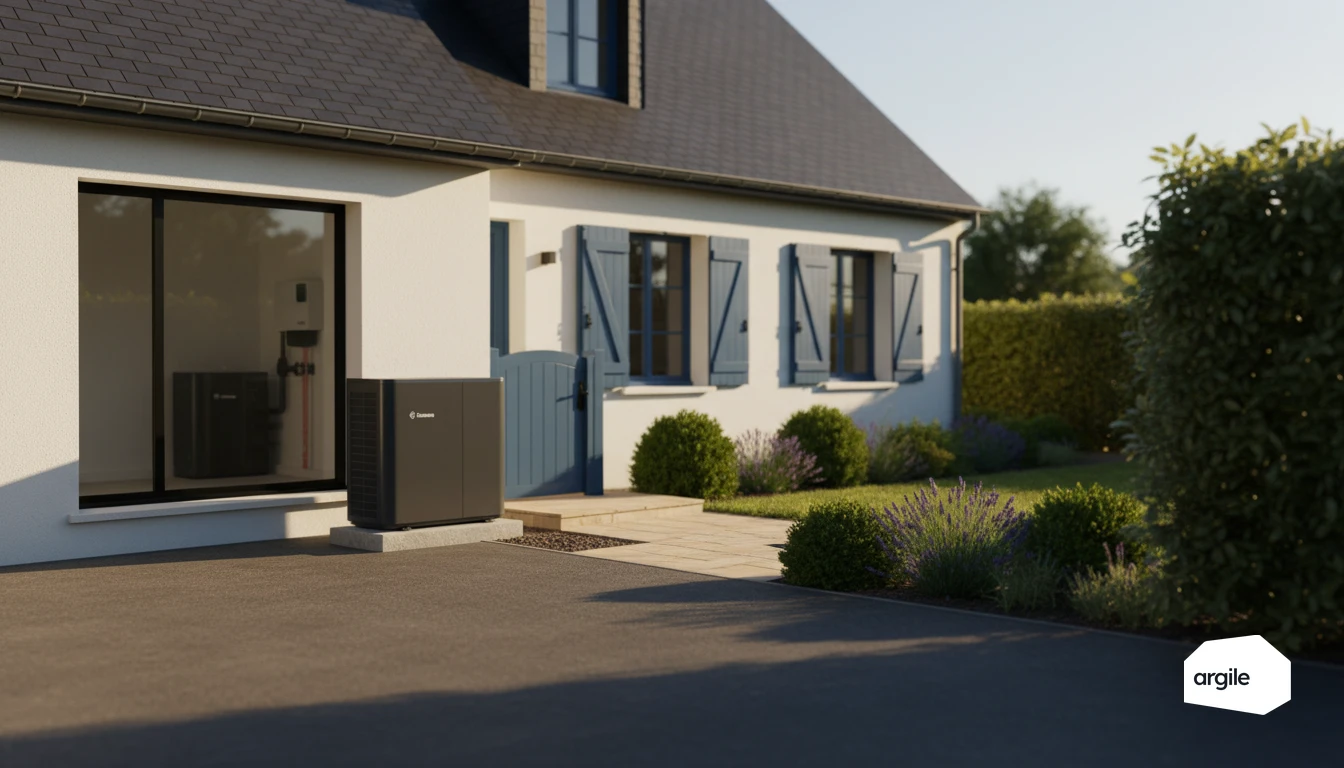
A hybrid oil heat pump pairs an air-to-water heat pump with the existing oil boiler, on the same radiator network and the same pipework. Over a heating season, the heat pump covers 70 to 80% of the demand and the oil boiler takes over on 20 to 30%, in severe cold or at high demand, for oil savings of 40 to 60%. Feasibility rests on two surveys: the condition of the boiler, burner, corrosion, circulator and flue, a boiler beyond fifteen years or so being open to debate as a backup, and the flow temperature the emitters actually need in winter. Radiators demanding 60°C tip the control over to oil for much of the season, which empties the installation of its point and shows on the first bill.
Understanding the hybrid oil heat pump and its appeal on site
How it works: who does what between the heat pump and the oil boiler?
A hybrid oil heat pump pairs an air/water heat pump with your client's oil boiler. The heat pump handles heating most of the time, when its performance is good. The boiler takes over for high-power needs, or when it's very cold. A controller automatically decides which generator should run, sometimes in "bivalent" mode with a backup element.
Typical use cases: renovation in an occupied home, existing network, radiators
On site, this is useful when renovating an occupied home without redoing the whole network. You keep the radiators and the existing hydraulic distribution, often running at high temperature. It's also a solution when the electrical supply is limited, or when you want to proceed in stages without cutting off heating for too long.
Concrete benefits: comfort, consumption, winter service continuity
You improve comfort with steadier heat, and reduce oil consumption during mild periods. In winter, the boiler secures service continuity if the heat pump reaches its limits, or during maintenance. The result is a more flexible system that adapts to the weather like a good thermostat. To go further on the logic of a hybrid system, see transitional solution.
Checking feasibility before proposing a hybrid heat pump
Condition of the oil boiler: checkpoints and age limits
Before sizing the heat pump, check the condition of the oil boiler. Look at leaks, corrosion, the burner, the circulator, the controls, and the flue. A well-maintained boiler can stay on as backup. Beyond about 15 years, the risk of breakdowns and overconsumption increases, and keeping it in service becomes debatable.
Emitters and temperatures: radiators, underfloor heating, heating curve
Note the flow temperature needed in winter. If the radiators require 60°C, efficiency drops and the hybrid system often switches to oil. With underfloor heating or oversized radiators, targeting 35 to 45°C is more comfortable. Adjust the heating curve, balancing, and flow rates.
Placement and nuisance: outdoor unit, acoustics, defrost cycles, condensate drainage
Install the outdoor unit with clearances and an anti-vibration mount. Check neighbourhood noise and maintenance access. Plan for defrost cycles, with condensate and meltwater drainage routed away from walkways, to avoid ice. Also validate the electrical supply and protections. To limit complaints and secure the installation, refer to noise and vibration mitigation solutions for heat pumps.
Correctly sizing and setting the hybrid system to avoid callbacks
Sizing the heat pump: power output, bivalence, backup and relief
Base it on a heat-loss calculation (NF EN 12831 type) and the existing emitter. A hybrid heat pump is often sized to cover most of the need, without excess power. Set the bivalence point based on the climate and the flow temperature. Clearly plan the backup and boiler relief for domestic hot water and cold peaks. Short cycling and noise often come from over-ambitious sizing. That calculation is produced in the NF EN 12831-1 format from the survey readings, room by room, and goes straight into the customer's file.
Controls and priority: heating curve, switchover threshold, scheduling
Controls make the comfort. Set the heating curve after a few days of use, then lock in the maximum flow temperature. Define a heat pump/boiler switchover threshold consistent with the actual COP and energy prices. Schedule domestic hot water windows, anti-legionella cycles and absences, otherwise you're heating when no one's home.
Installation quality: hydraulics, filtration, sludge removal, commissioning and balancing
Clean hydraulics, or callbacks are guaranteed. Fit a filter and a sludge separator, carry out sludge removal if necessary, then rinse. At commissioning, check flow rates, delta T and the balancing of radiators or underfloor loops. Stable pressure, purging, expansion vessel and valve settings make the difference.
Support schemes and obligations in 2026: what's changing for hybrid oil heat pump jobs
Overview of available support: MaPrimeRénov' and CEE depending on client profile
In 2026, a hybrid heat pump that keeps an oil boiler is treated as a heating measure. MaPrimeRénov' remains possible depending on the income scale and the pathway chosen. On the CEE side, the bonus goes through a dedicated standardised operation sheet. Amounts change quickly. Have the scenario validated with the client before signing. The simplest route is to have public grants and the CEE bonus built into the pricing, with the remaining cost shown before signature.
RGE and documents to provide: quote, technical data sheets, attestation, commissioning
The job must be carried out by an RGE-certified company matching the heat pump scope. In the file, provide a signed and dated quote, technical data sheets, the energy label, the CEE sworn statement, and proof of commissioning with settings. Also keep photos of the equipment and rating plates.
Points of vigilance for 2026: local rules, timelines, inspections and combining support schemes
Removing the oil tank, outdoor-unit noise, co-ownership approval, these points can hold up a job. Support applications are filed before work starts, with timelines and possible inspections. Combining MaPrimeRénov' and the CEE certificates remains workable, provided everything is declared and the caps respected.
Client pitch and quote: selling the modernisation without replacing the whole installation
Highlighting the preserved network: limited work, timelines, cleanliness
Explain that you're keeping the radiators and most of the pipework. The result: limited work, less dust, and a job often wrapped up in a few days. The heat pump gets grafted onto the existing setup. You touch the minimum of finished surfaces. It's a comfort gain without tearing the house apart.
Costing it right: quote line items, useful options, maintenance and warranties
A clear quote reassures. Detail the supply, hydraulic connections, electrical work, condensate drainage, controls, commissioning, and, if needed, sludge removal.
- Useful options depending on the case: outdoor sensor, thermostat, buffer tank.
- Maintenance: offer a contract and remind the client of the checks tied to the refrigerant.
- Warranties: manufacturer, workmanship, and follow-up after start-up.
Handling objections: noise, space, reliability, real savings and oil consumption
On noise, validate the placement and the anti-vibration mounts. On space, show the actual footprint of the outdoor unit. On reliability, lean on an RGE installation and careful settings. For the savings, talk about measured savings. They depend on insulation, flow temperatures and usage. If oil stays as backup, frame when it runs and why.