Understanding the decision guide: from recommendation to work scenario
What you call a "recommendation": rules, home data, and trade logic
In a decision guide, a "recommendation" isn't an opinion. It cross-references home data (EPC, surface area, heating, ventilation, layout constraints) with the funding eligibility rules and the installation standards. The goal is to avoid inconsistencies, for example insulating without addressing airtightness or sizing a heat pump without an actual need.
Difference between a "single-measure" scenario and a whole-house renovation scenario (and when one beats the other)
A single-measure scenario aims for a quick gain. For example, insulating a loft or replacing a heating unit. It makes sense when the budget is tight or when a breakdown forces action. A whole-house renovation combines several coherent items (insulation, ventilation, heating) to achieve a performance jump, secure comfort, and limit consumption. It beats the single-measure approach when the work can be coordinated and the grant pathway favours an overall project.
On-site points of vigilance: technical constraints, budget, comfort, and job schedule
On the ground, the decision guide must factor in your field observations. Available thickness, humidity, electrical network, noise, access, shared building rules, lead times. Add the budget, comfort priorities (summer, indoor air), and the schedule. A good scenario plans for stages, limits rework, and sets the key checks before launching the job.
Preparing the right information for reliable scenarios with Argile
Essential data before the visit: address, type, energy source, surface areas, equipment
Before heading out, lock down the basics. An exact address, the type of home (house, flat), the year of construction, the energy source (gas, oil, electricity), and the heated surface areas prevent shaky scenarios in Argile. Add the EPC, invoices, and plans if you have them. Also think about your decision guide file to quickly compare options.
During the visit: recording the essentials without missing anything (insulation, ventilation, heating, thermal bridges)
On site, note the insulation by zone (loft, walls, floors), the condition of the windows, and above all the ventilation (mechanical ventilation, air inlets, humidity). On the heating side, record power, emitters, regulation, and take useful photos. Spot visible thermal bridges, such as slab-to-wall junctions or shutter boxes.
Avoiding common mistakes: inconsistencies, overly optimistic assumptions, forgetting ventilation
Three pitfalls come up repeatedly. Surface areas that don't match the plans. Overly optimistic assumptions about the existing insulation. And forgetting ventilation, which drives up humidity and hurts comfort. In Argile, document your choices and keep a realistic margin. A reliable scenario means a job that starts on solid measurements.
Using Argile's automatic recommendations to choose the right scenario
Reading and comparing several scenarios: work priorities, energy impacts, and comfort
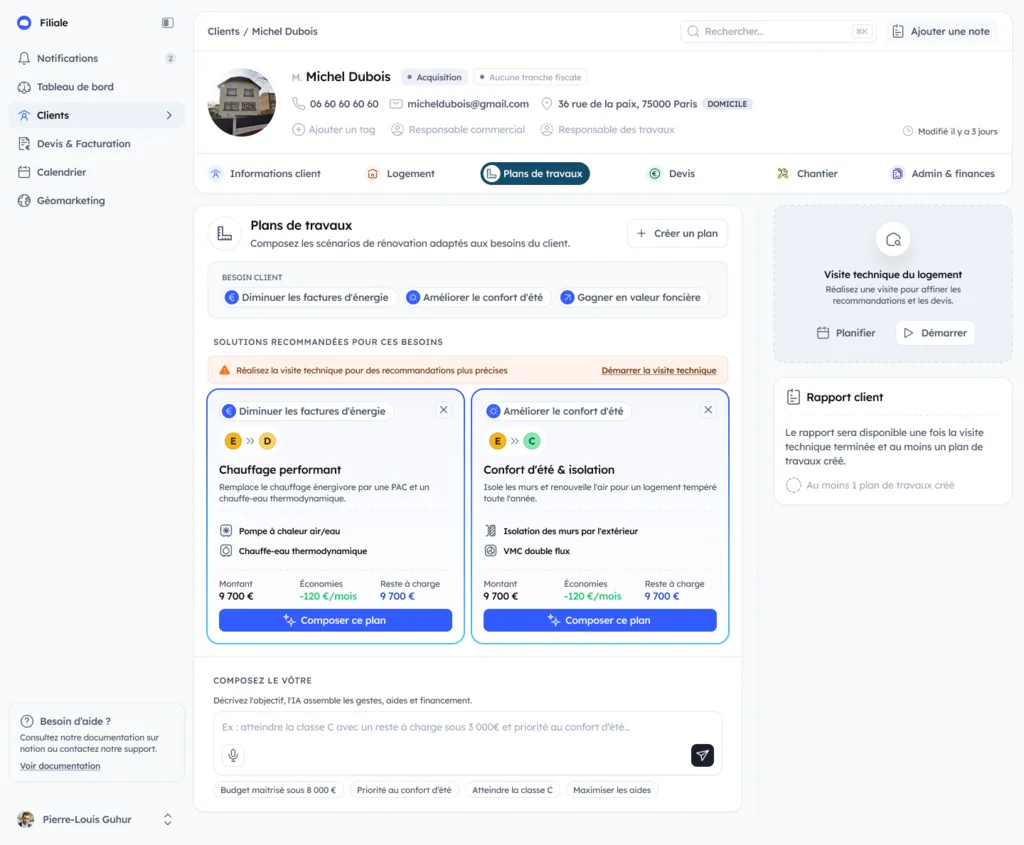
With Argile, you start from a clear comparison. Each scenario highlights work priorities, the expected effect on consumption, and comfort (more stable air, less cold surfaces). Use the decision guide to check consistency. Address the envelope first, then the systems, otherwise it's like heating an energy sieve. That hierarchy does not have to be rebuilt for every file: the measures are proposed as soon as the home is qualified, then assembled into a works plan.
Deciding based on the client profile: "tight budget," "quick gain," "whole-house renovation" in 2026
In 2026, clients often fall into three groups. Tight budget: secure the cost-effective measures that are simple to install. Quick gain: aim for a visible jump in bills with a short job. Whole-house renovation: build a coherent pathway, compatible with the grants and the support required on large-scale projects.
Turning the recommendation into a clear choice: options, variants, and phasing of the work
Starting from the chosen scenario, present 1 "base" option and 1 to 2 variants. Example: loft insulation alone, or loft plus walls, or loft plus heat pump. Propose a 2-step phasing if the budget is tight. The goal is a clear, priced, and defensible choice during the visit.
Pricing and securing the chosen scenario: grants, quote, and admin
Integrating the funding into the decision guide: checking eligibility and framing the amounts
In your decision guide, start by locking down the prerequisites. Type of home, construction date, tenure, household income or benefits, and above all consistency of the work with the funding routes. Identify the applicable measure specification, the technical criteria, and who holds the offer (the obligated supplier, a delegate, or you via a partner). The goal: give a realistic order of magnitude and flag what can change the amount.
Moving from pre-pricing to the quote: line items, quantities, technical points, and scope limits
Pre-pricing sets the architecture. The quote itself needs to hold up to scrutiny. Detail each line item with quantities, performance levels (R, COP, SCOP), accessories, protections, removal, evacuation, and rework (electrical, hydraulic, sealing). Add the scope limits and starting assumptions. This avoids "surprises" and secures your margin.
Saving time on admin: documents, traceability, and best practices for 2026
In 2026, the rule stays the same. A clean file saves weeks. Centralise signed quotes, proof of certification, product data sheets, dated before-and-after photos, detailed invoices, and the certificates the funding requires. Keep simple traceability, and a job checklist. You move fast, without losing sight of the finish line, even in the event of an audit.
Improving your signing rate with a simple presentation of scenarios
Highlighting concrete benefits: bills, comfort, property value, and health
Present a maximum of 2 or 3 scenarios. For each, translate the gains into a lower bill, winter and summer comfort, and impact on the EPC, and therefore the property's value. Add a health point. Less humidity, less mould, more stable air.
Proving technical consistency: feasibility, constraints, and implementation solutions
A scenario closes when it looks feasible. Show what was confirmed during the visit, then the points still to be confirmed. Examples. Outdoor unit placement, routing of connections, network insulation, ventilation. Give a clear solution. Well-managed installation, step by step, without surprises.
Structuring the conversation: common objections, quick decisions, and follow-up through to signature
Frame the conversation with a decision-guide support document. Answer the classic objections. Budget, length of the work, the funding available. Set a next step. Scenario validation, quote sent, dated follow-up. With Argile, you share a clear summary, and you track the file through to signature. To go further, draw on techniques to increase your quote-signing rate in energy renovation. And once the decision is made, the quote goes out for electronic signature, on the spot at the end of the visit or remotely from the client's email.