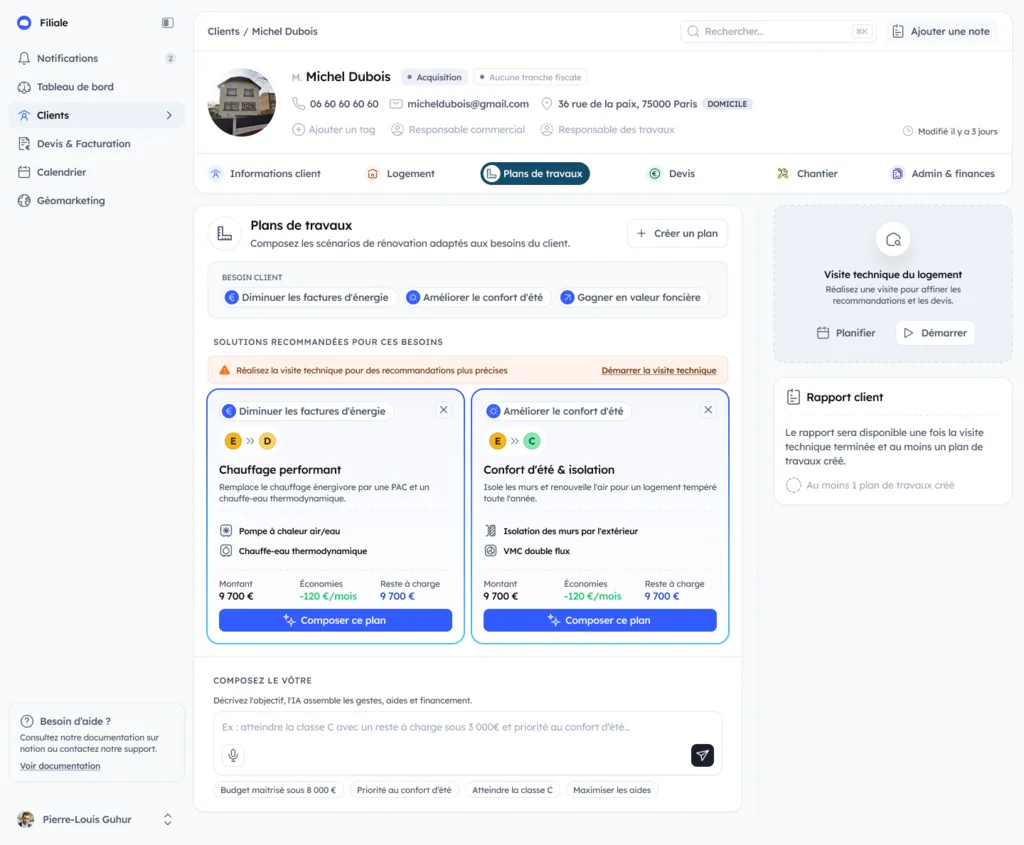
Multi-scenario: why this approach changes your energy renovation jobs
Moving from a single proposal to several clear options for the client
With a multi-scenario approach, you no longer sell a single solution. You show 2 or 3 clear paths. For example, a priority measure, an intermediate step, then a whole-house renovation. The client understands what they gain, what it costs, and decides faster.
Reducing back-and-forth between the visit, grant calculation, and technical adjustments
Each option can factor in the work assumptions, the home's constraints, and an estimate of the funding under current rules right from the start. The result: fewer returns to square one. You stay in control of the pricing and the conversation.
Securing your design time on complex projects (whole-house renovation, older homes)
In older homes, a good idea on paper can hit a snag on site. Working with scenarios protects you. You plan for a technical variant (heat pump, insulation, ventilation) and a budget variant, without redoing the entire file. It's time saved and better-signed quotes.
Comparing scenarios effectively: the criteria that really matter in 2026
Energy gains and comfort: what you need to make objective (EPC, band jumps) in 2026
In multi-scenario work, start with simple measures. Estimated consumption in kWh, EPC band jumps, and above all, actual comfort. Look at winter, but also summer. A scenario that insulates without addressing ventilation can degrade indoor air. And a high-performance heat pump doesn't make up for cold walls.
Budget and funding: comparing what the client pays without getting it wrong
To compare, calculate what is left to pay scenario by scenario. Same measure, same surface area, same registered company, otherwise the comparison is skewed. Check the 2026 eligibility conditions. A single-measure route or a whole-house retrofit, an assessment and a retrofit coordinator can change the scope of the funding. Amounts vary depending on the measure and volume, so ask for a costed offer, not an estimate. To go further on the changes, see the 2026 eligibility conditions. That calculation holds up when grants, certificates and monthly payments are gathered in a single financing plan.
Job feasibility: technical constraints, phasing, and impacts on lead times
A good scenario holds up on the ground. Access, ceiling height, hydraulic network, outdoor space, noise, electrical constraints, and any applicable planning rules. Anticipate the phasing. Insulation, ventilation, heating in the right order. You reduce rework, and you secure the lead times.
With Argile, building and adjusting your scenarios in a few minutes (without losing control)
Quick energy diagnosis: generating several scenarios from the first contact
During an appointment or on the phone, you run a quick diagnosis and get multi-scenario work plans. Insulation, ventilation, heat pump. You compare the estimated gains, the order of the trades, and the funding the household could draw on, without waiting for the full assessment. Each plan is composed by objective, with the measures ranked from the home's characteristics.
Feasibility analysis: detecting constraints at the address and prioritizing the work
Starting from the address, Argile cross-references available data and flags points of vigilance. Protected zone, building type, energy label, space constraints for the outdoor unit. You prioritize the measures, avoid making promises you can't keep, and prepare for a visit with the right questions.
Technical visit and 3D reconstruction: making your measurements more reliable to avoid gaps with the quote
On site, you document the visit and the 3D reconstruction makes your measurements more reliable. Insulated surfaces, network lengths, locations. The result: fewer gaps between the estimate and the signed quote, and cleaner grant files, with clear evidence for the client. To go further, discover the digital workflow from technical visit to quote.
Helping the client decide: turning the comparison into a signed decision
Presenting the options with simple arguments: performance, cost, priority work
With a multi-scenario approach, compare 2 or 3 work pathways. A "minimum" scenario to address the blocking points, a "comfort" scenario to target a better rating, and an "ambitious" scenario if the budget allows. Put 3 figures on the table. Estimated bill savings, budget, remaining cost. Restate the priorities. Insulation before the system, ventilation, regulation.
Highlighting the trade-offs: investment, comfort, complexity of implementation
A good trade-off is clear. More investment often means more comfort and lower consumption, but also more trades, longer lead times, and more constraints. Highlight the risks. Heat pump sizing, thermal bridges, humidity. Say what's simple to phase and what creates a bottleneck.
Speeding up the signature: a detailed quote and integrated grants to reassure
To close the sale, the quote needs to tell the story. Detail the line items, surface areas, performance levels, schedule, and factor in the funding to display clearly what is left to pay. Add the expected supporting documents (proof of registration, technical data sheets, photos). The client can picture it, and you secure the sale.
From multi-scenario to selling whole-house renovations: organizing your method from A to Z
Choosing a "base" scenario and variants to fit the household's budget
In multi-scenario work, start from a coherent base scenario. It first addresses the losses that are easy to fix. Often, insulation of the most heat-losing surfaces and ventilation. Then add 2 variants. A "controlled budget" version and a "comfort+" version with a high-performance heating system. You keep the technical thread, and the household chooses based on its remaining cost.
Standardizing your steps: from pre-pricing to admin, without re-entering data
Set up a simple, repeatable method, without re-entering data. The same set of data is used throughout. Site measurements, surface areas, photos, constraints. Then pre-pricing, funding calculation, quote, and supporting documents. With Argile, you centralise the information and produce comparable scenarios in a few clicks. To avoid follow-up requests and secure processing, you can also rely on avoiding rejected applications.
Tracking your projects: limiting oversights and securing funding files
A whole-house retrofit is also won at the desk. Track each file with a funding file checklist. Dated and signed quote. Valid registration for the relevant measure. Product technical data sheets. Before, during, and after photos. Compliant invoice and the scheme's certificates. You avoid follow-up requests, secure the payments, and keep the job under control.