Why the registered electrician's trade is changing with energy renovation
Electrification of household uses is accelerating. Heat-pump heating, hot water heat pumps and EV charging points are being added to the consumer unit. For a registered electrician, this means more dedicated circuits, finer management of power draw and suitable protection, notably 30 mA for personal safety. In a better-insulated, more airtight home, heating needs go down, but peaks can concentrate on a handful of appliances. Sizing circuit breakers, residual-current devices and sometimes the incoming supply becomes a real issue. And since the envelope breathes less, ventilation can no longer be treated as an afterthought. It needs to be coordinated with the electrical system, automation and usage. On the client side, the expectation is clear: measurable savings, stable comfort and a reliable installation, with no nuisance tripping or risk areas.
Registered electrician: what certification covers and who it serves
Certification on site
For a registered electrician, certification isn't a marketing sticker. Part P work is signed off through a competent person scheme, with competency rules, traceability requirements and possible audits on job sites. In practice, it reassures clients, opens access to markets tied to energy renovation, and requires you to maintain a standard of rigour in quotes, execution and end-of-work evidence.
Certification on the client side
For your clients, your registration mainly serves as a gateway to the funding schemes. The application requires solid documentation: a quote signed at the right time, certification in the correct scope, consistent invoices, and sometimes checks or requests for additional documents.
Common mistakes and how to avoid them
- Certification outside the scope of the job. Check the exact scope before quoting.
- Inconsistent dates between quote, invoice and certificates. Lock down your process.
- Missing documents. Prepare a complete file pack from day one.
Typical projects where a registered electrician makes the difference
On a retrofit, the registered electrician secures the interfaces between trades and prevents "mystery" failures. For a heat pump, they create a dedicated circuit, size the protections, plan load shedding in line with the incoming supply, notify the DNO where required, and coordinate with the heating installer on start/stop commands and backup heat. For mechanical ventilation, they handle the power supply, controls, humidity-based regulation and safety, especially in wet rooms. For photovoltaic, they adapt the consumer unit, separate AC and DC, install the protections and prepare the control interfaces for self-consumption, with the G98 or G99 notification to the network operator. Finally, for an EV charging point, they follow the installation rules, add a dedicated circuit with dedicated protections, and balance loads to avoid overheating and nuisance tripping. To stay compliant on certification, also check the compliance rules that registered tradespeople need to know.
Field method: securing an energy renovation from the electrical standpoint
From the site visit to handover
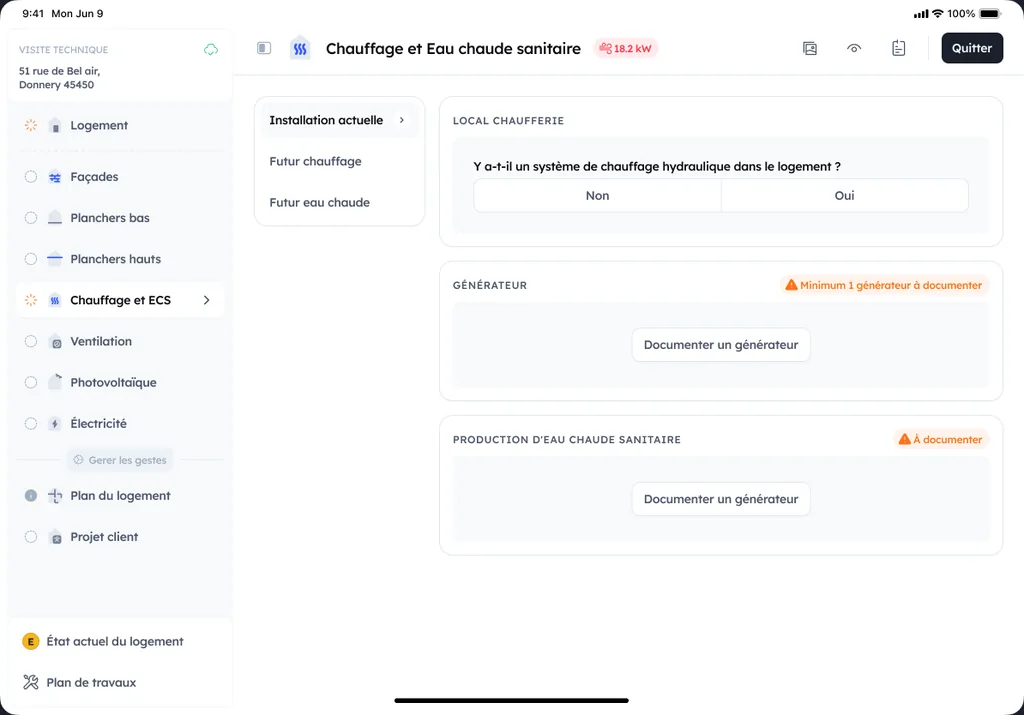
Everything starts with a preliminary visit. The registered electrician surveys the state of the earthing, equipotential bonding, existing circuits, cable routes, and identifies risk points such as an overloaded consumer unit, worn conductors or a missing residual-current device. Sizing comes next. Check the power draw of the heat pump, the ventilation system or the water cylinder. Adapt cable sizes, ratings and protection accordingly. Everything surveyed on that visit belongs in the file the same day: the site visit flow records readings, photos and equipment positions.
Quality and compliance: what matters in 2026 for a registered electrician
Standards and best practice: staying rigorous on the points that get checked
In 2026, compliance comes down to the basics, but checked to the millimetre. For a registered electrician, this means an installation aligned with the current BS 7671 wiring regulations, consistent residual-current protection, properly sized cables, a legible consumer unit, and dedicated circuits whenever you add a heat pump, ventilation system or EV charging point. Inspections also look at fire safety, connections and the quality of the test certificates.
Traceability: photos, technical data sheets and proof of execution
The best job is the one you can prove. Keep dated photos before, during and after, product labels, single-line diagrams, manuals, and settings. On subsidized work, traceability acts as a shield in case of an inspection, and speeds up file approval.
Multi-trade coordination: insulation, heating, ventilation and impacts on electrical work
- Insulation. Plan penetrations, airtight boxes, and cable routes to avoid air leaks.
- Heating and DHW. Check power, load shedding, and protections, especially with new electrical uses.
- Ventilation. Plan power supply, maintenance access, and continuity of service to avoid moisture and mould.
Growing your electrical business without spreading yourself thin
To grow without scattering your efforts, choose a clear direction. Either whole-house retrofit, working alongside a retrofit coordinator and a team of registered tradespeople, or small, highly profitable, repeatable jobs, such as controls, load management and consumer unit upgrades. Qualified subcontracting also works if the framework is clear, with plans, scope limits and checks. When pricing, factor in load control and everything that comes with it: load shedding, protections, labelling, rewiring, earthing, tests, as-built documentation and coordination time. On the client side, explain technical choices in simple terms. Show the impact on comfort and kWh saved, without promising a bill cut in half. Finally, build complementary partnerships. A registered electrician who works with a heating installer, an insulation specialist and a joiner gains in pace, reduces rework, and secures the funding. When pricing, the electrical package sits in the same works plan as the insulation and the heating, priced-item library and free lines included.