Understanding the Ug of a glazing unit: what you need to master for your compliance files
Ug, Uw, Sw: don't confuse the indicators, and know what to declare
Ug (W/m².K) describes the heat loss of the glazing alone. Uw covers the whole window, frame included. The g-value indicates solar gains. In a compliance file, you generally declare Uw and the g-value when replacing an entire window frame. Ug is mainly used when the work covers only the glazing (replacing the insulating glass unit). For opaque walls, the logic is different: see the automatic calculation of the U-value of walls.
Common Ug values by glazing type (double, triple, gas, spacer)
- Old-style double glazing with air fill: Ug around 2.7 to 3.0.
- Low-emissivity double glazing with argon: Ug around 1.1, sometimes 1.0 with a "warm edge" spacer.
- High-performance triple glazing: Ug around 0.5 to 0.7 depending on gas and thicknesses.
Tolerances, justifications and common mistakes on site and administratively
Rely on the DoP, an ACOTHERM classification, or a manufacturer data sheet. Don't reuse a "catalogue" Ug if the composition installed changes (gas, spacer, thickness). Classic mistake: declaring Ug instead of Uw, or forgetting that the result depends on the calculation conditions (standard and dimensions). To avoid non-compliance during an inspection, also rely on the good practices described in preparing your job sites and paperwork.
Method using the Ug table: how to quickly find the right value without getting it wrong
Where to find the Ug table: manufacturer data sheets, DTA/ATec, CE marking and site documents
For an insulating glass unit, the Ug table is generally in the manufacturer's technical data sheet for the double or triple glazing. Also look for the Declaration of Performance tied to the CE marking, often supplied with the quote or delivery slip. For a complete system, a DTA or an ATec can specify the validated compositions and their Ug values. On site, keep the labels, the manufacturing slip and, if present, a CEKAL certificate.
Reading a Ug table: thicknesses, gas, spacer, low-emissivity coating
Identify the composition (e.g. 4/16/4), then the gas (air, argon, krypton) and its fill rate. Check the spacer type (aluminium or warm edge) and whether a low-emissivity coating is present. Then take the Ug value calculated according to EN 673. This is the glazing value, not to be confused with Uw. To also frame the entry of U-coefficients (default, calculated or measured), see the U-coefficient entry method.
Edge cases: old window frames, partial replacement and custom glazing
If the window frame is old or you're only replacing the glazing, the exact composition is often missing. Measure the total thickness, spot the low-e coating (reflection test), then ask the glazier for an equivalent composition with a documented Ug. For custom glazing, require a manufacturing sheet or a Ug calculation (EN 673). When in doubt, stick to a cautious option.
Entering glazing in Argile: saving time on the Ug calculation and securing your assumptions
Recording the glazing: useful fields, level of detail and good entry practices
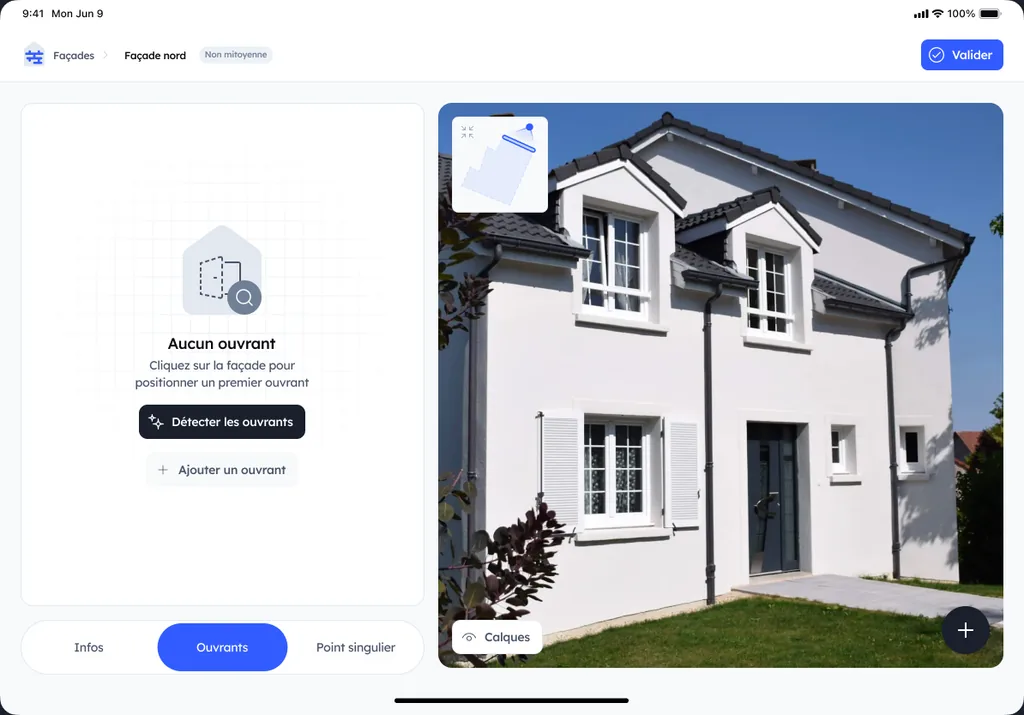
In Argile, start by identifying the most common glazing in the dwelling. Enter the type (double, triple, old), the presence of a low-emissivity coating, the gas (air, argon), and, if you have it, the manufacturer reference. If several windows coexist, group them into consistent families. A photo of the product data sheet or the marking on the spacer saves you from shaky assumptions. On the surveyed façades, windows and doors are detected automatically and listed for pricing, so no unit is forgotten when you enter the glazing.
Using tables and default values: when to accept them, when to adjust them
When the exact reference is missing, tables and default values give a quick baseline for estimating Ug and moving forward with the preliminary pricing. Accept them for a first simulation. Adjust as soon as you get a manufacturer declaration, especially if the spacer is "warm edge", if the gas isn't standard, or if the glazing is very old. Keep the same assumption from the scenario through to the quote.
Consistency checks: spotting inconsistencies before the quote and before the audit
Before the quote and before the audit, run a simple consistency check. A very low Ug with single glazing is a red flag. Also check that you're not confusing Ug (glass) with Uw (whole window frame). The latter depends on the frame and the dimensions. Argile helps spot these discrepancies, to protect your margins and your promises.
From Ug to quote: integrating the calculation and the funding without friction
Impact of glazing on performance: prioritising work items and selling whole-building renovation
Ug measures the heat loss of the glazing. The lower, the better. But a window is also judged on its Uw and its installation. Good glazing can help improve comfort, especially if you also address insulation and ventilation. It's the ideal angle to propose a whole-building renovation, with a clear scenario rather than a "one-off" replacement.
Translating your choices into a quote: clear wording, evidence to keep and traceability
In the quote, note the window frame type, the dimensions, Uw, Ug, the g-value, the installation method, and the trickle vents. Keep technical data sheets, proof of registration, photos, and detailed invoices. On a funded measure, compliance often hinges on one forgotten mention. A traceable quote avoids callbacks.
Automating pricing and paperwork in Argile: reducing back-and-forth and oversights
Argile turns your choices into consistent quote line items, works out what the measures can attract for the household, and generates the list of documents to attach. You save time on pricing, and you secure the file without re-entering the same data three times.
Good practices for 2026: making your Ug values reliable and avoiding blockers during inspection
Documents to archive in 2026: technical data sheets, glazing references, proof of performance
For each job, keep a simple, complete file. Archive the DoP and CE marking of the window, the technical data sheet of the glazing with the exact reference (composition, gas, spacer) and the associated Ug value. Add the purchase order and the invoice that unambiguously link the reference installed to the dwelling. In case of an inspection, it's often traceability that makes the difference.
End-of-site-visit checklist: photos, measurements, identification and options
- Photo of the label, the silk-screen marking or the order reference on the glazing.
- Useful dimensions: width, height, thickness, opening direction, sills.
- Identification by window: room, orientation, constraints. Shutters, grilles, guardrails.
- Note the possible options (double or triple) and the impact on Ug and lead time.
Standardising your method: entry templates and glazing library in Argile
Standardise data entry. One line per window with glazing reference, Ug, documentary source and attachment. In Argile, a glazing library avoids "gut-feel" values. You reuse references already validated, and you secure your quotes without getting blocked during an inspection. The same logic applies to the equipment: the technical characteristics of the products are checked and kept up to date in your catalogue, references and prices included.