Due south at 35° is the reference, but a roof that departs from it costs far less than the trade usually claims. On a PVGIS simulation at the same latitude as central France, with identical output and system losses, a south-east pitch loses 6% of annual production, and a pitch of either 15° or 60° due south also loses 6%. You have to swing all the way to due east before the loss reaches 21%. Pitch barely matters and azimuth matters late: the one parameter that justifies giving up on a roof plane is shading, whose effect dwarfs all of these.
Understanding what makes a PV panel's production vary
Why orientation directly affects the kWh produced
A photovoltaic panel produces power based on the angle at which it receives light. In France, a due south orientation generally gives the best annual production. An east or west installation can still be very worthwhile if your goal is self-consumption, since you produce more power earlier in the morning or later in the evening, when the household is active.
How tilt affects sun exposure across the seasons
Tilt sets the "shape" of production. The steeper it is, the more it captures the low winter sun. The flatter it is, the more it benefits from the high summer sun. On many roofs, aiming for a good compromise around 30° to 35° works well, then you fine-tune based on region, use case and installation constraints.
Shading, obstructions and reflection: the details that eat into production
Chimney, tree, dormer, guardrail. Partial shading can drop the output of a whole string of modules if they're wired in series. Map the obstructions across the year and, if needed, consider micro-inverters or optimizers. Even dirt and certain reflections can chip away at kWh: for more, see our article on the impact of a tree or a chimney.
Choosing the best PV orientation for your roof
Due south, east-west, southeast/southwest: what you really gain or lose
In mainland France, a due-south roof with a tilt around 30° remains the benchmark for annual yield. A slight southeast or southwest shift barely hurts production. An east-west layout often lowers total production, but flattens the curve. You produce more in the morning and late afternoon, which can improve self-consumption when the house is occupied.
Flat roofs: orientation via mounting frames and limits to respect
On a flat roof, orientation is set with mounting frames. Aim for a moderate tilt to limit shading between rows and wind exposure. Respect the setback distances from parapets, avoid roof penetrations when possible, and check the loads and specifications from the waterproofing manufacturer.
Adapting orientation to site constraints (walkways, safety, singular points)
On site, the ideal orientation must remain compatible with safe access routes. Keep clear paths to exits, roof lights and roof equipment. Plan ahead for singular points (chimneys, valleys, roof windows) and shaded zones. One fewer row is better than an array that's hard to maintain or risky to install, a trade-off to settle at the PV layout stage.
Setting PV tilt to optimize output across the year
"Ideal" tilt: distinguishing annual production from winter production
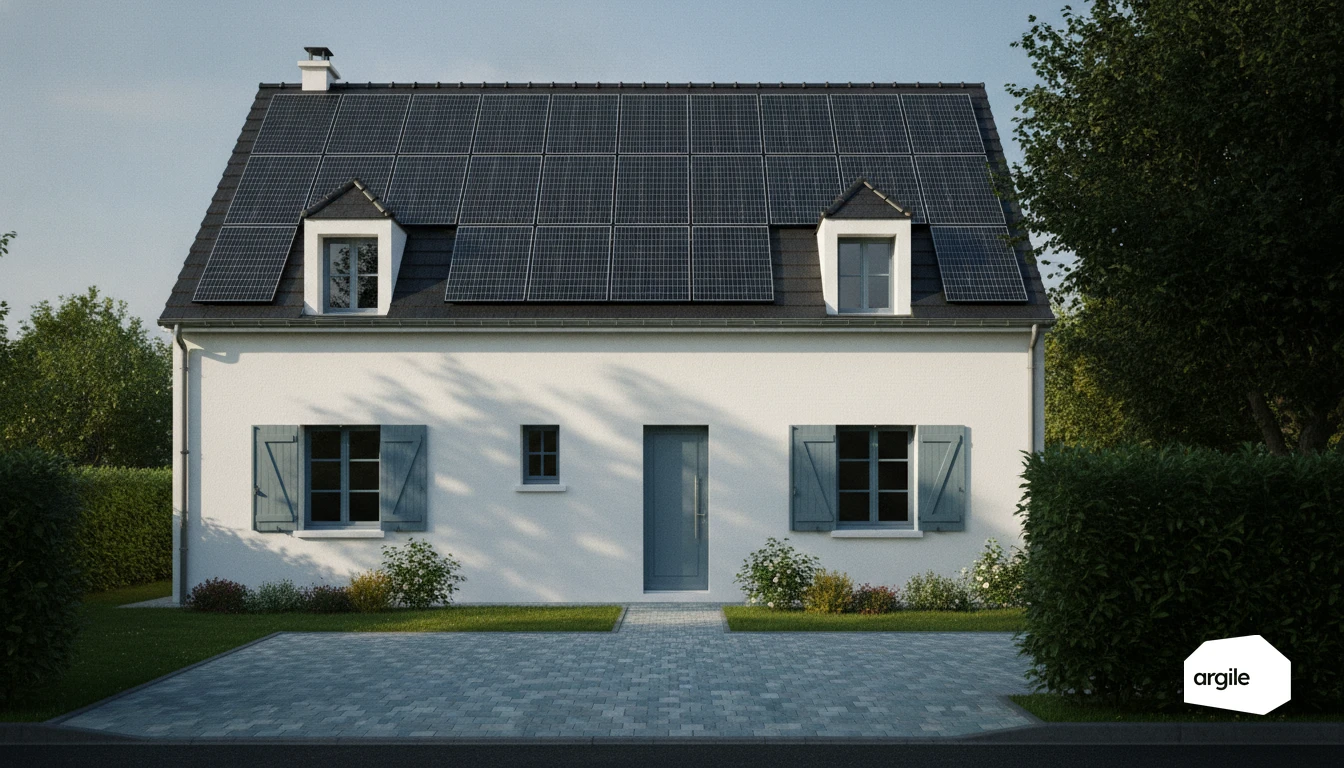
In France, a tilt around 30 to 35° often gives the best compromise for annual photovoltaic production. If your priority is winter (heating, heat pump, hot water tank), aiming for 45 to 60° captures a lower sun better. The gain from December to February comes at the cost of a drop in summer. Conversely, a shallow tilt favours summer peaks but clearly penalizes the cold season. Argile estimates production roof plane by roof plane from the azimuth and tilt chosen, with the sun's path hour by hour.
Common tilts on tile, slate and steel roofing: practical field benchmarks
On a roof, start from the existing pitch. Usual benchmarks:
- Mechanical tiles: 30 to 35°.
- Slate: 35 to 45°.
- Steel sheeting: 10 to 20°.
Below 10°, raising the panels is often useful. It limits dirt buildup and keeps good water runoff.
Impact of latitude and region: simple adjustments to apply
The higher the latitude, the steeper the tilt should be. Simple rule: annual tilt ≈ latitude minus 10°. In Brittany or Hauts-de-France, 35 to 40° works well. In Provence or Corsica, 25 to 30° is often enough. To target winter, add 10 to 15° to the annual setting, while staying consistent with wind exposure. To fine-tune these choices for your location, also refer to PV solar yield by climate zone.
Balancing yield, aesthetics and regulation: the choices that matter in 2026
Zoning and local constraints: points to check before changing the tilt
Before touching the tilt, check what the local zoning plan (PLU) says, and whether you're in a designated heritage area or near a listed monument. A change visible from the street can trigger a prior declaration, or even require sign-off from the Architecte des Bâtiments de France. Also plan ahead for colour and surface-mounting requirements.
Wind, overload and watertightness: securing the mechanical stability of the installation
The steeper you set the modules, the more you increase wind exposure. Have the fixings, hook spacing and snow load validated for the zone. On a roof, the priority remains roof watertightness. Flashings, membranes, cable penetrations, and treatment of singular points, to avoid leaks and after-sales callbacks.
Self-consumption: choosing orientation and tilt based on your usage patterns (morning/evening)
For a self-consumption PV installation, the best angle isn't always the most productive one over the year. If your usage is morning and evening, an east-west orientation flattens production and matches the usage profile. Adjust the tilt to limit shading and keep a discreet look on the facade.
Quick sizing and on-site validation method
Recording azimuth and pitch: simple tools and measurements to log
On the relevant roof plane, measure the azimuth with a smartphone compass or a classic compass, then the pitch with a clinometer (app or tool). Move away from metal elements and record the measurement in degrees, with the same reference (north). Also log usable area, exclusion zones, roofing type, substrate condition and photos.
Checking shading losses: pre-installation control checklist
- Identify chimneys, trees, parapets, nearby terrain, and their possible shadows in the morning and evening.
- Check the most penalizing period, usually winter, when the sun is low.
- Check shading across several rows. A thin shadow can hurt a whole string of modules.
- Decide right away. Relocate the array, add electrical optimization, or accept a partial reduction.
Validating the estimated production: how to explain your choices to the client without jargon
For a photovoltaic project, announce a production figure in kWh per year with a range, not a magic number. Tie it to three simple levers. Orientation and tilt, shading, then normal losses (temperature, inverter, dirt). Show a cautious scenario and a favourable scenario. The client understands, and you validate your choices without overpromising. For the visual side, Argile projects the panels onto a photo of the building taken during the visit.