Glass wool versus rock wool: what really changes on site
What are we talking about: mineral wools, formats (rolls, boards, loose fill) and typical uses
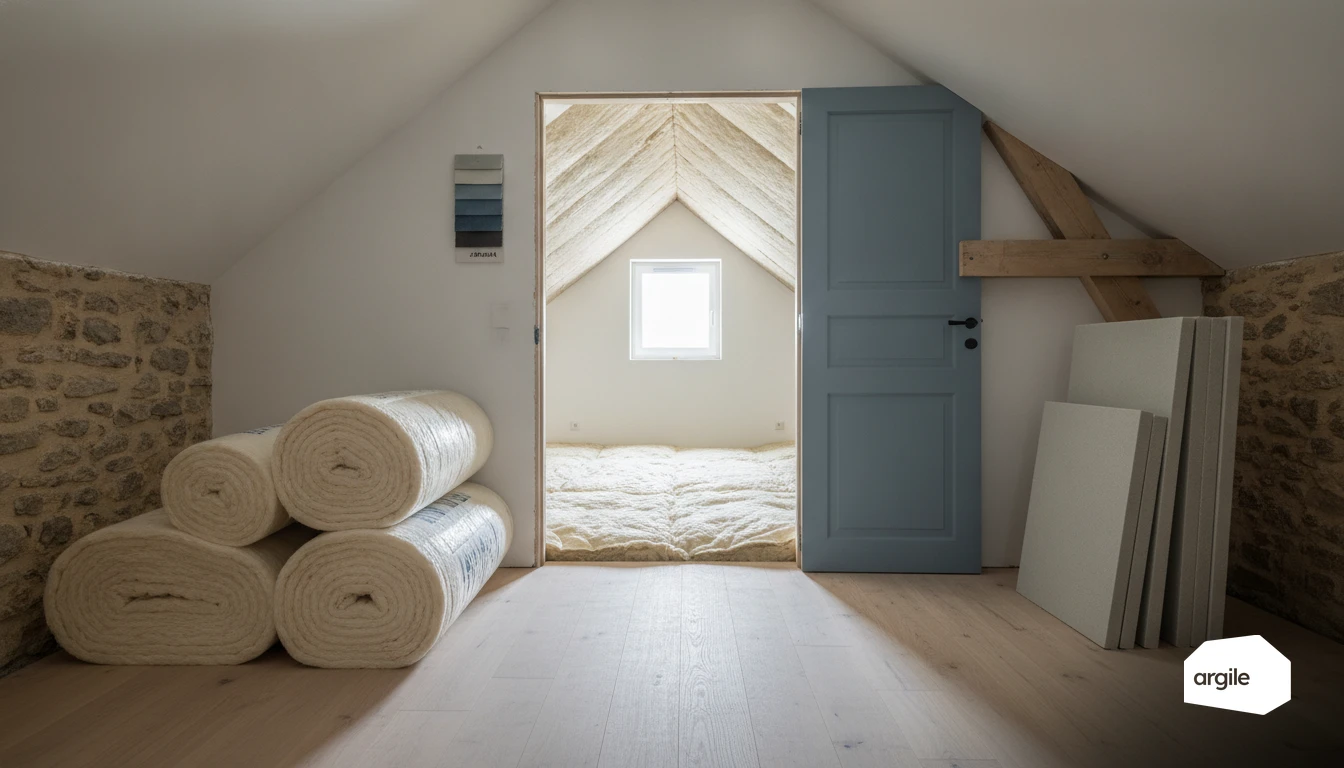
We are talking about two mineral wool insulations, made as rolls, semi-rigid boards and loose-fill products for blowing. In unused lofts, you often have to choose between blown-in and roll-out insulation. In rafters and linings, boards help with layout and around details. In external wall insulation, you quickly move away from standard “mineral” products, but the logic stays the same: density, mechanical strength, fire reaction.
The criteria that matter when deciding: thermal performance, fire, moisture, acoustics, settlement, price
When choosing between glass wool and rock wool, decide line by line, using the Declaration of Performance, the ACERMI certificate and fire classifications.
| Criterion | Winner | Why, from an installation point of view |
|---|---|---|
| Lambda at equal thickness | Glass wool | Often lower, for comparable products |
| Fire performance | Rock wool | More often A1, less sensitive to binder |
| Moisture | Rock wool | More robust if there is a risk of water ingress |
| Acoustics | Rock wool | Density is useful in linings and between joists |
| Settlement in unused lofts | Rock wool | Better stability when blown in, at equivalent surface mass |
| Price | Glass wool | More competitive for the target thermal resistance |
2026 context: incentives, VAT and the customer choice (when insulation alone is no longer MaPrimeRénov’ by measure)
Since 1 September 2026, insulation on its own is no longer funded under MaPrimeRénov’ by measure. For these “single-trade” jobs, the main option left is the relevant CEE bonus, with renovation VAT generally at 5.5% if the conditions are met. As a result, your quotes must justify the product with certified performance, not with a flat-rate package.
Thermal comparison: lambda at equal thickness, who wins?
Reading lambda and R correctly: what you should compare for equivalent products
In a quote, start by comparing the declared lambda (λD, in W/m.K) at exactly the same thickness, then the corresponding R-value (R = e/λ). For the same target performance, also check anything that distorts the reading: useful thickness after installation (settlement, compression), continuity, and product reference (roll, board, loose fill) when the customer is hesitating between glass wool and rock wool. The free Argile thermal resistance calculator layers up the components and gives the wall’s R and U values.
Line-by-line result: winner for “lambda at equal thickness” (glass wool) and why
At equivalent grade, glass wool most often offers a slightly lower λ. So, at a given thickness, you get a slightly higher R, or the same R with fewer millimetres.
| Item | Basis for comparison | Winner |
|---|---|---|
| Lambda (W/m.K) | Common products 0.032 vs 0.036 | Glass wool |
| R at 120 mm (m².K/W) | 3.75 vs 3.33 | Glass wool |
| Thickness for R 7 (mm) | 224 vs 252 | Glass wool |
Field cases: lofts, walls, floors… when the gap becomes visible, or not
The gap becomes visible when thickness is constrained: rafters, technical linings, floors with limited underfloor clearance. In unused lofts, the gap quickly fades; you are stacking thickness and the real issue becomes installation (cutting, blowing, vapour control layer, thermal bridges) rather than 0.00x of lambda. For more on sizing, see how to calculate thickness for a target R.
Fire safety and summer comfort: fire resistance, who comes out on top?
Euroclasses and fire reactions: how to compare without jargon
To compare glass wool and rock wool, start with one document only: the product Declaration of Performance. Look at the Euroclass (A1 to F). A1 and A2 are the best. Add the s index (smoke) and d index (droplets). This trio is enough to assess the risk in plant rooms, lofts and service shafts.
Line-by-line result: winner for “fire resistance” (rock wool) to secure sensitive areas
| Item | What you compare | Winner |
|---|---|---|
| Fire reaction | Declared Euroclass for bare product and with facing | Rock wool |
| High-temperature performance | Stability, melting point, edge retention and around penetrations | Rock wool |
| Summer comfort | Available density at equivalent thermal resistance | Rock wool |
Good practice: facings, ducts, recessed spotlights… the points to check to avoid claims
- Combustible facings (kraft, foil, nonwoven). Check the Euroclass of the full assembly, not just the insulation.
- Recessed spotlights. Respect clearances and use suitable covers.
- Ducts and electrical boxes. Fire-stopping at penetrations, mechanical support.
- Flues and chimneywork. Fire clearance, shields and protection in contact zones.
Moisture, acoustics and stability: the long-term performance match
Behaviour with moisture: condensation, leaks, drying: winner (rock wool)
During a site visit, a roof leak or a cold spot can load the insulation. Glass wool or rock wool, both remain vapour open. But rock wool, being more hydrophobic, holds less water and recovers its performance faster after drying. In your traceability records, note the condition of the underlay membrane, gaps in the vapour barrier and any airtightness repairs.
Acoustic insulation: sound reduction and absorption: winner (rock wool)
At equal thickness, rock wool gains the edge thanks to its often higher density and better absorption capacity. To objectify the choice, rely on the acoustic tests for the installed reference (αw, Rw) and state the density on the quote, rather than using marketing claims.
Resistance to settlement in unused lofts: thickness retained over time: winner (rock wool)
In unused lofts, drift mainly comes down to blown-in insulation. Rock wool loose fill holds the useful thickness better, and therefore the target R-value, with less make-up work needed. On the site sheet, record the insulated area, blown thickness, number of bags and control gauges — that is what protects you if the work is challenged.
Price and final decision: the table that settles it (a winner on every line)
Comparison table for mineral wool: glass wool or rock wool, winner for each criterion
| Criterion | Glass wool | Rock wool | Winner |
|---|---|---|---|
| Typical lambda (W/m.K) | 0.032 to 0.040 | 0.034 to 0.041 | Glass wool |
| Fire reaction (Euroclass) | A1 to A2-s1,d0 | A1 | Rock wool |
| Acoustics (at equivalent density) | Good | Very good | Rock wool |
| Moisture resistance | Sensitive if poorly protected | More tolerant | Rock wool |
| Mechanical stability, loft settlement | Variable depending on product | More stable | Rock wool |
| Price (€/m²) | Lowest | Higher | Glass wool |
Line-by-line result: winner for “price” (glass wool) and how to explain it to the customer
When the question becomes “glass wool or rock wool”, the “price” item is quickly settled. You sell glass wool on a lower direct cost for the same thermal performance. On the quote, anchor the comparison on the target R-value, installed thickness, product reference and the ACERMI certificate. The customer is paying for a resistance value, not a material name.
Ready-to-sell recommendations: which insulation to propose by application (unused lofts, partitions, walls)
- Unused lofts. Glass wool in rolls or blown-in, if access is simple and the vapour barrier is properly controlled. Price winner.
- Partitions and counter-partitions. Rock wool semi-rigid boards when acoustics and stability are the priority.
- Walls (internal wall insulation, linings). Rock wool if you are looking for better stability and a more favourable fire reaction, especially behind sensitive facings.