Understanding internal gains: what the EPC expects from you on appliances and lighting
Field definition: internal gains, free gains, and summer/winter comfort
Internal gains are the watts produced inside the home. Occupants, appliances, lighting. We call them free gains because this heat sometimes reduces the heating need, but it can also complicate summer comfort if the home is already prone to overheating.
Appliances: which uses really matter (cooking, refrigeration, laundry, small appliances)?
For the EPC, appliance consumption is generally a specific use outside the rating. However, the heat they give off can count in the thermal balance via standard values. On the ground, the big contributors are refrigeration (running 24/7), washing and drying, then small appliances on standby.
Lighting: LED, halogen, automation... and effects on consumption and heat output
The EPC accounts for a lighting use. Switching to LED lowers consumption and reduces internal gains. Halogen and older bulbs give off more heat. Motion sensors, dimmers, and timers limit the hours lights stay on, and therefore the bill and unnecessary heat.
Calculating internal gains: a simple method and points of vigilance to avoid mistakes
Input data: surface area, occupancy, equipment present, and usage scenarios
To estimate internal gains, start with simple data. The heated surface area is used to express gains in W/m². Occupancy matters as much as the number of people. Daytime presence, evenings, remote work, vacant home. Add the equipment that gives off heat within the heated volume. Lighting, cooking, computing, appliances, a tank located inside the home. Describe 2 or 3 usage scenarios, rather than aiming for an illusory level of precision.
Orders of magnitude (W, kWh/year): going from common sense to a calculation without overcomplicating it
Useful orders of magnitude. An occupant often represents 70 to 100 W of heat. Equipment and lighting are handled as an average power over the heating season. The formula stays the same. P (W) x hours / 1,000 = kWh. Example. 2 people at 90 W present for 2,000 hours over the season give around 360 kWh of useful heat, to be compared with heating needs.
Common mistakes in assessments and EPCs: overestimating gains, ignoring seasonality, confusing electricity consumption with useful heat
Internal gains don't show up exactly when you need them. In summer, they worsen overheating. In winter, they only reduce heating during periods of occupancy. Also watch out for appliances that vent part of their heat outside the home. Finally, don't confuse electricity consumption with useful heat. A heat pump can deliver more heat than the electricity it consumes, depending on the COP.
Internal gains and the EPC: what affects the rating and what doesn't (or barely does)
Interactions with insulation, airtightness, and ventilation: when internal gains "matter" more
Internal gains (occupants, lighting, equipment) are factored into the calculation, but in a conventional way. They matter most when the envelope is already high-performing. The more you insulate and address airtightness, the more visible these gains become in the thermal balance. Without properly managed ventilation, they can also increase the risk of overheating.
Impact on heating, hot water, and summer comfort: a practical read for your clients
In the rating, the effect mainly shows up on heating needs, sometimes marginally. On hot water, it's essentially nil. For summer, internal gains can hurt comfort if the home is poorly shaded or poorly ventilated. Message for the client: the right work remains insulation, suitable mechanical ventilation, and a low-carbon heating system.
Typical retrofit cases: lighting replacement, efficient appliances... what real effect on the EPC?
Switching to LED can slightly reduce the lighting item, but the overall impact on the band letter is often limited. Efficient appliances improve the day-to-day bill, but are generally outside the scope of the EPC. Sell them as a comfort and budget bonus, not as a primary lever for changing the band.
Internal gains in 2026: how to factor them into a whole-house renovation without wasting time
Prioritizing the work: envelope, ventilation, systems... then "optimizations" (lighting, uses) at the right time
In a whole-house renovation, address the losses first. A high-performing envelope and well-managed ventilation stabilize the home. Only then should you size heating and hot water. Internal gains (occupants, cooking, appliances, lighting) then become a real lever for fine-tuning settings, limiting summer overheating, and avoiding oversizing.
- 1. Insulation and airtightness.
- 2. Ventilation (flow rates, air inlets, extraction).
- 3. Systems and regulation, then LED, programming, and usage.
Talking to clients: explaining simply why appliances don't "make up for" an energy sieve
A more efficient appliance reduces a bill, but it doesn't compensate for walls or a roof that let heat escape. In an energy sieve, heating "fills a leaky bucket." Once the envelope is addressed, internal gains matter more, and your settings become more precise.
Job-site coordination: who does what between the electrician, heating engineer, drywaller/insulator, and engineering firms
The engineering firm sets the assumptions and validates the power ratings. The drywaller/insulator secures insulation and airtightness continuity. The heating engineer adjusts generation, emitters, and regulation. The electrician sets up LED lighting, load shedding, control, and metering. An "interfaces" checkpoint at the start of the job avoids rework, on that note, managing interfaces between trades is a real factor in quality and schedule adherence.
Gaining reliability with Argile: quick calculations, scenarios, and quotes that integrate the EPC and the funding
Energy diagnosis in under 5 minutes: estimating the impact of internal gains in renovation scenarios
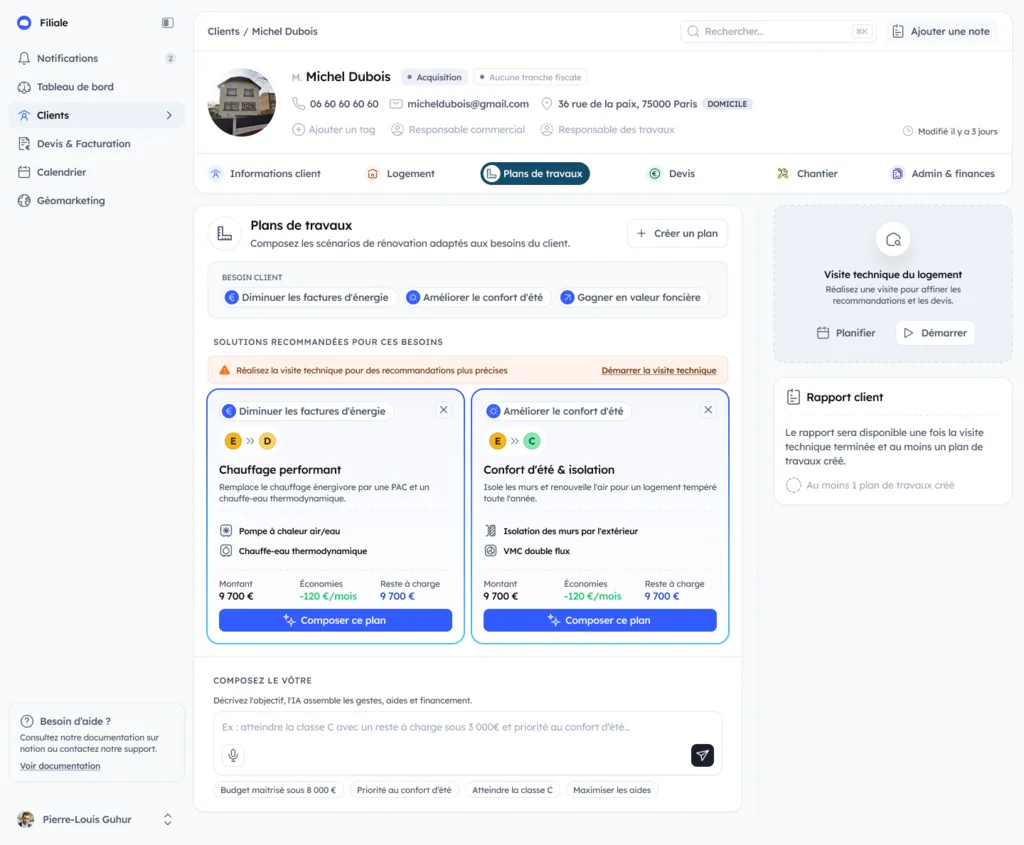
With Argile, you set up a consistent EPC baseline in 5 minutes. You visualise the effect of internal gains (occupants, cooking, lighting, appliances) on heating needs. The result: you quickly test several options, insulation, ventilation, heat pump, without oversizing or "fudging" the assumptions.
Renovation scenarios and recommendations: linking internal gains, ventilation, and summer comfort
Internal gains can help in winter, but they weigh on summer comfort if ventilation and solar protection don't keep up. Argile helps you connect the different items, to propose clear scenarios, suitable mechanical ventilation, controlled airtightness, overheating management, and a simple message for the client. In practice, the relevant measures are proposed from the qualification stage, based on the home’s characteristics.
Quotes and admin: pre-pricing, funding calculation, and a simpler file for your teams
You move from scenario to quote with pre-pricing and integrated funding. The key documents are framed earlier, which lightens the load for your teams. The client, for their part, sees their remaining cost and monthly payments before signing.
- Structured work data and energy gains.
- Estimated grant amounts based on the project.
- A cleaner file for signing and execution.